A 12-week winter template for a cycling club: groups by level, a weekly rhythm, indoor and daylight sessions, two tests, Christmas and riding in the dark.
A club winter training plan works when every member knows their group, their week and what each session is for. The template below runs for 12 weeks, from the first Monday in November to late January. It has four groups, one indoor session, one strength session and one easy or skills session on weekdays, and a group ride in daylight on Saturday. Two tests bracket the block, and Christmas is a break that everyone can see coming. Copy the tables, change the dates and hours, and post them before the first session.
How should a club split riders into winter groups?
Split riders by the pace they can hold comfortably on a winter group ride, not by their summer racing results. Four groups suit most clubs: racers, regular club riders, newer riders and returners, and juniors under 16. A rider can move group at any time.
| Group | Who it is for | Saturday ride | Club sessions a week | Tuesday indoor session |
|---|---|---|---|---|
| A | Racers and strong riders | 3 to 3.5 hours | 4, plus a ride of their own | Full session, longer intervals |
| B | Regular club riders | 2.5 to 3 hours | 4 | Full session |
| C | Newer riders and returners | 1.5 to 2 hours | 3 | Shorter intervals, longer rests |
| Juniors | Riders under 16 | 1.5 to 2 hours with skills stops | 3, plus other sports | Games, sprints and cadence work |
Set the winter pace of each group below its summer pace and publish it with the route. Cold air, wet roads and heavier winter bikes slow everyone, and a group that rides at its summer pace in January drops its newest member. Group C exists so a returner after injury or a long break has somewhere to start; say so when you advertise it. For juniors, the junior cycling training guide gives hours by age, and those ranges overrule this table.
What does a club's winter training week look like?
A club's winter week has four sessions: an indoor session on Tuesday, strength on Wednesday, an easy ride or a skills session on Thursday, and a group ride in daylight on Saturday. Monday and Friday are rest days, and Sunday is each rider's free choice.
| Day | Session | Length | How hard it should feel, 0 to 10 | Where |
|---|---|---|---|---|
| Monday | Rest | |||
| Tuesday | Club indoor session | 60 minutes | 3 to 7, by week | Clubhouse, sports hall or online together |
| Wednesday | Strength and mobility | 45 minutes, 30 in weeks 4 and 12 | 5, or 4 in the shorter weeks | Gym or at home |
| Thursday | Easy ride or skills session | 45 minutes | 3 | Indoors, or a floodlit car park for skills |
| Friday | Rest | |||
| Saturday | Group ride in groups A, B and C | 1.5 to 3.5 hours | 4, or 3 in easier weeks | Outdoors, in daylight |
| Sunday | Free choice | 1 to 2 hours | Any | Cyclo-cross, mountain bike, a run or a family ride |
Put weeknight riding indoors. In mid-December the sun sets at about ten to four in London and twenty to four in Copenhagen, so every weekday evening session falls in the dark. Indoors, the coach can run the same session for 20 riders at once, with no traffic and no ice. The guide to indoor cycling training covers trainer settings, fans and why indoor watts can differ from outdoor ones.
What is in the 12-week club winter training plan?
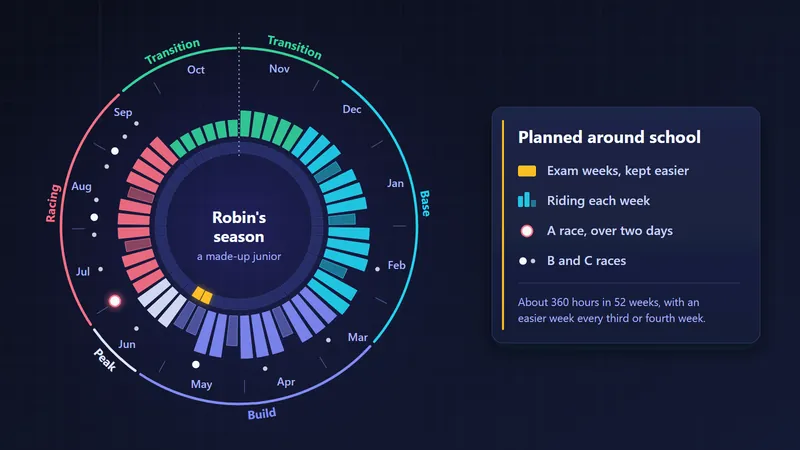
The plan has three blocks of two or three harder weeks, an easier week after the first block, two Christmas weeks without club sessions, and a test in the first and the last week. The table gives the dates for a start on Monday 2 November 2026.
| Week | Starts | Focus | Tuesday indoor, 60 minutes | Saturday ride, A / B / C |
|---|---|---|---|---|
| 1 | 2 Nov | Start and test 1 | 20-minute test after a set warm-up | 3 h / 2 h 30 / 1 h 30 |
| 2 | 9 Nov | Base | Endurance with 6 × 1 minute at high cadence | 3 h / 2 h 30 / 1 h 30 |
| 3 | 16 Nov | Base | 3 × 10 minutes at tempo | 3 h 15 / 2 h 45 / 1 h 45 |
| 4 | 23 Nov | Easier week | 45 minutes easy | 2 h 15 / 2 h / 1 h 15 |
| 5 | 30 Nov | Build | 3 × 12 minutes at tempo | 3 h 15 / 2 h 45 / 1 h 45 |
| 6 | 7 Dec | Build | 4 × 8 minutes at sweet spot | 3 h 30 / 3 h / 2 h |
| 7 | 14 Dec | Build | 3 × 10 minutes at sweet spot, 6 short sprints | Club Christmas ride, 3 h 30 / 3 h / 2 h |
| 8 | 21 Dec | Christmas | No club session | Social ride on 26 December, 2 h, all together |
| 9 | 28 Dec | Christmas | No club session | New Year ride on 2 January, 2 h |
| 10 | 4 Jan | Back in | 3 × 10 minutes at tempo | 3 h / 2 h 30 / 1 h 30 |
| 11 | 11 Jan | Build | 3 × 12 minutes at sweet spot | 3 h 30 / 3 h / 2 h |
| 12 | 18 Jan | Test 2, easier | The same test as week 1 | 3 h / 2 h 30 / 1 h 30 |
Tempo means 76 to 90% of FTP, and sweet spot 88 to 93%; the guide to structured training plans has the full set of sessions and zones. Riders without power use the 0 to 10 scale instead. Rated over the whole session, easy warm-up included, an endurance session should feel about 4, tempo 5, sweet spot 6 and a test 7. Group C rides the same sessions with one interval fewer and a minute more rest between them.
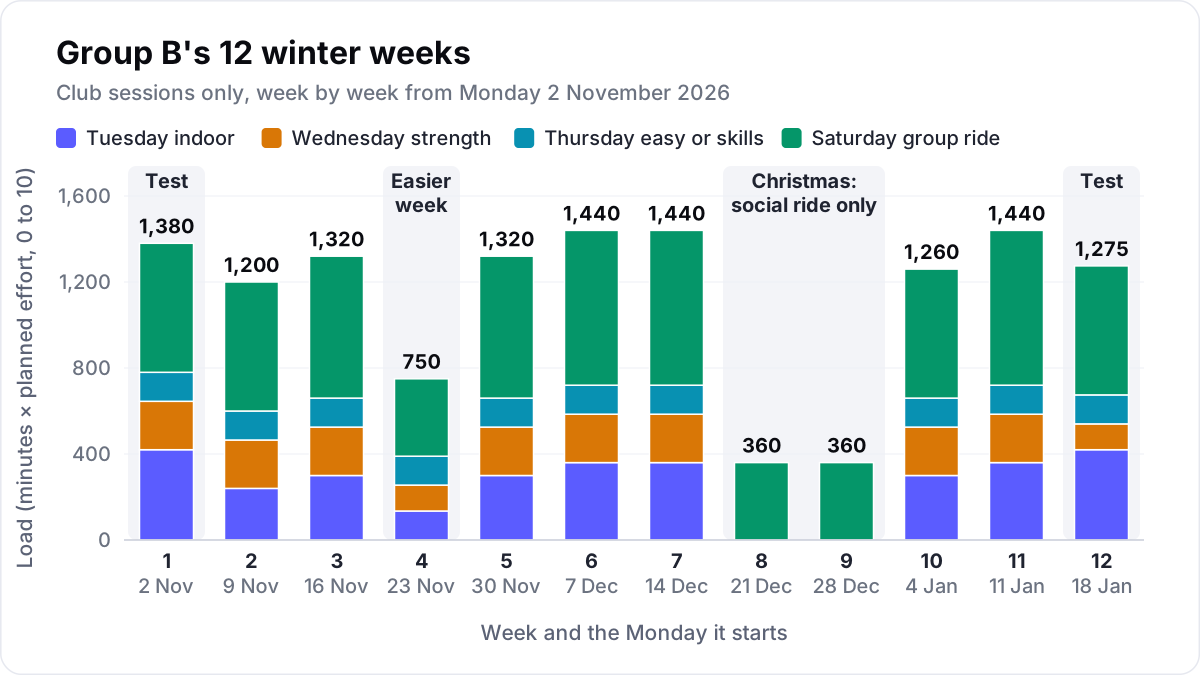
Each bar adds up minutes times planned effort for group B's club sessions. Carl Foster and colleagues proposed this score, called session RPE, in 2001, and found that it agreed well with a heart-rate method in cycling and basketball. Group B's week 6, for example, scores 1,440: 60 minutes at 6, 45 at 5, 45 at 3 and 180 at 4.
How do you test riders in a club winter plan?
Test in week 1 and week 12 with the same protocol, on the same trainer, at the same time of day. Riders with power ride a 20-minute test after a set warm-up. Riders without power repeat the same 20 minutes on the same trainer, and juniors under 16 ride a timed skills course instead.
| Rider | Test | What to record |
|---|---|---|
| With a power meter or smart trainer | 20 minutes as hard as can be held evenly, after a 15-minute warm-up with three short efforts | Average power, average heart rate, how hard it felt |
| Without power | The same 20 minutes on the same trainer, gear and tyre pressure | Distance shown, average heart rate, how hard it felt |
| Juniors under 16 | A timed skills course: slalom, slow riding along a line, a tight turn | Time, cones touched, and what they enjoyed |
Write down the sleep and the day before each test as well. A test after a night shift or a hard Sunday tells you little. The result sets each rider's zones for the next block; what FTP is explains how. Share each result with the rider and their coach only.
Ask riders, and a parent for every junior, before you record anything, and tell them who will see it. The guide to athlete data privacy covers consent and access for a club. In Velograph, a club can name its own groups, give each rider weekly targets and put the template's sessions on their calendars, while each rider decides which parts of their record the club sees.
How do you keep winter club rides safe in the dark?
Ride outdoors in daylight wherever you can. After dark, use only lit, low-traffic routes, with front and rear lights on every bike, a ride leader at the front, a back marker at the rear and an agreed rule for cancelling in ice or fog.
In the UK, Rule 60 of the Highway Code says a bike ridden at night must have a white front light and a red rear light lit. It also needs a red rear reflector, and amber pedal reflectors if it was made after 1 October 1985. Other countries have their own rules, so check yours. Rule 66 adds that riding two abreast can be safer in larger groups or with less experienced riders.
| Check | The club's rule |
|---|---|
| Lights | Front and rear on every bike, charged, and a spare set with the back marker |
| Rear lights in the group | Steady and low, so they do not dazzle the wheel behind; the back marker's light can flash |
| Clothing | Bright colours and reflective bands on ankles and arms |
| Mudguards | Asked for on Saturday rides, so the wheel behind stays dry |
| Start time | Saturday at 09:30 to 10:00, so every group is home before dark |
| Ice and fog | If the forecast shows frost on untreated roads at the start, the ride starts later or moves indoors |
| Contacts | The ride leader carries a phone, a basic first aid kit and each rider's emergency contact |
Decide the cancelling rule before November and post it with the plan, so nobody has to argue about ice in a car park.
How do you keep juniors and older riders coming all winter?
Give juniors variety and skills they can see improving, and give older riders strength work and a group that waits for them. Both groups drift away when winter becomes a series of hard intervals in a cold hall.
For juniors, make Thursday a skills night with games and races on a floodlit car park or in a sports hall. Point them to cyclo-cross or mountain biking on Sundays, where handling improves and mud is part of the fun. Let each junior set one skill goal for the winter, such as a track stand or riding a narrow line, and test it in week 12. Ask two parents to help on skills nights.
For older riders, the Wednesday strength session matters most. The World Health Organization's 2020 guidelines ask adults aged 65 and over to do varied activity that focuses on balance and strength on three or more days a week, to improve everyday function and prevent falls. For cycling itself, a review by Rønnestad and Mujika (2014) found the strongest evidence of an added benefit on cycling performance from heavy strength training. Add weight gradually, with a qualified coach teaching technique. A rider with a health condition, or new to lifting, should check with a doctor or physiotherapist first.
Count attendance, not speed, in every group. A rider who misses two Saturdays in a row gets a message from their group leader. A monthly ride for newcomers, a mechanics' evening in December and a café stop on every Saturday ride keep people coming when the weather does not. For running the club's year beyond winter, see the guide to cycling club training.
Further reading
- Optimizing strength training for running and cycling endurance performance: a review, Rønnestad and Mujika, Scandinavian Journal of Medicine and Science in Sports, 2014.
- WHO guidelines on physical activity and sedentary behaviour, World Health Organization, 2020.
- The Highway Code: rules for cyclists (59 to 82), GOV.UK.
Velograph is not affiliated with, sponsored by or endorsed by any team, rider or company named in this article. Names are used only to refer to publicly reported work.