What research shows about heavy strength training for cyclists, a season plan with sets and reps, four key lifts and how to fit the gym around riding.
Strength training for cyclists works when it is heavy, short and planned around the riding: two gym sessions a week through the winter and one a week in the racing season. Trained cyclists who added heavy leg exercises to their usual riding raised their power in 40-minute all-out tests and kept more power late in long rides, without gaining body weight. Below are what the research shows, a season plan with sets and reps, the four lifts used in the studies and why each matters on the bike, and how to fit the gym around your riding.
Does strength training make cyclists faster?
Heavy strength training added to normal riding can make trained cyclists faster, possibly through better efficiency and more short-term power. A 2025 meta-analysis of 17 studies found small to moderate gains in cycling performance, but rated the certainty of the evidence low.
That meta-analysis, by Cristian Llanos-Lagos and colleagues, pooled 262 cyclists, 60 of them women. Heavy meant at least 80% of the most a rider could lift once. Programmes lasted 5 to 25 weeks, with one to three sessions a week. Compared with riders who only rode, the lifters improved their efficiency, their short-term power and their results in time trials and rides to exhaustion. VO2max did not change, and the analysis found no difference by sex, level or programme length.
An earlier review by Bent Rønnestad and Iñigo Mujika found that, for cycling performance, the strongest evidence of an added benefit comes from heavy strength training. The single studies behind it are small but clear:
| Study | Riders | What they did | What changed |
|---|---|---|---|
| Rønnestad, Hansen and Raastad, 2010 | 20 well-trained cyclists | Four leg exercises, 3 sets of 4 to 10 repetitions, twice a week for 12 weeks | Power in a 40-minute all-out test went up, thigh muscle grew and body mass stayed the same |
| Rønnestad, Hansen and Raastad, 2011 | 20 well-trained cyclists | The same programme, then a 5-minute all-out effort after 185 minutes of riding | The lifters rose from 371 W to 400 W; the riders who only rode did not change |
| Vikmoen and colleagues, 2016 | 19 well-trained women | Heavy strength training for 11 weeks | 40-minute power and cycling economy both improved |
| Louis and colleagues, 2012 | 9 masters endurance athletes with a mean age of 51.5, and 8 young athletes | Knee extensions, 10 sets of 10, three times a week for 3 weeks | The masters gained 17.8% in strength, against 5.9% for the young athletes, and became more efficient on the bike |
The 2011 result matters most for road riders. The power left after three hours of riding is durability, and heavy lifting raised it in riders who kept their usual riding.
Will lifting weights make you heavier on the bike?
In studies of trained cyclists who kept riding, heavy lifting did not raise body mass, although thigh muscle grew in some of them. The interference ran the other way: a high riding volume reduced how much strength the gym added.
In a 2012 study, Rønnestad and colleagues gave one 12-week strength programme to two groups: well-trained cyclists who kept a high riding volume, and people who did no endurance training. Both groups got stronger, but the cyclists gained less strength, less muscle and less jump height. That is one reason to lift hardest in winter, when the riding hours are lowest.
Expect sore legs in the first two or three weeks, and plan for it. Start lighter than you think you need to, and keep heavy squats away from the day before your hardest interval session.
What is a good strength training plan for cyclists?
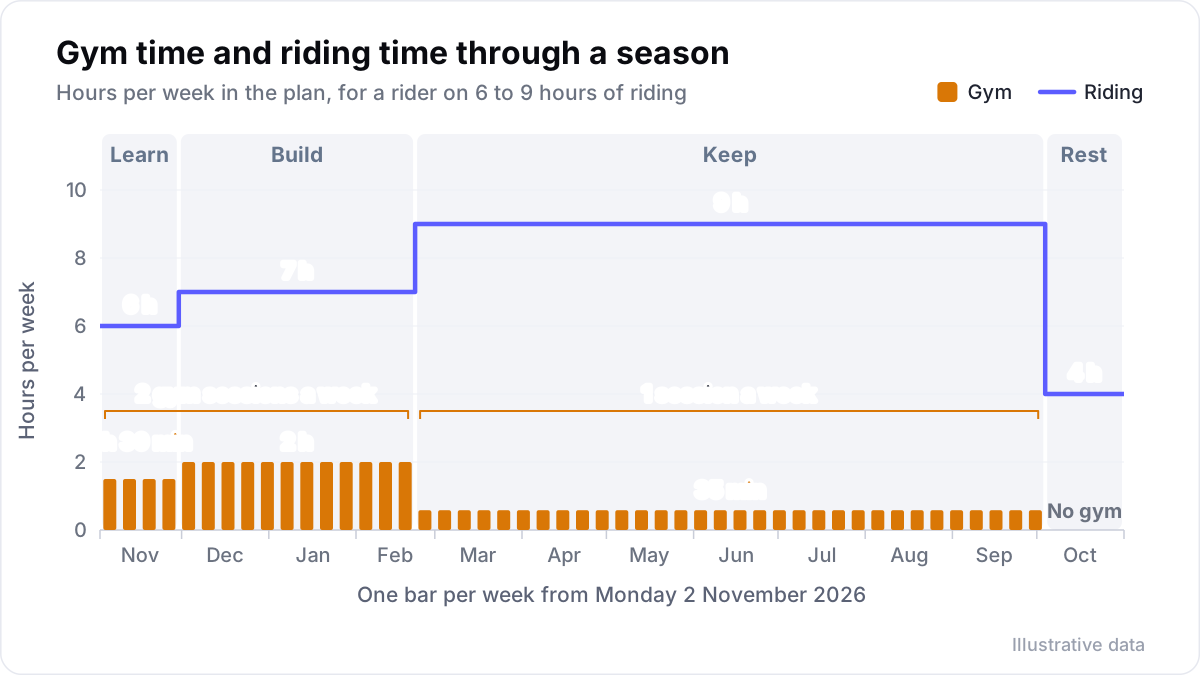
A good plan has three phases: four weeks to learn the lifts with moderate weights, twelve weeks of heavy lifting twice a week through the winter, and one heavy session a week through the racing season. A short break at the end of the season completes the year.
Here is a season starting on Monday 2 November 2026, for a rider on 6 to 9 hours of riding a week:
| Phase | Weeks | Dates | Gym sessions a week | Sets and repetitions | Gym time a week | Riding a week |
|---|---|---|---|---|---|---|
| Learn | 1 to 4 | 2 to 29 November | 2 | 3 × 10 to 12, with a weight you could lift 3 or 4 more times | 1 h 30 min | 6 hours |
| Build | 5 to 16 | 30 November to 21 February | 2 | 3 sets, from 10 down to 4 repetitions | 2 hours | 7 hours |
| Keep | 17 to 48 | 22 February to 3 October | 1 | 2 or 3 × 4 to 6, heavy | 35 minutes | 9 hours |
| Rest | 49 to 52 | 4 to 31 October | 0 | Mobility only | None | 4 hours |
In the build phase, the weights go up as the repetitions come down. RM means repetition maximum, and a 6RM is the heaviest weight you can lift six times with good form. The two weekly sessions follow the pattern of a 2019 study by Morten Kristoffersen, Bent Rønnestad and colleagues, one lighter and one heavier:
| Build weeks | Session 1 | Session 2 |
|---|---|---|
| 1 to 3 | 3 × 10RM | 3 × 6RM |
| 4 to 6 | 3 × 8RM | 3 × 5RM |
| 7 to 12 | 3 × 6RM | 3 × 4RM |
In the study the three steps lasted 3, 3 and 4 weeks; here the last step lasts 6 weeks to fill the build phase. Rest 2 minutes between sets, as that study did. Lift fast on the way up and lower slowly. Many coaches stop each set one repetition before failure, which keeps the technique clean. If Christmas takes a week out, repeat the week before it.
One session a week can keep the gains. In a 2010 study by Rønnestad and colleagues, cyclists who dropped to one session a week kept their extra muscle and strength through the first 13 weeks of racing, and by then had improved more on the bike than riders who only rode. When elite cyclists stopped lifting altogether, a 2016 study found their gains in jump height, maximal aerobic power and 30-second sprint power falling back over the next 8 weeks. Skip the gym in the week of an important race, then come back to it.
Which strength exercises should cyclists do?
Start with the four leg exercises used in Rønnestad's cycling studies: the half squat, the single-leg leg press, the one-legged hip flexion and the calf raise. Add a hip hinge, such as the Romanian deadlift, and a few trunk exercises if you have time.
| Exercise | How | Why it helps on the bike |
|---|---|---|
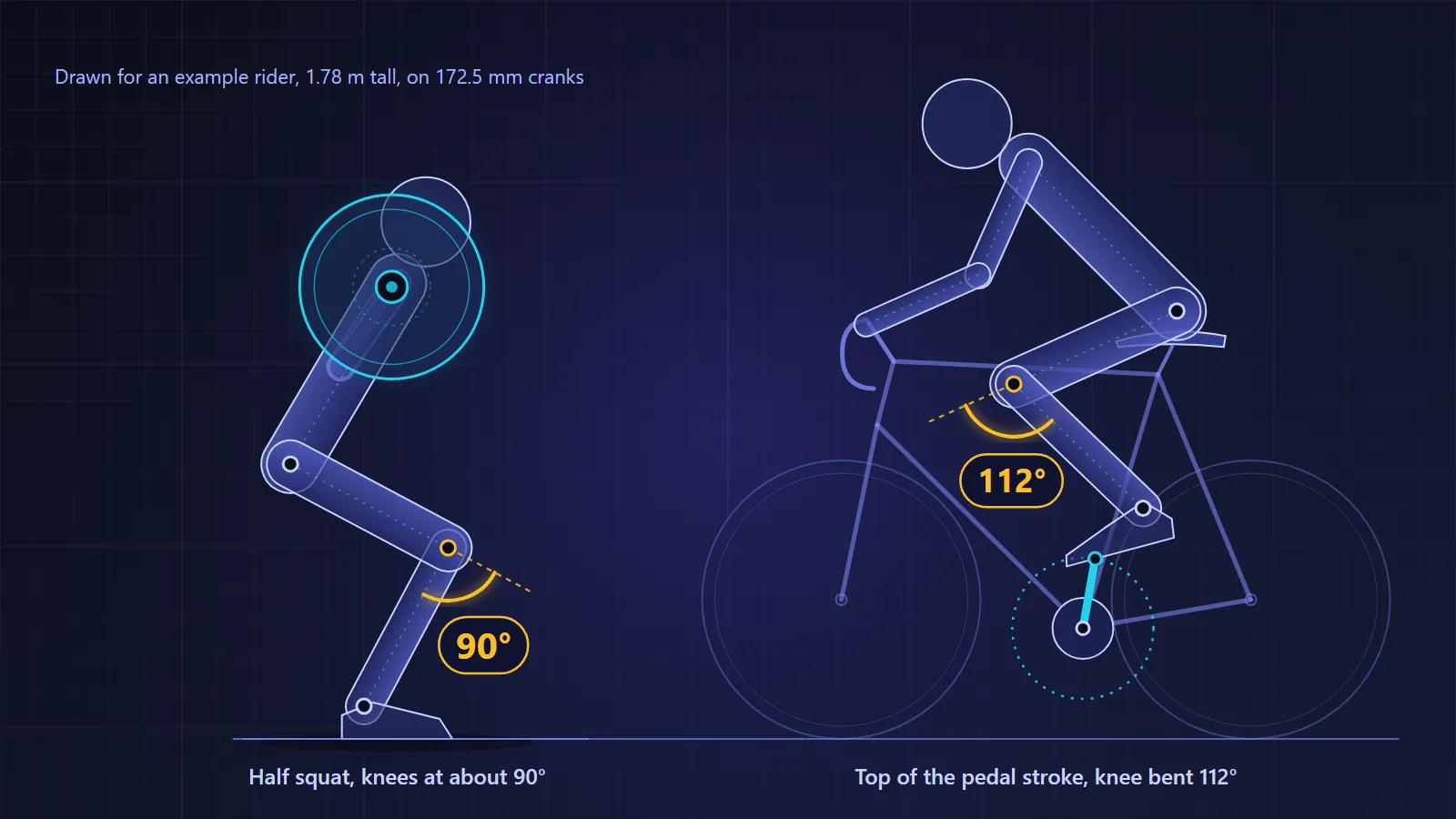
| Half squat | Bar on the upper back, down until the knees are at about 90 degrees, then up fast | Hips and knees extend together, as they do in the downstroke |
| Single-leg leg press | One foot at a time, knee in line with the foot | Each leg works on its own, as in pedalling, and a weaker side shows |
| One-legged hip flexion | Cable or band at the ankle, knee driven up to hip height | Trains the muscles that lift the leg over the top of the pedal stroke |
| Calf raise | On the edge of a step, up onto the toes, then slowly down | Trains the calf and ankle that pass force from the leg to the pedal |
These extras are not from the studies, but they cover what the four leave out:
- Romanian deadlift. It trains the back of the legs and the hinge you hold on the bike.
- Plank and side plank. They keep the trunk steady when you push hard on the pedals.
- One-arm row. It trains the upper back that holds the bars in a sprint or on a climb.
Learn each lift with light weights first, ideally with a qualified coach watching. If you have pain or an injury, see a physiotherapist before you start, and tell them you ride.
How do you fit gym sessions around your riding?
Put the gym on a day that is already hard, a few hours after the intervals, or on its own day before a rest day, so the easy days stay easy. Keep heavy legs away from the day before your key interval session, and in the racing season do your one session early in the week.
Two example weeks, built from the plan above:
| Day | Winter, build phase | Racing season, keep phase |
|---|---|---|
| Monday | Rest | Rest |
| Tuesday | 75 minutes with intervals, gym session 1 later the same day | 90 minutes with intervals, then the gym, 35 minutes |
| Wednesday | 75 minutes of endurance | 90 minutes of endurance |
| Thursday | 30 minutes of easy spinning, then gym session 2 | 75 minutes with intervals |
| Friday | Rest | 45 minutes easy |
| Saturday | 2 hours 30 minutes of endurance | Long ride or race, 3 hours |
| Sunday | 90 minutes of endurance | 60 minutes easy |
The winter week has 7 hours of riding and 2 hours in the gym, and the racing-season week 9 hours of riding and 35 minutes in the gym. Easy days stay easy, which is the idea behind the 75 rule as well. When you place the phases in a season, start from your main race, as the guide to an annual training plan does.
Velograph's session library has gym sessions for each phase, from Strength foundation to Strength maintenance (in season), and a gym session you log counts in fitness and fatigue next to your rides. Planning sessions on the calendar is part of Rider Plus, a paid plan, and the riders page lists what the free Rider plan keeps.
Should juniors and older riders lift weights?
Juniors and older riders can both gain from strength training, as long as the programme suits their age and the lifts are well taught. Juniors should start with body weight and light loads before any heavy lifting.
For juniors, the guide to junior cycling training covers what the IOC's consensus statement on youth athletic development says about strength work. Add weight only when the technique is solid. For masters riders, Louis and colleagues' study above found bigger strength gains in the older group than in the young one. A club can run the winter sessions together; the club winter training plan has a weekly strength slot.
Further reading
- Optimizing strength training for running and cycling endurance performance: a review, Rønnestad and Mujika, Scandinavian Journal of Medicine and Science in Sports, 2014.
- Heavy strength training effects on physiological determinants of endurance cyclist performance: a systematic review with meta-analysis, Llanos-Lagos, Ramirez-Campillo and Sáez de Villarreal, European Journal of Applied Physiology, 2025.
- Strength training improves 5-min all-out performance following 185 min of cycling, Rønnestad, Hansen and Raastad, Scandinavian Journal of Medicine and Science in Sports, 2011.
- In-season strength maintenance training increases well-trained cyclists' performance, Rønnestad, Hansen and Raastad, European Journal of Applied Physiology, 2010.
- Strength training improves cycling performance, fractional utilization of VO2max and cycling economy in female cyclists, Vikmoen and colleagues, Scandinavian Journal of Medicine and Science in Sports, 2016.
Velograph is not affiliated with, sponsored by or endorsed by any team, rider or company named in this article. Names are used only to refer to publicly reported work.