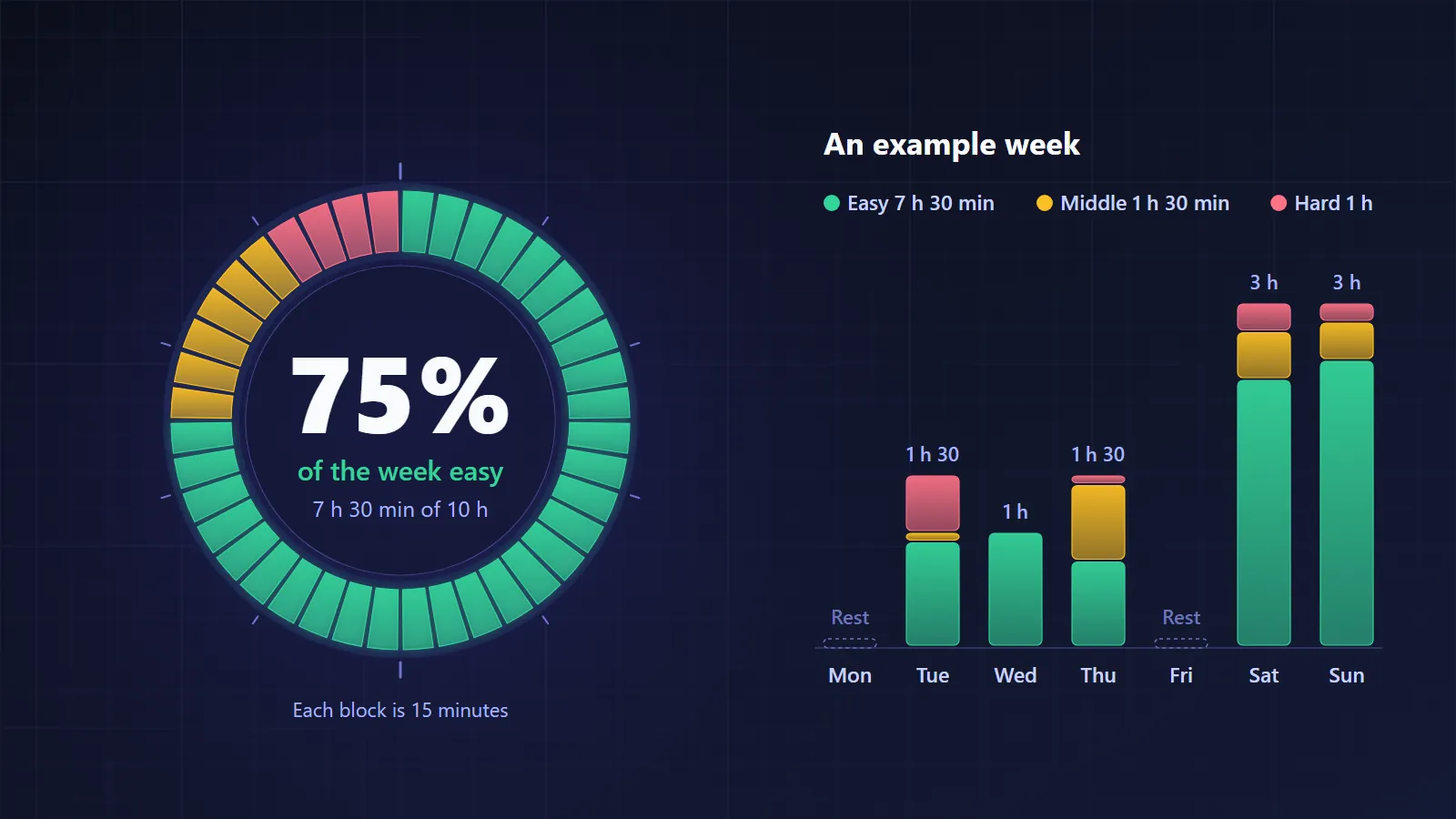
The 75 rule says about three-quarters of your riding should be easy. Where it comes from, what the research says, and how to check your own split.
The 75 rule cycling coaches and club riders talk about is simple: about three-quarters of your riding should be easy, at or below 75% of your maximum heart rate, and the rest can be harder. It is a rule of thumb from coaching columns, not the result of one study. It is close to what research on endurance athletes shows: most of their training is done at low intensity, and what they do with the rest matters as much as the 75. Here is what the rule says, how it compares with the science and how to check your own split.
What is the 75 rule in cycling?
The 75 rule in cycling says that at least 75% of your weekly riding, counted by time or distance, should be at or below 75% of your maximum heart rate. The other quarter can be harder, and a small part of it should be very hard.
The rule turns up in two versions, both from coaching columns:
| Source | Easy part | Hard part |
|---|---|---|
| RoadBikeRider, "Ask the Coach" (Stan Purdum) | About 75% of training time at or below 75% of maximum heart rate | About 25% above that line |
| Active.com (Tyrone A. Holmes, a USA Cycling coach) | At least 75% of weekly time or distance at or below 85% of threshold heart rate | About 10% above threshold heart rate |
Holmes gives the reason in plain terms. Riding too hard to recover from, but not hard enough to improve, is what he calls "Zone 3 syndrome", and he names it as one of the most common reasons riders stop getting faster. The 75% of easy riding keeps you fresh enough for the hard 10%.
Two other 75s turn up when you search. In the Velominati's tongue-in-cheek list of cycling etiquette, Rule #75 says race numbers come off the frame before your next training ride. RoadBikeRider's coach also gives the rule a group-ride meaning: do not ride so hard that you leave everyone else behind.
Where does the 75 percent rule come from?
No study set the 75 percent rule; it is a coaching rule of thumb, and neither source names an origin. Research on endurance athletes points the same way, though: successful athletes do roughly three-quarters or more of their training below their first threshold, where breathing is still easy.
One well-known study found almost exactly 75%. In a 2006 study by Stephen Seiler and Glenn Øvrevik Kjerland, junior cross-country skiers did about 75% of their training in the easiest zone by heart rate. The guide to polarised training covers that study and the 80/20 label that grew from it.
A trial from 2007 tested what the rule cares about most. Jonathan Esteve-Lanao and colleagues trained 12 sub-elite runners for about five months, with the same share of hard work in both groups. One group did 80.5% of its training easy, 11.8% in the middle zone and 8.3% hard. The other did 66.8% easy, 24.7% in the middle and 8.5% hard. In a 10.4 km cross-country test race, the first group improved by 157 seconds and the second by 121.5 seconds, a difference large enough to be statistically significant.
Moving time from the middle zone into easy training helped, as long as the hard work stayed. The athletes were runners, so treat the result as a pointer for cyclists rather than proof.
Is the 75 rule the same as 80/20 training?
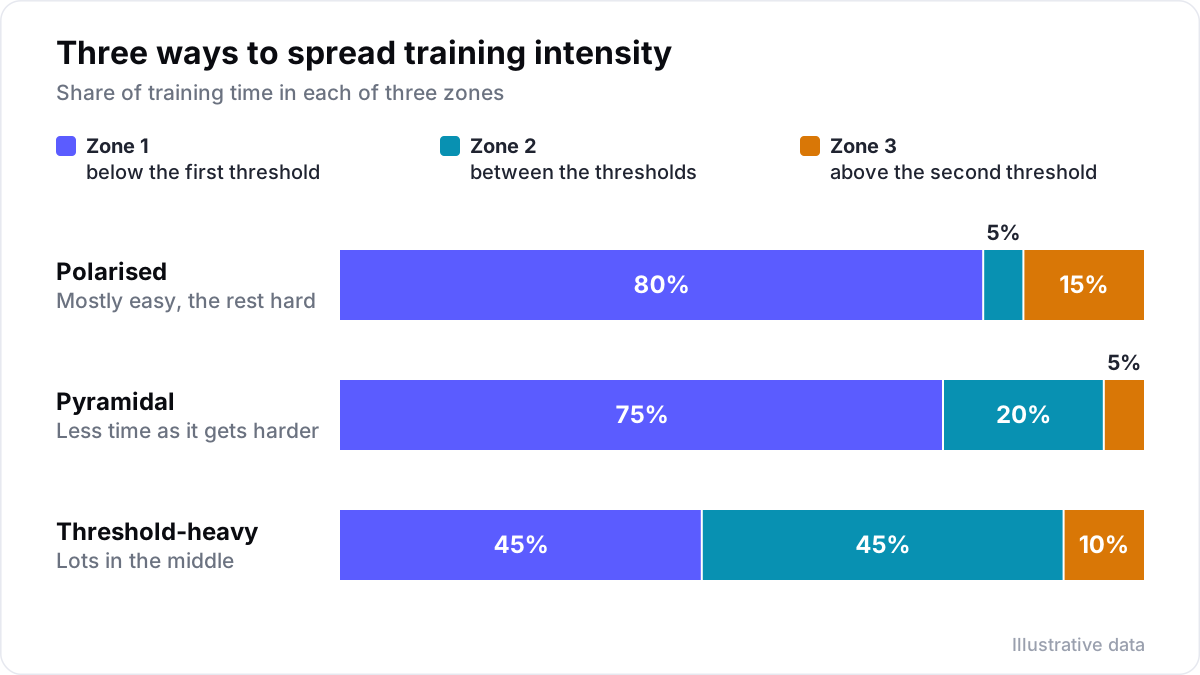
The 75 rule and 80/20 training are close but not the same. Both put most riding at low intensity, but 80/20 counts sessions while the 75 rule counts time or distance. Neither says how to spend the hard quarter: mostly very hard, which is polarised, or mostly in the middle, which is pyramidal.
The counting matters, because every hard session also holds a warm-up and easy minutes between efforts. Counted by the clock, a week of structured hard sessions and easy rides often passes the 75 rule without trouble; the guide to polarised training works through one week counted both ways. The weeks that fail are usually full of medium rides.
To tell polarised from pyramidal, Gunnar Treff and colleagues proposed the polarisation index in 2019. Write each zone as a fraction of your training time and work out log10 of zone 1 ÷ zone 2 × zone 3 × 100. A week counts as polarised when zone 1 is bigger than zone 3, zone 3 is bigger than zone 2, and the index is above 2.00.
| Week | Easy, middle, hard | Passes the 75 rule? | Polarisation index | Polarised? |
|---|---|---|---|---|
| Polarised | 80%, 5%, 15% | Yes | 2.38 | Yes |
| Pyramidal | 75%, 20%, 5% | Yes | 1.27 | No |
| Threshold-heavy | 45%, 45%, 10% | No | 1.00 | No |
Both of the first two weeks pass the 75 rule. They train different things, so decide what the hard quarter is for.
What heart rate is 75% of your maximum?
For a rider whose maximum heart rate is 185 beats per minute, 75% is about 139. Use the highest heart rate you have seen in a hard race or test, not an age formula, because age formulas miss many riders' real maximum by 10 beats or more.
| Maximum heart rate | 75% of it |
|---|---|
| 170 bpm | 128 bpm |
| 180 bpm | 135 bpm |
| 185 bpm | 139 bpm |
| 190 bpm | 143 bpm |
| 200 bpm | 150 bpm |
Formulas disagree with each other, and with you. For a 60-year-old, 220 minus age gives a maximum of 160 and an easy line of 120 beats. Tanaka and colleagues' formula, 208 minus 0.7 times age, gives 166. The formula from Norway's HUNT study of 3,320 adults, 211 minus 0.64 times age, gives about 173, which puts the easy line near 129. The HUNT authors give its typical error as 10.8 beats per minute. If you have never ridden all-out, or you have a heart condition, ask a doctor before a maximal test.
The two versions of the rule land close together for many riders. Take a rider with a maximum of 185 and a threshold heart rate of 165. Then 75% of maximum is 139 beats, and 85% of threshold heart rate is 140. Both are slightly above the top of Coggan's endurance heart-rate zone, which ends at 83% of threshold heart rate, or 137 beats here. The guide to cycling training zones shows how the zone systems line up.
With a power meter, use the top of the endurance zone, 75% of FTP, as the easy line. FTP, functional threshold power, is the most you can hold in a steady effort of roughly 30 to 70 minutes. The two 75s are the same number by chance, not by conversion. Zone 2 training explains how to ride below that line on purpose.
How do you check your own easy riding percentage?
Add up four weeks of riding time by zone and divide the easy time by the total. Use power zones if you have them and heart rate if not, count pedalling time only, and compare the share with the 75% line and with what you planned.
A practical split from power zones is easy up to 75% of FTP, middle from 76 to 105%, and hard above 105%. It is close to the three-zone model sports scientists use, but not identical, because each rider's real thresholds differ.
Here is one rider's week on 7 hours, the kind many club riders recognise:
| Day | Ride | Easy | Middle | Hard |
|---|---|---|---|---|
| Tuesday | Chain gang, 90 minutes | 30 min | 50 min | 10 min |
| Thursday | Solo "steady" ride, 60 minutes | 20 min | 40 min | 0 |
| Saturday | Club ride, 3 hours | 110 min | 60 min | 10 min |
| Sunday | Ride with friends, 90 minutes | 60 min | 30 min | 0 |
| Total | 7 hours | 220 min, 52% | 180 min, 43% | 20 min, 5% |
The rider is 23 points short of the rule. The hard share is fine; the middle is the problem. Research on planned and perceived effort suggests one reason. A 2022 review by Allan Inoue and colleagues gathered 29 studies of planned and perceived effort. Athletes rated easy sessions harder than their coaches had planned them, while moderate and hard sessions matched. The authors rated the certainty of that evidence very low.
Two traps change the count. Heart rate lags behind short efforts, so a week of 30-second intervals counted by heart rate shows less hard work than it had; the guide to heart rate vs power explains why. Long descents and stops add easy minutes without training much, so count pedalling time. Velograph's rider overview has a Time in zones panel that shows the last 7 days against a usual week, in power zones when your rides have power, with the share ridden at threshold or harder.
How do you apply the 75 rule to your week?
Plan the easy rides first, so they are long enough and easy enough to make up three-quarters of the time, then add one or two hard sessions. On 6 hours a week, that is about 4.5 hours easy; on 10 hours, about 7.5 hours easy.
Here is the same 7-hour rider after three changes: a structured hard session replaces the chain gang, the solo ride becomes easy, and Saturday is ridden with a slower group.
| Day | Ride | Easy | Middle | Hard |
|---|---|---|---|---|
| Tuesday | 90 minutes with 4 × 5 minutes hard | 70 min | 0 | 20 min |
| Thursday | 60 minutes easy | 60 min | 0 | 0 |
| Saturday | Club ride with a slower group, 3 hours | 150 min | 25 min | 5 min |
| Sunday | 90 minutes with 2 × 15 minutes at tempo | 60 min | 30 min | 0 |
| Total | 7 hours | 340 min, 81% | 55 min, 13% | 25 min, 6% |
The hours did not change. The middle shrank by 125 minutes. Of those, 120 became easy riding and 5 became hard work. The week is now pyramidal and passes the rule with room to spare.
Three habits keep the easy part easy:
- Use a ceiling, not a target. Set an alert at 75% of maximum heart rate or 75% of FTP, and back off when it sounds.
- Use the talk test. On an easy ride, you can speak in full sentences.
- Choose the group by its pace. A group that rides your easy pace is worth more than a faster one you hang on to.
The 75 rule is a floor for easy riding, not a law. Your hours, your events and how you recover decide the exact split. For riders who train on their own, the riders page says what Velograph's free Rider plan keeps.
Further reading
- What is the 75 rule in cycling?, Stan Purdum, RoadBikeRider.
- Impact of training intensity distribution on performance in endurance athletes, Esteve-Lanao and colleagues, Journal of Strength and Conditioning Research, 2007.
- The polarization-index: a simple calculation to distinguish polarized from non-polarized training intensity distributions, Treff and colleagues, Frontiers in Physiology, 2019.
- Internal training load perceived by athletes and planned by coaches: a systematic review and meta-analysis, Inoue and colleagues, Sports Medicine - Open, 2022.
- Age-predicted maximal heart rate in healthy subjects: the HUNT fitness study, Nes and colleagues, Scandinavian Journal of Medicine and Science in Sports, 2013.
Velograph is not affiliated with, sponsored by or endorsed by any team, rider or company named in this article. Names are used only to refer to publicly reported work.