What a cycling club needs from software, from members, fees and group rides to squad training, safety and privacy, and which kind of tool does each job.
Cycling club software has two jobs, and few products do both well. One is running the club: members, fees, group rides and messages. The other is coaching the riders who train seriously: plans, rides, tests and their consent. Most clubs are best served by a membership app for the first job, a training platform for the second, and a written rule about who sees which data.
What does a cycling club need from software?
A cycling club needs software for seven jobs: a member register with fees, group rides, messages, safety on the road, coaching a squad, consent for juniors and the protection of members' data. Membership apps cover the first three well. Coaching and consent usually need a training platform beside them.
| Job | What it involves | Who does it |
|---|---|---|
| Members and fees | The register, renewals, fees and licences | Secretary and treasurer |
| Group rides | Routes, pace groups, sign-ups and waiting lists | Ride leaders |
| Messages | News, changes of plan, reminders, parents of juniors | Committee and coaches |
| Safety | Emergency contacts, who leads each ride, notes after a crash | Ride leaders and the welfare officer |
| Coaching | Plans, rides, tests and the weekly review | Coaches and squad riders |
| Juniors and consent | A parent's agreement, who sees a junior's data | Coaches, welfare officer and parents |
| Data privacy | Least data for each role, deletion when a member leaves | The committee |
Give each job to one tool before you buy anything. Two tools that both keep the member list will soon disagree.
What do cycling club management apps do well?
Cycling club management apps do the administration well: member lists, fees, sign-ups for sessions and messages to groups. Spond, Holdsport and Join It are examples, and Strava lets a club post group rides. The features below are from each product's own pages on 29 October 2026.
- Spond comes from Norway's Spond AS. Its app has events, a season planner, waiting lists, availability and payment requests and messages, and a young member's guardians can be added. Spond Club adds member management and a club website, for new clubs only in Norway, the UK, the USA, Canada and Ireland in October 2026.
- Holdsport is a Danish club system, written in Danish. It keeps members and teams, has a calendar where members sign up for training, and sends news, texts or emails to chosen groups. It bills membership fees with reminders and gives coaches a chat that members do not see.
- Join It, from Seattle, is membership software for clubs and associations. It keeps a member database, sells one-off or recurring memberships with renewal reminders, takes event registrations and gives members digital cards for check-in.
- Strava clubs let an admin post a group ride with a start time and place, a route, up to four pace groups, a limit on sign-ups and the surface: road, trail, gravel or mixed.
These tools know who signed up, who paid and who was told. None sets a coach's plan against what each rider rode.
Where does a club's training data fall between the tools?
A club's training data falls into the gap between membership apps, which record who signed up for Tuesday's session but not what each rider rode, and riders' own training apps, which record their rides but know nothing of the club's plan. A coached squad needs both views in one place, with each rider's consent.
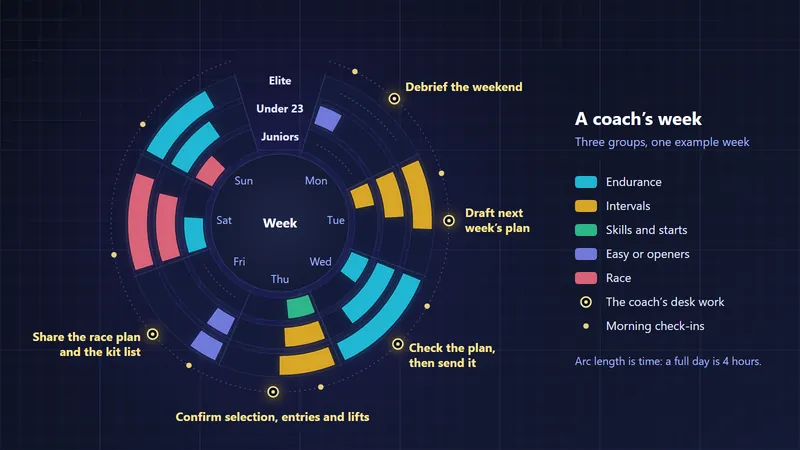
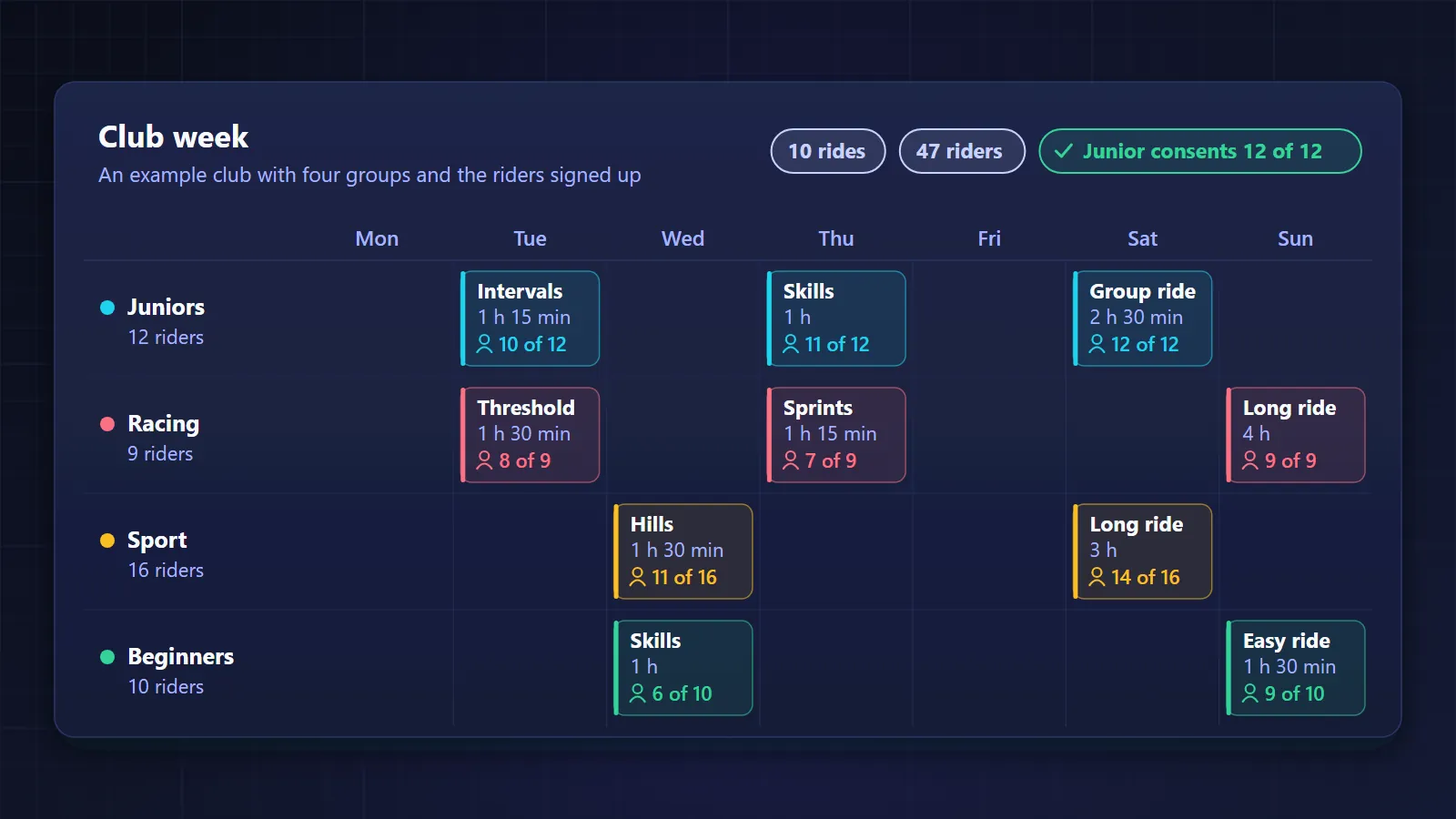
Picture a volunteer coach with a squad of 12 riders. The sign-up list shows that nine came to Tuesday's intervals. Four riders train on Garmin Connect, three on Zwift, two on intervals.icu and three record nothing. Two mentioned a cold in the group chat. To review the week, the coach opens a dozen accounts or asks a dozen riders.
The squad side needs five things that membership apps leave out:
- A plan written once and copied to each rider.
- Rides that arrive by themselves from what riders already use, and set against the plan.
- Exceptions first: who missed sessions, who reported feeling unwell and whose training load jumped.
- Consent part by part, so a rider can share rides with the coach without sharing everything with the club.
- A clean handover, so plans and notes stay with the club when a volunteer steps down.
Our guide to cycling club training covers the coaching itself.
How should a club keep riders safe and their data private?
Keep each member's emergency contact where the ride leader can reach it, record only what the club uses, give access by role and involve parents for juniors as your federation and national law require. Health details, such as illness and injury, need extra care under European data protection law.
- Emergency contacts belong with the ride leader, not in a list every member can open.
- A named ride leader for every group, with the route and the regroup points.
- A short note after any crash: what happened, who helped and who was told.
- A data map: for each tool, what it holds, who can see it and who deletes it when a member leaves.
- A processor agreement from every vendor. Spond's agreement for clubs, for example, names the club as the controller of members' data and Spond as its processor.
- Messages to juniors in channels a parent can see, which is why Spond lets a club add guardians.
Our article on athlete data privacy explains the legal side. The junior cycling training guide covers growth, load and consent for young riders.
Where does Velograph fit in a cycling club?
Velograph covers the training side of a club's squad: plans, rides, readiness, consent and roles for coaches, mechanics and bike fitters. It does not keep a member register, collect fees or take sign-ups for club rides, so a club keeps its membership app beside it.
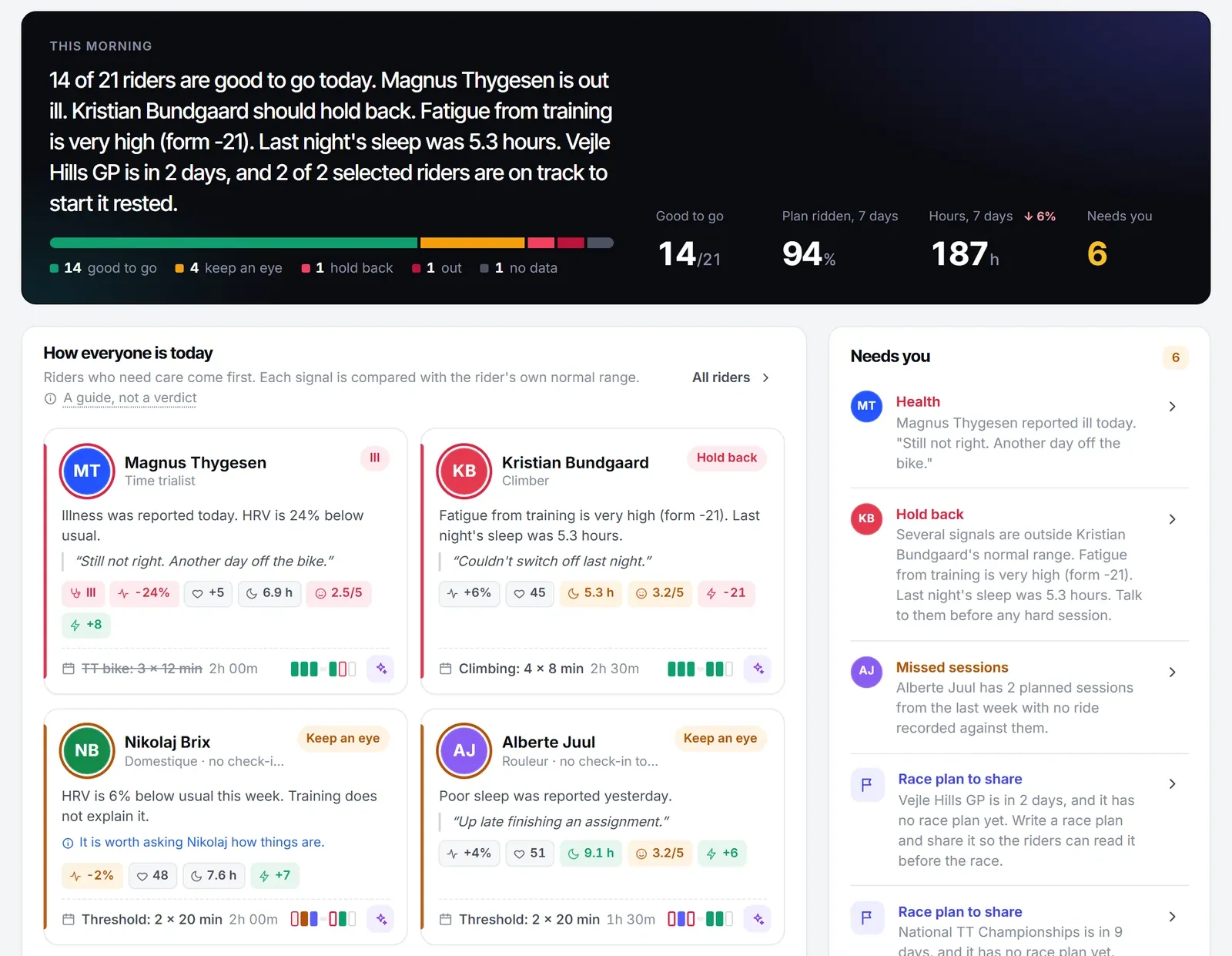
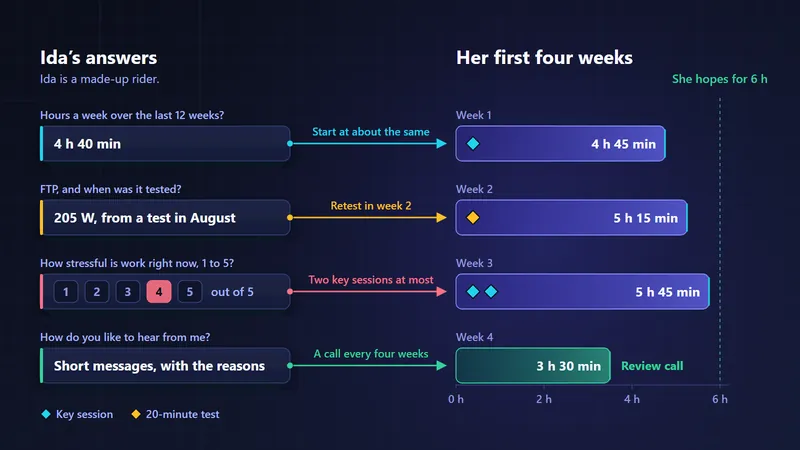
The squad board is the Monday review on one page. It shows each rider's readiness against their own normal, the plan against what was ridden, form and the coming races, with the riders who need a word first. Coaches drag sessions onto the calendar and copy them from one rider to the next. Riders sit in groups the club names, such as juniors or under-23.
Rides come in from intervals.icu, which collects them from most devices, or as FIT files from any bike computer. Strava rides are shown to the rider only and are never used by the AI, so a coach sees a rider's training through intervals.icu or uploaded files.
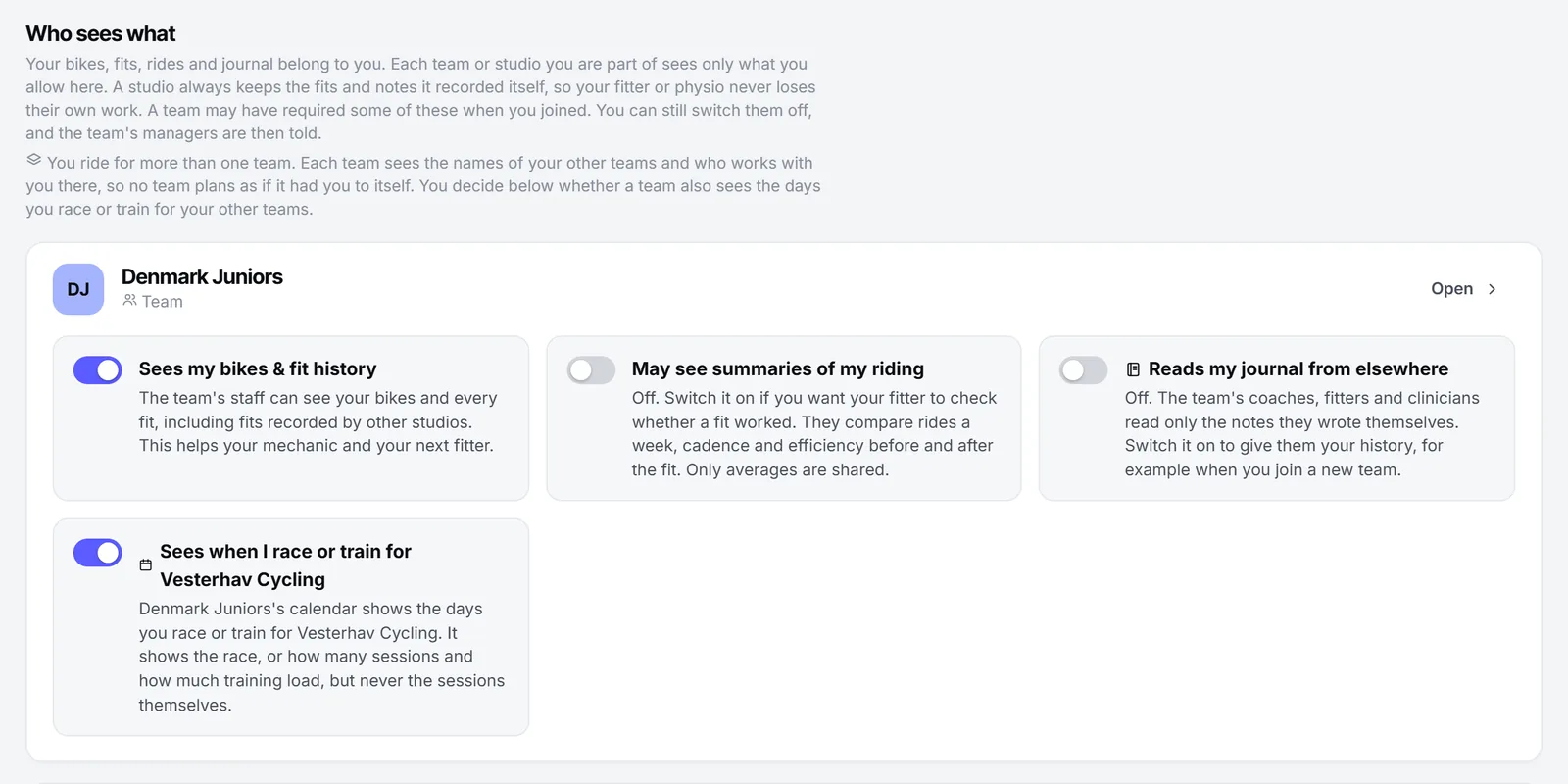
The club's invitation lists what it asks for as boxes, and nothing is ticked for the rider. Notes that may hold health information can be asked for but never required. Riders under 18 tick the boxes themselves, and Velograph does not ask a parent to confirm them. A club with juniors should collect parents' agreement itself.
The team feed carries club news, and a post can be set to team only, so race briefings and kit notes stay inside the club. There are no direct messages between members, a deliberate choice made with juniors in mind.
How do you choose cycling club software?
Choose cycling club software by writing down the club's jobs, giving each one to a single tool, and asking every vendor the same questions. Ask where data is kept, who can see what, what volunteers' accounts cost, how a member leaves with their data and how parents of juniors are involved.
- Where is members' data kept, and will the vendor sign a processor agreement?
- Can access follow the role? A ride leader needs emergency contacts and a coach needs rides.
- What do volunteer accounts cost? Paying for each coach or helper pushes clubs back to shared logins.
- Does it work with what members already ride with? Nobody should change bike computer to join a squad.
- Can a member leave cleanly, taking their rides and leaving nothing behind?
Velograph's Team plan is priced by the number of riders, and staff accounts are free, so coaches, ride leaders and the club mechanic join at no cost. A club can try it free first, and the pricing page has the details. A bigger squad with paid staff may also want our guide to cycling team management software. When you are ready, start for free.
Velograph is not affiliated with, sponsored by or endorsed by any team, rider or company named in this article. Names are used only to refer to publicly reported work.