What a general chatbot does well as a cycling coach, what it cannot see without your rides, prompts you can copy and what to keep out of the chat.
A ChatGPT cycling coach works well as an assistant that explains and drafts, not as the one who decides. It explains training ideas, turns your goal and free evenings into a draft week and helps you prepare questions for a coach. It cannot see your rides, sleep or legs unless you tell it, so its plan is only as good as what you type. In published tests, coaches said chatbot plans for runners and swimmers needed checking, and the running plans improved with more detail.
Can ChatGPT be used as a cycling coach?
ChatGPT can be used as a coaching assistant that explains, drafts and checks, while you or your coach make the decisions. It works from what you type, the files you upload and what you let it remember, so every ride, ache and bad night you leave out is missing from its answer.
| Task | How a general chatbot does | What it needs from you |
|---|---|---|
| Explaining FTP, zones or W/kg | Well | Your level and the words you already use |
| Writing one session | Well | Your FTP and what the session is for |
| Drafting a week or a block | Reasonably, with enough facts | Goal and date, hours per day, FTP, recent weeks |
| Reading one ride | Only from what you paste | Laps or a spreadsheet of the ride |
| Following fatigue over weeks | Poorly | Every ride, night and feeling, every time |
| Pain, illness or injury | Not its job | A doctor or physio |
What is ChatGPT good at for cycling training?
ChatGPT is good at explaining, drafting and organising. It can put FTP or training zones into plain words, turn a goal and your free time into a first draft, write a session as steps and summarise a spreadsheet of rides you upload.
- Explaining. Ask it what threshold means or why your zones changed after a test. Our guide to what FTP is is a good check on its answer.
- Writing sessions. It can write a warm-up, steps with targets in % of FTP and a cool-down, ready to type into your trainer app.
- Reading a spreadsheet. OpenAI's help centre says ChatGPT can analyse uploaded .csv and .xlsx files by running Python code, and asks you to review that code. Ride files in the .fit format are not on its list, so export a spreadsheet of your laps first.
- Keeping context. A ChatGPT project keeps chats, files and instructions together, so your FTP, goal and weekly hours can live in one place for the season.
What can't ChatGPT see about your training?
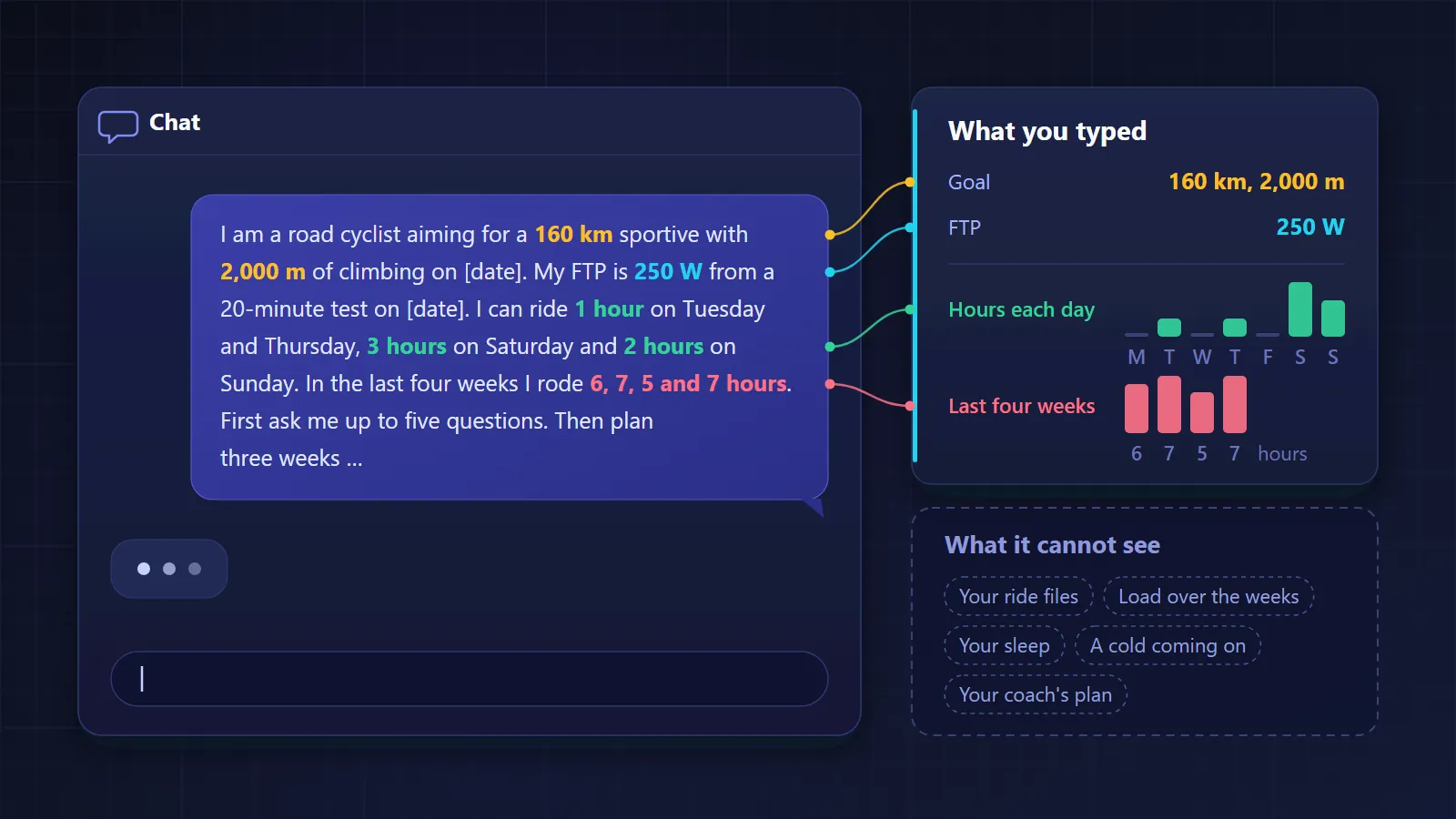
ChatGPT cannot see anything you have not given it: your ride files, how your training load built up over the weeks, your sleep, a cold coming on or your coach's plan. A plan written without those facts can sound confident and still rest on guesses.
Fatigue is the clearest gap. It builds from the load of every ride, as our guide to training load, fitness, fatigue and form explains, and a chatbot that has seen one week cannot follow it across six. Memory adds a second risk. OpenAI says ChatGPT can remember details from past chats when memory is on, so an FTP from March may still shape an answer in October. State your current numbers in every planning chat.
Two published tests show what more or less detail does:
- Running plans. Peter Düking and colleagues had ChatGPT, as it was in May 2023, write three six-week plans for a made-up runner from little, more and much input. Ten coaching experts rated them from 1 to 5, and the median overall rating rose from 2 to 3 to 4. Even the most detailed plan was only neutral on health screening and several testing and monitoring points, and below neutral on how it increased volume.
- Swimming plans. Luca Puce and colleagues had ChatGPT-4 write a week for distance swimmers and one for sprinters. Twenty-three coaches rated them 3.6 and 3.7 out of 5, and 36 swimmers 2.8 and 3.1. Easy aerobic work was handled well, while moderate and hard sets had faults, so the authors concluded that complex plans need a person to oversee them.
Models have changed since, so the scores may not apply to today's versions. The pattern still helps: more facts give a better plan, and the hard sessions need the closest check.
How do you write a good training prompt for ChatGPT?
Give it the facts a coach would ask for: your goal and its date, the hours you have on each day, your FTP and how you tested it, your last four weeks of riding, and anything that limits you. Then ask it to ask you questions before it writes a plan.
Five prompts to copy, with your own details in the brackets:
A three-week block. I am a road cyclist aiming for a 160 km sportive with 2,000 m of climbing on [date]. My FTP is 250 W from a 20-minute test on [date]. I can ride 1 hour on Tuesday and Thursday, 3 hours on Saturday and 2 hours on Sunday. In the last four weeks I rode 6, 7, 5 and 7 hours. First ask me up to five questions. Then plan three weeks with every session in % of FTP, say why each hard session is there, and make the third week easier.
One session. Write a 75-minute indoor session to raise my threshold. My FTP is 250 W. Give each step its time, its target in % of FTP and in watts, and a cadence, with a 15-minute warm-up and a 10-minute cool-down.
A ride review. Here are the laps from today's ride, with average power, heart rate and cadence for each: [paste]. The plan was 4 × 8 minutes at 95 to 100% of FTP, and my FTP is 250 W. What do the laps show, and what would you change next time? Tell me what these numbers cannot show.
Your coach's plan. My coach has given me this week: [paste]. Explain what each session is for, in plain words. Do not change the plan or suggest another one. List the questions I could ask my coach.
A check. Check this plan against my rules and list every session that breaks one: no two hard days in a row, at least one rest day, and no more than [hours] hours in the week. [paste the plan]
Then check the answer. Do the hours add up to what you said? Is endurance riding below about 75% of FTP, as in our guide to cycling training zones? Is there an easy day before each hard one? If it quotes a study, ask for the source and look it up.
Is it safe to share health data with ChatGPT?
Share only what the question needs. On personal ChatGPT plans, your conversations can help train OpenAI's models unless you turn off "Improve the model for everyone", and memory can carry details into later chats. Diagnoses, medicines and anything about a junior rider are better left out of a general chat.
OpenAI's help pages, read on 30 October 2026, set out the controls:
- Model training. On personal Free, Plus and Pro accounts, data sharing is on by default. Switching off "Improve the model for everyone" under Settings, Data controls keeps new conversations out of training. If you rate an answer with a thumbs up or down, OpenAI says the whole conversation may be used for training.
- Temporary Chat. These chats stay out of your history, create no memories and are not used to improve the models, though OpenAI may keep them for up to 30 days for safety.
- Health in ChatGPT. Rolling out since 23 July 2026 to adults in the U.S., it connects Apple Health and medical records. OpenAI says that data, and the chats that use it, are not used to train its foundation models or to target ads.
For training questions, your hours, FTP, ride summaries and how a session felt are usually enough. A coach should never paste riders' data into a chatbot without their consent, and a parent's for a rider under 18, as our guide to athlete data privacy explains. Pain, illness and injury belong with a doctor or physio.
How is an AI coach that reads your rides different?
An AI coach built on your training record starts from your ride files, not from what you remember to type. It sees every new ride and the history behind it, so it can notice a fade or a missed week you never mentioned.
Velograph's AI coach, Ask, works this way. It answers from your rides, power curve, fitness and form, calendar and races, with numbers worked out by fixed rules from each ride's original file wherever there is one. Strava rides are shown to the rider only and are never used by the AI. Ask proposes sessions, and nothing changes until a person accepts them. If a coach is linked to you, Ask sends the drafts to the coach, who decides.
Ask comes with Rider Plus, a paid plan with monthly AI credits. The free Rider plan keeps your bikes, bike fits and rides with ride analysis, with no end date; see what a rider gets on their own.
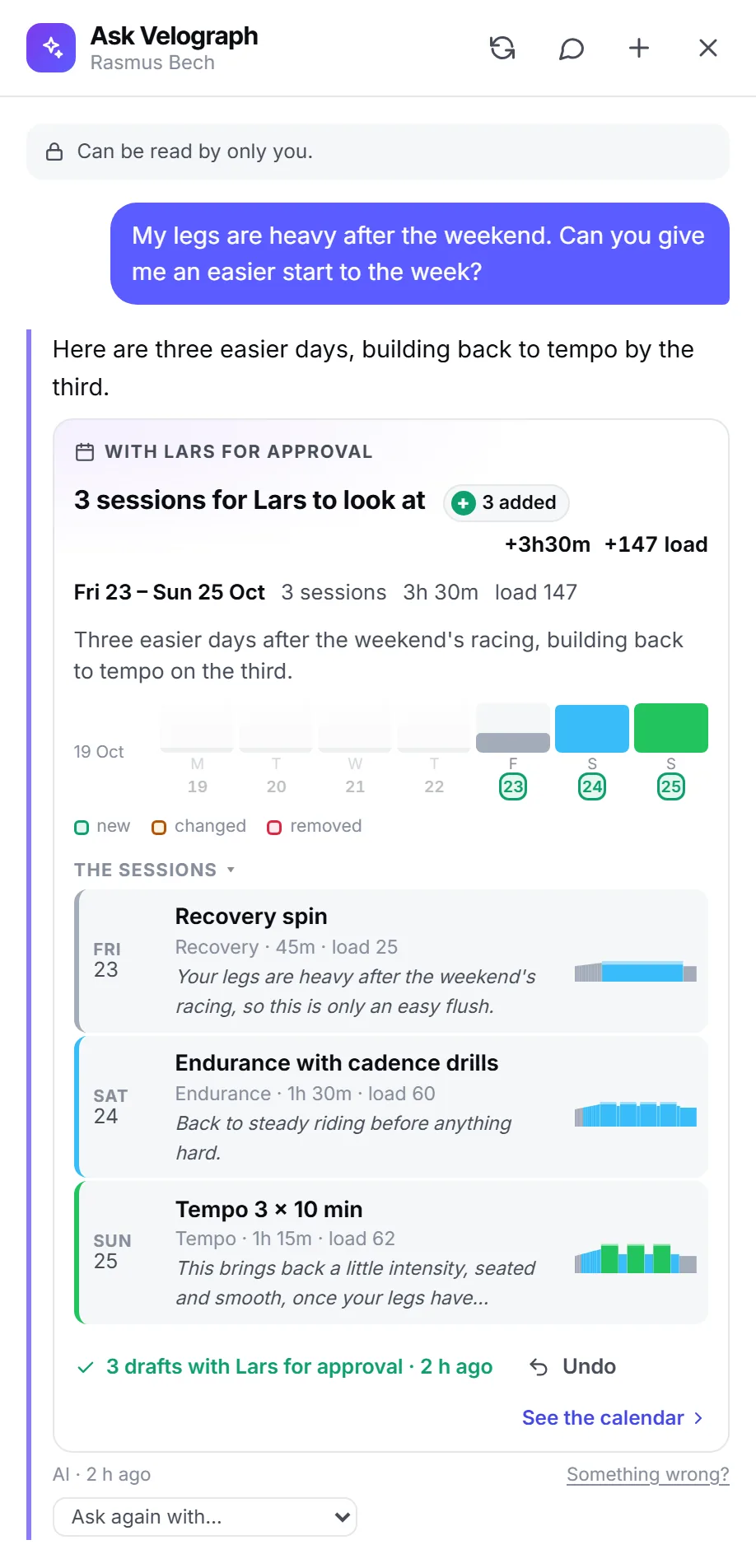
If you would rather keep your own chatbot, a connector is the middle way. MCP, the Model Context Protocol, is an open standard that lets an AI app read another service's data with your permission. Velograph can be added as one.
You choose which workspaces the app sees. It can read your rides, form, plans and bike fits, and on a plan with training plans add draft sessions marked as AI, but it can never publish or delete. Rides that came from Strava are never shared with apps. On 30 October 2026, Anthropic offered custom connectors on Claude's Free, Pro, Max, Team and Enterprise plans, one on Free, and OpenAI listed custom MCP connections for ChatGPT Business, Enterprise and Edu.
Can a chatbot replace a human cycling coach?
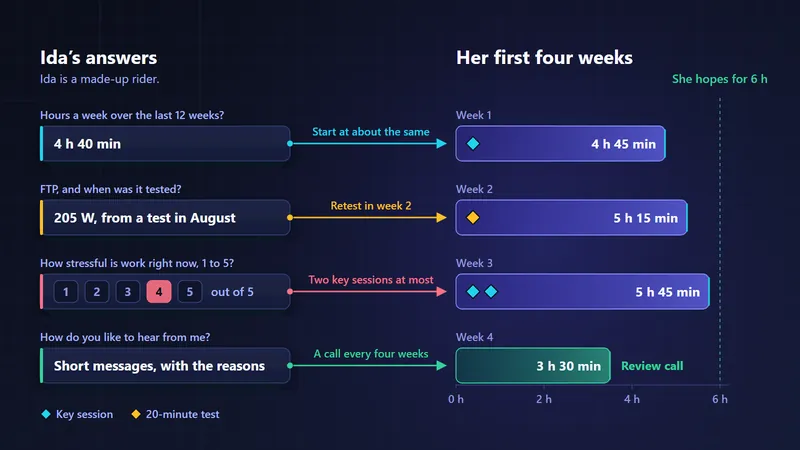
No, a chatbot does not replace a human coach. If you have a coach, the coach decides, and a chatbot helps you understand their plan and prepare your questions rather than write a rival one. If you coach yourself, it can draft and explain, but you still judge how you feel.
A coach knows things no chat holds: how you sounded after last week's race, the exams or the new baby at home. That is why the safest design keeps a person in charge, as our article on the AI cycling coach explains. If you train alone, the guide for the self-coached cyclist covers the judgement you keep, and AI cycling coach apps compares apps that read your rides.
Further reading
- ChatGPT generated training plans for runners are not rated optimal by coaching experts, but increase in quality with additional input information, Düking and colleagues, Journal of Sports Science and Medicine, 2024.
- The role of artificial intelligence in sports training: opportunities, challenges and future applications for competitive swimming, Puce and colleagues, Biology of Sport, 2025.
- Data controls in ChatGPT, OpenAI Help Center, 2026.
- Launching Health in ChatGPT, OpenAI, 2026.
Velograph is not affiliated with, sponsored by or endorsed by any team, rider or company named in this article. Names are used only to refer to publicly reported work.