Cleat wedges tilt the shoe to meet a tilted forefoot. How a fitter decides, which way they go, how many to stack and what the studies show.
Cleat wedges are thin tapered plates fitted between the shoe and the cleat to tilt the foot sideways on the pedal. Most are varus wedges, thicker on the big-toe side, for a forefoot that rests with its big-toe side higher than its little-toe side. A fitter adds them only after measuring the foot and watching the knee from the front while you pedal, and changes them one degree at a time. Studies show that wedges change how the leg moves, but the published reviews found no study showing that they prevent or treat knee pain.
What are cleat wedges?
Cleat wedges are tapered plates, usually 1 to 2 degrees each, that sit between a road shoe and its cleat and tilt the shoe sideways on the pedal. With the thick edge on the big-toe side, a wedge is a varus wedge. With the thick edge on the little-toe side, it is a valgus wedge.
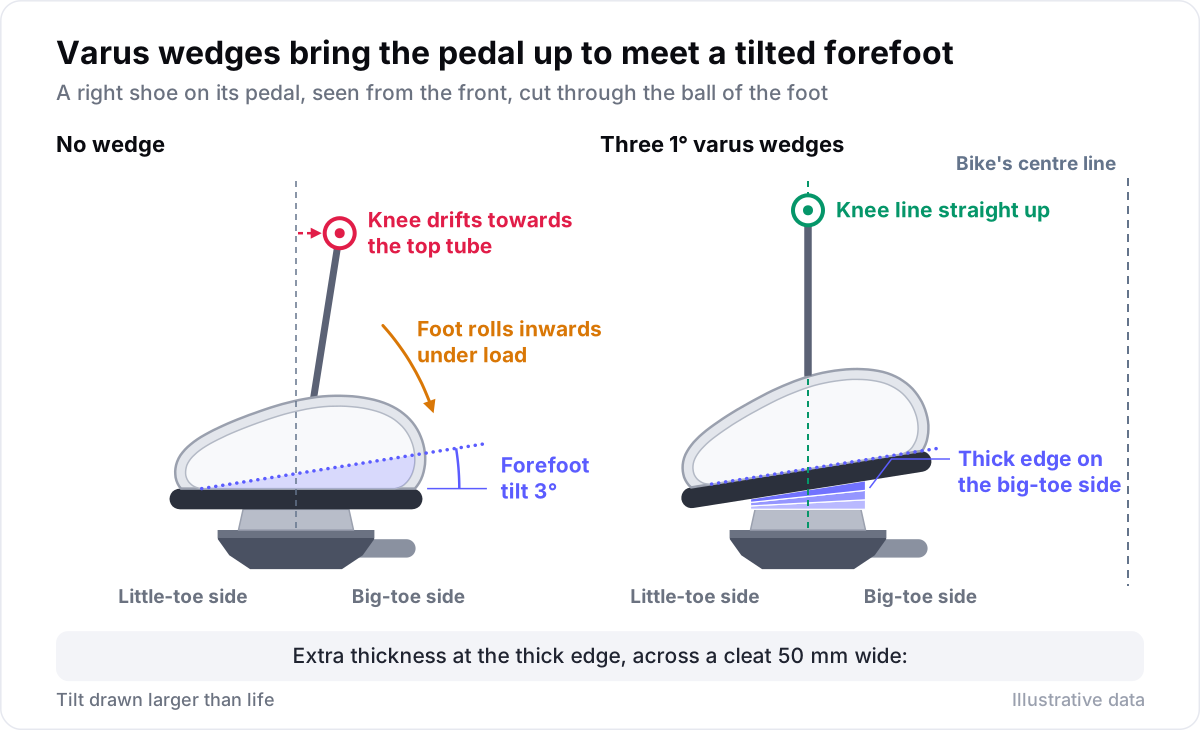
They exist because a cycling shoe has a stiff sole and the pedal is flat. A forefoot that rests at an angle has to roll to meet a flat pedal, and the roll can carry the knee with it. A wedge tilts the pedal surface up to meet the foot instead.
Cleat wedges can be stacked. In-shoe forefoot wedges go inside the shoe, under the forefoot, and one maker's add 1.5 degrees each. A 2016 review describes the wedges sold for cycling as reaching about 4 or 5 degrees in all.
Are cleat wedges the same as cleat shims?
Cleat wedges and cleat shims are different parts. A wedge is thicker on one side and tilts the foot, while a shim is a flat spacer of even thickness that raises the whole cleat. Fitters use shims for a measured difference in leg length and wedges for a foot that tilts.
Our cleat position checklist covers shims, and the fore-aft, rotation and float that are set before any wedge.
What is forefoot varus?
Forefoot varus means the front of the foot is tilted against the heel, with the big-toe side higher, when the foot is relaxed. It is common. Most of the feet measured in a 1994 study of healthy people had some.
That study, by Garbalosa and colleagues, measured 120 people with a forefoot measuring device and a goniometer, an angle ruler. Its abstract reports 234 feet measured and gives the shares as 86.67% with forefoot varus, 8.75% with forefoot valgus, the big-toe side lower, and 4.58% level.
So a tilted forefoot is normal, not a fault to correct. What matters on the bike is whether your foot rolls under load and what your knee does as it rolls. In a 1992 laboratory study of 23 riders by Ruby and colleagues, the group whose forefoot was most tilted had a larger average backward force at the knee and a larger moment straightening it.
How does a bike fitter know if you need cleat wedges?
A fitter decides from two checks taken together: the angle of your forefoot, measured off the bike with the foot relaxed, and how your knee moves over the pedal while you ride, watched from the front. A tilted forefoot on its own is no reason to wedge, because most feet have one.
A typical sequence:
- The foot, off the bike. With your leg relaxed and the ankle held in a neutral position, the fitter looks along each sole to see how far, and which way, the forefoot tilts.
- The cleats. Fore-aft, rotation and stance width are set before any wedge.
- The knee, on the bike. At a steady effort, the fitter watches each downstroke from the front. Does the knee travel in a fairly straight line above the foot, or drift towards the top tube?
- A trial. A wedge goes in, one degree at a time, and the fitter watches the knee again. One maker of in-shoe wedges describes them as a quick way to check whether a forefoot tilts in or out.
Fitters use wedges to make the knee travel in a straighter line, because a more vertical lower leg is considered ideal for pedalling. The 2016 review by FitzGibbon and colleagues points out that this idea still needs testing in controlled studies.
Leave wedges out when the foot does not tilt, when the knee already tracks straight, or when cleat rotation and stance width are still wrong. A wedge does not make up for a cleat turned the wrong way.
What does the research say about cleat wedges?
The research shows that wedges and insoles change how the leg moves and how the foot is loaded, but not that they prevent or treat knee pain. The studies are small and run in laboratories. Some used wedges far steeper than the ones sold, and the reviews found none that followed riders over months.
- Foot tilt changes knee loads. Gregersen and colleagues (2006) had 15 riders pedal with the foot tilted 5 and 10 degrees each way. Raising the little-toe side by 10 degrees cut the peak sideways bending load at the knee by 55% on average. That is the direction of a valgus wedge, and 10 degrees is about twice what a stack of commercial wedges reaches.
- No gain in power. A 2014 systematic review by Yeo and Bonanno found six laboratory studies, only one of them on in-shoe wedges. Neither wedges nor insoles improved power.
- Riders respond differently. O'Neill and colleagues (2011) studied 12 competitive cyclists who rode with custom insoles. The insoles had no consistent effect across the group, but changed knee and hip movement significantly in some riders. Every rider moved differently on the left and the right.
The 2016 review of 11 papers concluded that wedges and insoles change how the leg moves, but that conclusions about whether they work, and about long-term use, are limited. So treat a wedge as a trial for one rider, judged on that rider's knee over weeks and monitored closely, as the review recommends.
How do you fit cleat wedges?
Fit cleat wedges one degree at a time, with the thick edge under the side of the forefoot that rests higher, and use longer cleat bolts. Mark the cleat's outline on both soles first, so it goes back in the same place, and ride for a week or two before adding more.
Which way do varus wedges go?
Varus wedges go with the thick edge on the big-toe side, under the inside of the shoe. That raises the pedal surface where a varus forefoot sits higher. A valgus wedge goes the other way, with the thick edge on the little-toe side, for the rarer forefoot that tilts down on the inside.
Check the direction on each shoe before you tighten the bolts. A wedge put in the wrong way round makes the gap under the foot bigger, not smaller.
How many cleat wedges can you stack?
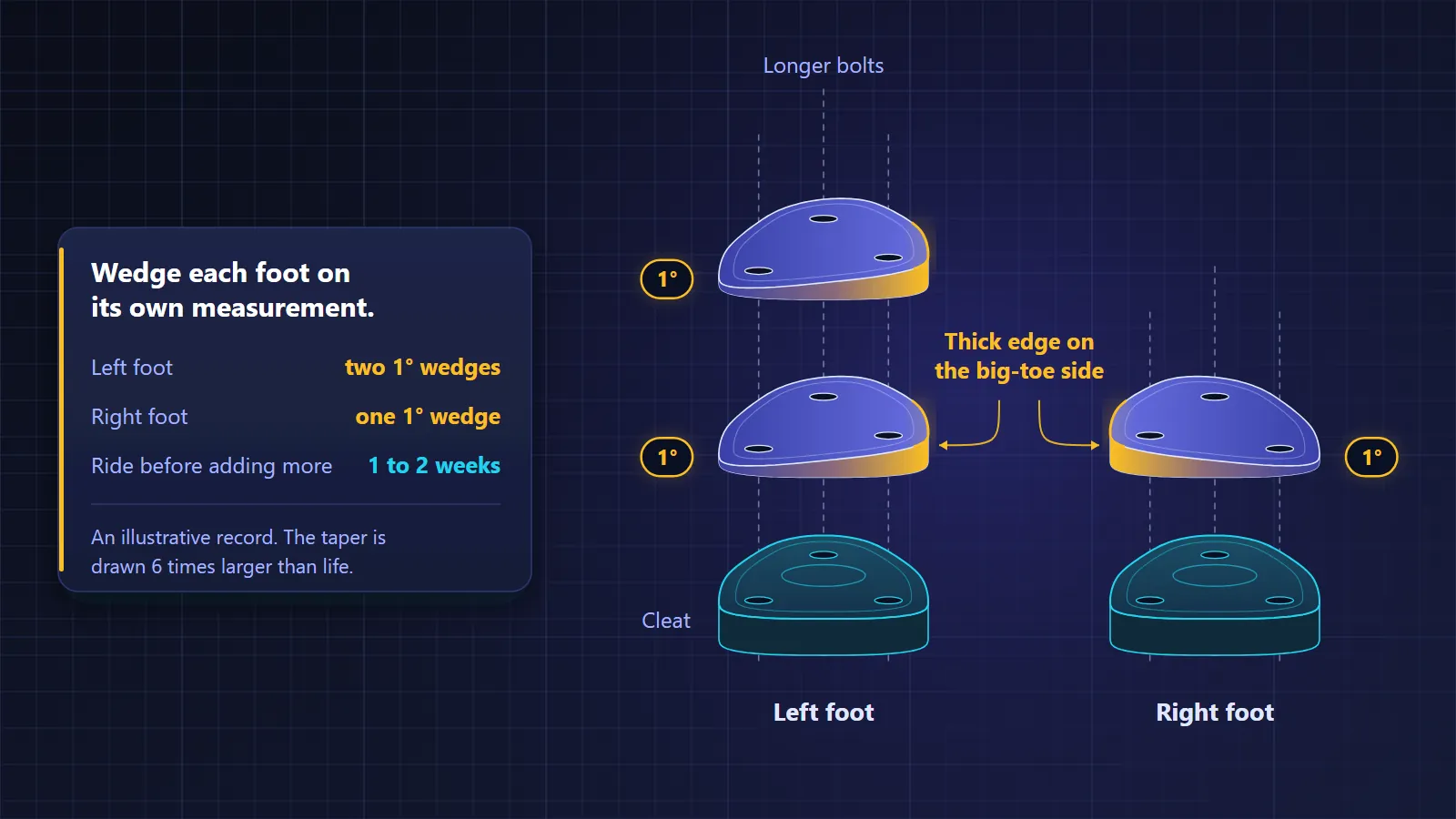
Stack only as many as your measured forefoot tilt and your knee's path justify, within the wedge maker's limit. Each wedge raises the cleat a little and needs longer bolts, so that the threads still grip the shoe. Wedge each foot on its own measurement, because the two can differ.
Across a cleat 50 mm wide, each degree adds about 0.9 mm at the thick edge. Three 1-degree wedges add about 2.6 mm there, on top of the wedges' own thickness. A tall stack raises your foot a little, so check your saddle height afterwards with the saddle height guide.
Should wedges go under the cleat or in the shoe?
Wedges can go under the cleat or in the shoe. Cleat wedges tilt the whole shoe and suit a shoe that already fits well. In-shoe wedges, or an insole with a raised edge under the forefoot, tilt the foot inside the shoe and need room there. A fitter may test with an in-shoe wedge before fitting cleat wedges.
One maker of in-shoe forefoot wedges states that they are only for feet that tilt up on the inside, and not for shoes that are already tight. Insoles change pressure as well as tilt. In a 2018 study of 23 cyclists by Bousie and colleagues, a raised edge under the forefoot changed how the pressure spread, and one under the outside of the forefoot made the heel less comfortable. If your feet also burn on long rides, our guide to hot foot covers insoles.
When should you see a physio instead of adding wedges?
See a GP or physio before anyone adds wedges if your knee hurts off the bike as well as on it, or has not improved within a few weeks, which is when the NHS advises seeing a GP. Get advice from NHS 111 at once if the knee is very painful, badly swollen, locks or gives way.
The NHS lists these reasons to get advice from 111 now:
- your knee is very painful,
- you cannot move it or put any weight on it,
- it is badly swollen or has changed shape,
- it locks, gives way or clicks painfully (painless clicking is normal),
- you have a very high temperature, or feel hot, cold or shivery, and there is redness or heat around the knee.
A bike fitter cannot examine any of these. Our guide to knee pain when cycling shows what to check by where it hurts, and how a physio and a bike fitter work together explains how a foot assessment can be passed to the fitter.
How do you record cleat wedges?
Record, for each foot separately, how many wedges there are, how many degrees each is, which way the thick edge points, whether they sit under the cleat or in the shoe, and the bolt length.
An illustrative example:
| What to record | Example |
|---|---|
| Left foot | Two 1-degree wedges under the cleat, thick edge on the big-toe side |
| Right foot | One 1-degree wedge under the cleat, thick edge on the big-toe side |
| Cleat bolts | Length in millimetres, and the torque used |
| Reason | Left knee drifted towards the top tube on each downstroke |
| Result after two weeks | Knee path straighter on video from the front, knee comfortable |
Date the record and file it in your bike fit history, so your next shoes can be set up from known numbers. In Velograph, a fit records the number of cleat wedges for the left and the right foot separately, with the direction of the thick edge in the notes. The rider keeps every fit in their own record, as the page for riders explains.
Further reading
- The effect of foot orthoses and in-shoe wedges during cycling: a systematic review, Journal of Foot and Ankle Research, 2014.
- Intervention at the foot-shoe-pedal interface in competitive cyclists, International Journal of Sports Physical Therapy, 2016.
- The frontal plane relationship of the forefoot to the rearfoot in an asymptomatic population, Journal of Orthopaedic and Sports Physical Therapy, 1994.
Velograph is not affiliated with, sponsored by or endorsed by any team, rider or company named in this article. Names are used only to refer to publicly reported work.