Measure your sit bones at home with corrugated card, read the number against the maker's chart for how you ride, and test a saddle before you buy it.
The right saddle width lets both sit bones rest on the flat rear part of the saddle in the position you ride most. Your sit-bone width is the distance between the two bony points you sit on, measured centre to centre, and it takes ten minutes to measure at home with a piece of corrugated card. Read that number against the chart for the saddle you are thinking of buying, because makers convert it in different ways. Remember that the lower you ride, the further forward you sit. Then test the saddle on real rides before you decide.
How do I measure my sit bones at home?
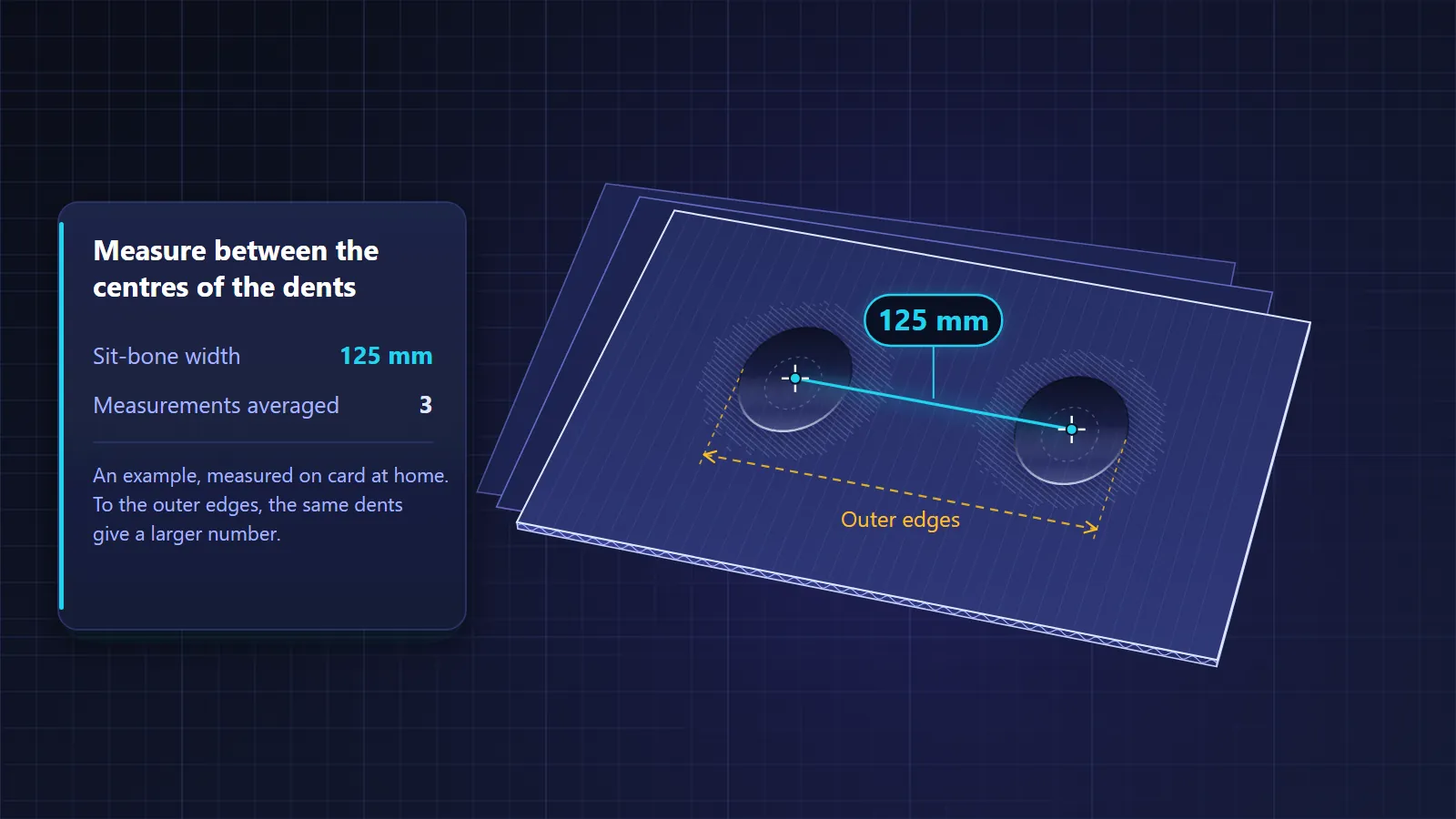
Sit on a piece of corrugated card on a hard, flat stool, with your feet raised a little, then stand up and measure between the centres of the two deepest dents. Measure three times and use the average. That number, in millimetres, is your sit-bone width.
- Lay the card on a hard, flat seat, such as a kitchen stool or a low table. Avoid a seat with a shaped top, as Ergon's guide advises.
- Wear thin clothing, not padded shorts.
- Sit straight down on the card with your back straight and your feet raised slightly on a step or a thick book, so that your weight goes through the sit bones.
- Stand up carefully. Rub a soft pencil lightly across the card if the dents are hard to see, and mark the centre of each.
- Measure between the two centres in millimetres. Repeat on fresh card, three times in all, and use the average.
The saddle makers SQlab and Ergon both tell riders to measure between the centres of the dents. Measured to their outer edges, the same dents give a larger number, so write down which way you measured. The dents show where your weight pressed through, not the bones themselves, so treat the number as a good estimate.
Is a sit bone measurement in a shop or studio more accurate?
A shop or studio measurement is easier to repeat, but not more exact in principle. It uses the same idea with a measuring stool or a pad, and the fitter finds the centres for you, yet it still measures the marks your sit bones leave rather than the bones.
Write down how and where you were measured. Ergon's guide sends riders who are unsure of their home result to a dealer with its measuring stool. It also asks for extra care near the boundary between its saddle sizes, which it puts at around 12 cm. A few millimetres can change the size a chart gives you, so measure again if your number is close to a boundary.
What saddle width do I need?
You need a saddle wide enough that both sit bones rest on its flat rear part, not on its edges, in the position you ride most. No single formula fits every saddle, because each maker turns sit-bone width into a size with its own chart, so read your number against the chart for the saddle you are considering.
Makers' methods differ in what they add and what they measure. SQlab's published method takes the centre-to-centre measurement and adds a value for the riding position the rider picks from its pictures. It defines a saddle's width as the usable seat surface, measured at the widest point out to where the saddle drops away by more than 1 cm, not the total width. So the same number printed on two saddles may not describe the same seat.
Width matters for pressure, not only for comfort. In a study of 48 competitive female cyclists, Guess and colleagues found that wider saddles went with lower peak pressure on the soft tissue between the legs and lower average pressure over the whole saddle. The study looked at the saddles the riders already used, so it shows a link rather than proof.
| What you notice | What it may mean |
|---|---|
| A dull ache under the sit bones, a feeling of sitting on the edges | The saddle may be too narrow for your sit bones |
| You keep shifting back to find a wider part | The saddle may be too narrow, as our saddle pressure mapping guide notes |
| The inner thighs rub on the sides of the saddle | The saddle may be too wide where your thighs pass, or set too high |
| Pressure or numbness in front of the sit bones | Check tilt, nose shape and the handlebar before the width |
Why does riding position change the saddle width you need?
A lower position rolls your pelvis forward, and your weight moves forward on the saddle, onto a narrower part of it. A rider who sits upright rests on the sit bones at the back, while one riding low sits further forward, so the same rider can need a different saddle on each bike.
In a study of 20 female cyclists by Bressel and Larson, the pelvis tilted forward 77% more with the hands in the drops than on the tops. Potter and colleagues found that the centre of pressure on the saddle moved forward in the drops, as our guide to saddle pressure mapping describes. SQlab's own method says the same: a more aggressive posture moves the pressure point further forward on the saddle.
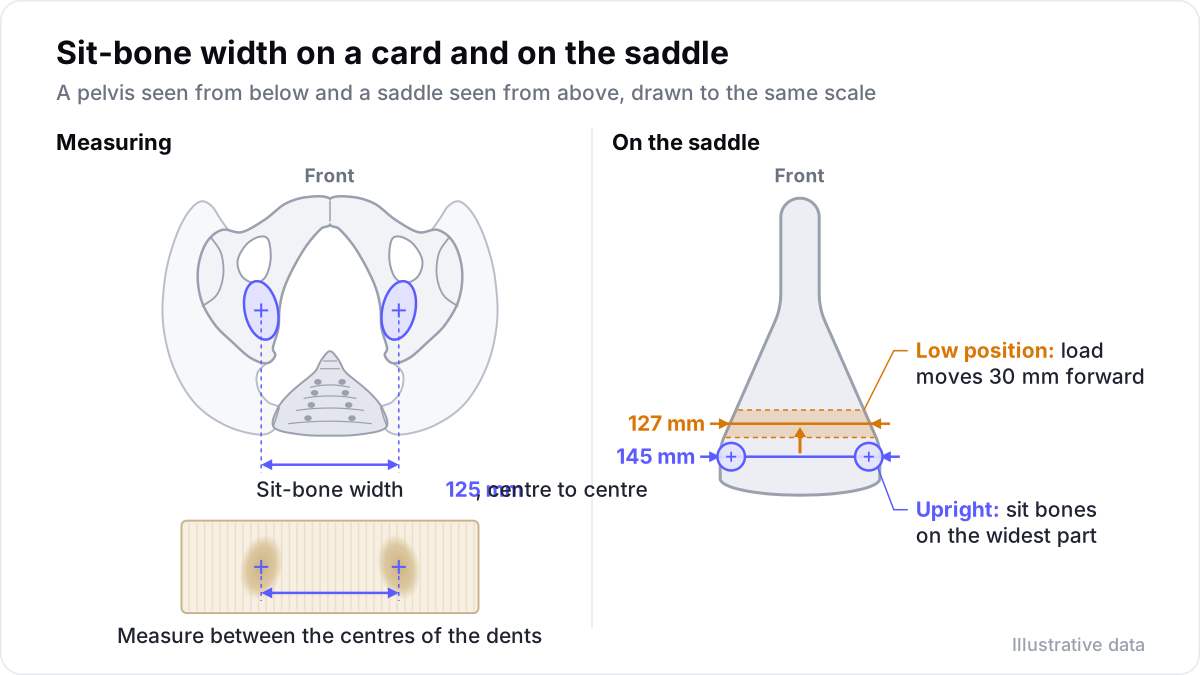
So the shape from back to front matters as much as the number on the label. A saddle that stays wide further forward may suit a rider who rides low for long, and a time trial position rotates you so far forward that you sit on the nose, as our time trial bike fit guide explains. If you ride two bikes in very different positions, measure once and choose for each.
Do women need a women's saddle?
Not necessarily. On average, women's sit bones are further apart than men's, but riders of both sexes vary, and research on saddle designs for women points in different directions. Choose by your own measurement, your position and how the saddle feels on real rides, not by the label.
Potter and colleagues measured 11 women and 11 men. The women's sit bones were wider on average, and sit-bone width also differed from rider to rider and went with where each rider loaded the back of the saddle. A comparison of averages cannot tell you where you fall, which is why you measure.
The studies of particular designs disagree with one another:
- Cut-outs. In the Bressel and Larson study, 55% of the women ranked a saddle with a partial cut-out as the most comfortable and 30% the standard saddle. In the Guess study, riders on cut-out saddles had higher pressure on the soft tissue than riders on saddles without one.
- Nose width. In Aalborg, Larsen and colleagues tested two new unpadded saddles with a partial cut-out and a wide or medium nose on 19 women. The wide nose moved pressure forward, both new saddles raised discomfort at the sit bones, and the authors judged the medium width the better compromise.
So a feature that suits one rider can bother the next. Padding is as hard to judge in a shop, because how a pad feels in the first minutes says little about the third hour, as the shorts-pad study in our guide to saddle pain shows. That guide also sets out what to check for numbness, sit-bone ache and saddle sores.
How do you test a saddle before you buy it?
Fit the test saddle at your old height and setback, both measured to where your sit bones rest, and at your old tilt, then ride it for several rides of your normal length. Score it after each ride, and compare it with your old saddle on the same route.
- Ask the shop or your fitter whether you can borrow a test saddle.
- Before you swap, put a strip of tape on the old saddle where your sit bones rest and note its distance from the nose.
- Set the new saddle to the same height at its own sit-bone point, as our saddle height guide shows.
- Set the sit-bone point back to the same place, not the nose, because saddles differ in length. The saddle setback guide explains why.
- Set the same tilt, ride three or four normal rides, and score the sit bones, the soft tissue and the inner thighs from 0 to 10 after each.
A fitter can also compare two saddles with a pressure map in one session, which shows where you press, though not how a long ride feels. Numbness or tingling that lasts after you get off the bike, or a sore that grows, feels hot or comes with a fever, is a reason to see a doctor rather than try another saddle, as the saddle pain guide explains.
How do you record your saddle?
Write down the make, model and stated width, your sit-bone width and how it was measured, and the saddle's height, setback and tilt with the points they were measured to. A new saddle or a new bike then starts from known numbers.
| What to record | Example |
|---|---|
| Sit-bone width and method | 125 mm, centre to centre, card at home, average of three |
| Saddle make, model and stated width | As printed on the saddle or the maker's page |
| Measuring point for height and setback | 130 mm behind the nose, marked with tape |
| Saddle height | 740 mm to the measuring point |
| Setback | 80 mm to the nose |
| Tilt | Level, or 1 degree nose down |
| How it felt | Scores from 0 to 10 after each of the first four rides |
A bike fit history keeps these with every change, so the next fitter knows what you have tried. In Velograph, a fit records the saddle model and its stated width beside the height, setback, tilt and rail position. If the model's name gives a different width from the one recorded, the fit review asks which is right. Each fit stays in the rider's own record, and the riders page lists what the free Rider plan keeps.
Further reading
- Gender differences in bicycle saddle pressure distribution during seated cycling, Medicine and Science in Sports and Exercise, 2008.
- Women's bike seats: a pressing matter for competitive female cyclists, The Journal of Sexual Medicine, 2011.
- Bicycle seat designs and their effect on pelvic angle, trunk angle, and comfort, Medicine and Science in Sports and Exercise, 2003.
- The effect of saddle nose width and cutout on saddle pressure distribution and perceived discomfort in women during ergometer cycling, Applied Ergonomics, 2018.
Velograph is not affiliated with, sponsored by or endorsed by any team, rider or company named in this article. Names are used only to refer to publicly reported work.