Critical power and FTP both mark the top of steady effort. How each is defined and tested, how far apart they land in studies, and when each one helps.
Critical power vs FTP comes down to how each number is made. FTP, functional threshold power, is the highest power you can hold in a long, close-to-steady effort, estimated from one test and a rule of thumb. Critical power (CP) is the level your power-duration curve flattens towards, fitted from several all-out efforts, and it comes with W′, the reserve of work above it. In three studies of trained riders, the two averaged within 3 to 16 W of each other, but for a single rider the gap could reach about 30 W either way. Use FTP for zones and steady targets, and CP with W′ for efforts above threshold.
What is the difference between critical power and FTP?
FTP is a test result turned into an estimate of steady power, while critical power is one of two numbers in a model fitted to several all-out efforts. FTP stands alone. Critical power comes with W′, which says how long you can last above it.
| FTP | Critical power | |
|---|---|---|
| Defined by | Andrew Coggan: the highest power held in a quasi-steady state without fatiguing | Monod and Scherrer, 1965: the slope of work done against time to exhaustion |
| How it is found | One test and a factor: 95% of a 20-minute effort, or 75% of the best minute of a ramp | Three or more all-out efforts of about 2 to 15 minutes, fitted to one line |
| What comes with it | Nothing; how long you can hold it is a separate measure | W′, the work you can do above CP, in kilojoules |
| Where it describes you well | Steady efforts; TrainingPeaks puts the time you can hold FTP at about 30 to 70 minutes | Efforts of about 2 to 15 minutes, where the model fits best |
| Most useful for | Zones and steady session targets | Efforts above threshold, pacing and W′ balance |
Both numbers aim at the same ceiling: the highest intensity at which your body can still settle into a steady state. In a laboratory, that ceiling is measured as the maximal lactate steady state (MLSS), with blood samples over several constant-power rides. Andrew Jones and Anni Vanhatalo describe critical power as close to it, and studies test FTP against it because FTP is meant to estimate it in the field.
How do you test critical power and FTP?
Test FTP with one 20-minute all-out effort and take 95% of the average, or with a ramp test and take 75% of your best minute. Test critical power with at least three all-out efforts of about 2 to 15 minutes, well rested between them, and fit a line to them.
The tests themselves are explained in what FTP is and in critical power and W′. A short version of the critical power test uses only two efforts, 3 and 12 minutes, half an hour apart. Then CP = (12 × your 12-minute power − 3 × your 3-minute power) ÷ 9, and W′ = (3-minute power − CP) × 180, in joules. A rider who holds 358 W for 3 minutes and 299 W for 12 gets a CP of 279 W and a W′ of about 14.2 kJ. Two efforts always fit a straight line exactly, so only a third effort can show how good the fit is.
Why can FTP from a 20-minute test be above or below CP?
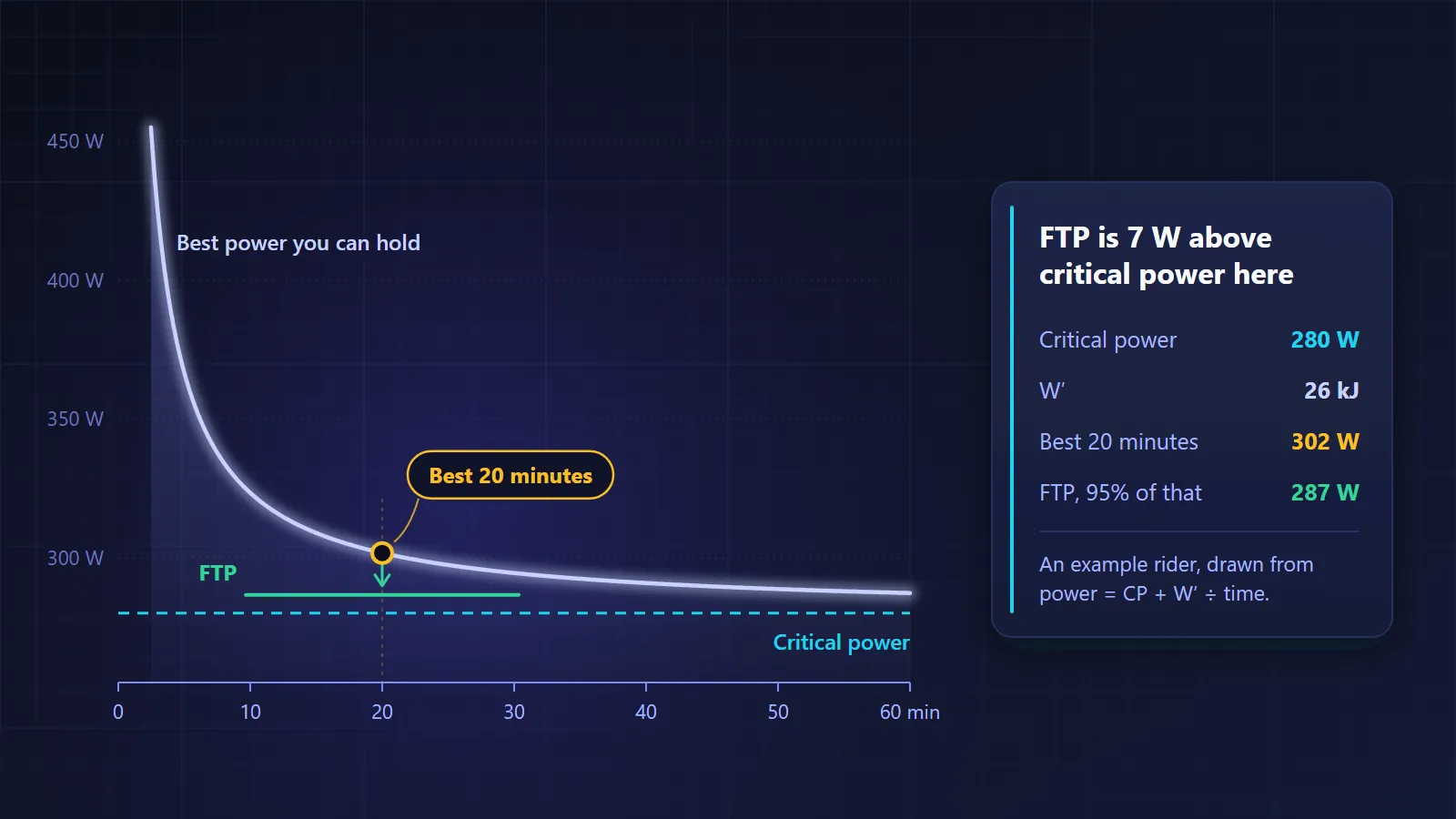
FTP from a 20-minute test is above or below critical power depending on the size of W′. All-out for 20 minutes, you ride at CP plus your W′ spread over 1,200 seconds. The 95% rule then takes off 5%, which can be more or less than that W′ share.
The model says the power you can hold for any time t is CP + W′ ÷ t. Take two riders with the same CP of 280 W:
| Rider A | Rider B | |
|---|---|---|
| Critical power | 280 W | 280 W |
| W′ | 14 kJ | 26 kJ |
| Best 20 minutes, from the model | 292 W | 302 W |
| FTP, 95% of it | 277 W | 287 W |
| FTP against CP | 3 W below | 7 W above |
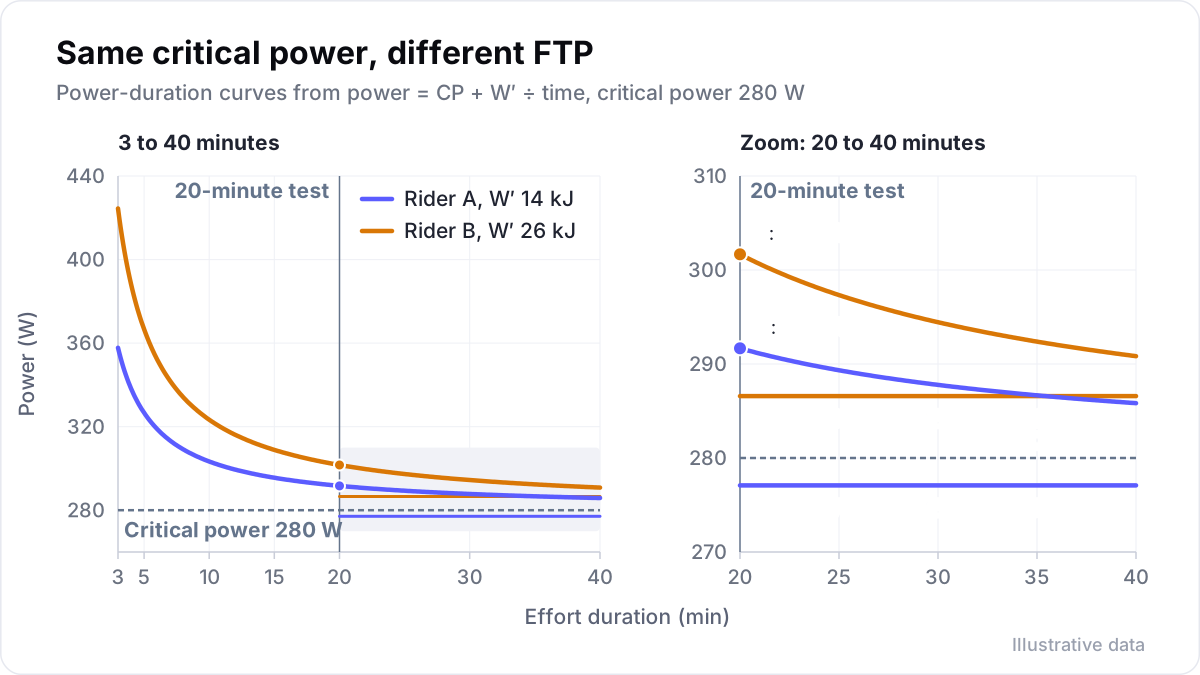
For a CP of 280 W, the 95% rule gives exactly CP when W′ is about 17.7 kJ. A rider with a bigger reserve gets an FTP above CP, and a rider with a smaller one gets an FTP below it. Real riders add noise from pacing and motivation. The model also tends to flatter longer efforts: in Karsten and colleagues' 2021 study, CP and W′ from 3-, 7- and 12-minute efforts predicted 270 W for 20 minutes, and the riders managed 262 W.
How close are critical power and FTP in studies?
Critical power and FTP are close on average but not close enough to swap for one rider. Three studies of trained riders found average gaps of 3 to 16 W, and each concluded that the two should not be used interchangeably.
| Study | Riders | Critical power | FTP | CP minus FTP for one rider |
|---|---|---|---|---|
| Morgan and colleagues, 2019 | 12 competitive male cyclists | 275 W | 278 W | from 36 W below to 30 W above (95% limits) |
| Karsten and colleagues, 2021 | 17 trained cyclists and triathletes | 256 W | 249 W | from 19 W below to 33 W above (95% limits) |
| McGrath and colleagues, 2021 | Highly trained cyclists and triathletes | 282 W | 266 W | CP consistently higher, by 16 W on average |
The critical power tests differed. Morgan's and Karsten's riders rode self-paced time trials, while McGrath's rode fixed-load trials, so part of the spread between studies comes from the method.
Does FTP match the maximal lactate steady state?
FTP matches the maximal lactate steady state on average in some studies and is above it in others. Two studies found FTP too high, by about 7% and by 12 W, and one of them found that FTP did not rise when the steady state rose with training.
- Borszcz and colleagues, 2019. In 15 trained and well-trained cyclists, FTP was within 1.4% of MLSS on average, with individual limits of about 9% either way. The authors judged FTP a practical estimate of MLSS.
- Inglis and colleagues, 2020. In 18 well-trained people, MLSS was 93% of FTP. After seven months of training, MLSS in the 10 who were retested rose by 12 W, while their 20-minute power did not rise.
- Lillo-Beviá and colleagues, 2022. In 11 trained cyclists and triathletes, 95% of 20-minute power overestimated MLSS by 12 W; 91% fitted better.
When is FTP more useful than critical power?
FTP is more useful for zones and steady targets, because Coggan's zones, most training plans and most apps are written as shares of FTP. It needs only one test, which you can repeat at the start of each block with the same protocol.
Steady sessions are at or below the ceiling, where W′ hardly matters. They include endurance at 56 to 75% of FTP, tempo at 76 to 90% and threshold at 91 to 105%. Swapping CP in for FTP moves every one of these targets. For the riders in McGrath's study, a CP 16 W above FTP would make each threshold interval about 6% harder than planned. The cycling training zones article lists the full set.
FTP's weak spot is the test itself. A 20-minute effort includes part of W′, so a punchy rider such as rider B gets a higher FTP than a steady one with the same CP. Inglis's result adds a second warning: a 20-minute test can miss a real change in the steady-state ceiling.
When is critical power more useful than FTP?
Critical power is more useful above threshold, because it comes with W′. Together, the two numbers tell you how long you can hold a given power, what an attack costs, and how hard to start a climb or a time trial that lasts 3 to 20 minutes.
Back to riders A and B. Their FTPs are only 10 W apart, so FTP-based VO2max targets at the top of zone 5, 120% of FTP, are 332 W and 344 W. The model says rider A can hold 332 W for about 4 minutes 30 seconds, so a 5-minute repetition at that target fails even when fresh. Rider B can hold 344 W for about 6 minutes 45 seconds, so the same repetition is easier than planned.
Setting the efforts from CP and W′ fixes both. If each 5-minute repetition should use about two thirds of W′, rider A rides 280 + 9,333 ÷ 300 = 311 W, and rider B rides 280 + 17,333 ÷ 300 = 338 W. The same arithmetic paces a climb or a short time trial, and W′ balance follows the reserve second by second through a race.
Why should a training app say whether it uses CP or FTP?
A training app should say which number sets your zones, which one sets W′ balance, and where each came from, because CP and FTP can differ by about 30 W for one rider. Without that, two apps can show different thresholds and both look right.
Apps model these numbers in different ways. TrainingPeaks' WKO software, for example, models an FTP from about the last 90 days of power data, together with sprint power and a reserve it calls FRC. Before you compare numbers between apps, ask four questions:
- Which number sets my zones and session targets: a tested FTP, a modelled FTP or critical power?
- Where did it come from: a test, a fit to my rides, or a value someone typed in, and when?
- Which efforts does the model fit, over how many days, and does it say when they were not all-out?
- Does W′ balance use my critical power, or FTP standing in for it?
In Velograph, zones and session targets follow FTP. Critical power and W′ are fitted to a rider's best efforts of 3 to 20 minutes in the 90 days up to each ride, unless a tested critical power has been entered. The ride page says which of the two it used. When no plausible fit is possible, FTP stands in for critical power and the page says it is an estimate. An FTP suggested from rides is the lower of 95% of the best 20 minutes and the fitted critical power. The riders page says what a rider keeps on the free Rider plan.
Further reading
- Road cycle TT performance: relationship to the power-duration model and association with FTP, Journal of Sports Sciences, 2019.
- Relationship between the critical power test and a 20-min functional threshold power test in cycling, Frontiers in Physiology, 2021.
- Maximal lactate steady state versus the 20-minute functional threshold power test in well-trained individuals, International Journal of Sports Physiology and Performance, 2020.
- Is the functional threshold power interchangeable with the maximal lactate steady state in trained cyclists?, International Journal of Sports Physiology and Performance, 2019.
- The critical power concept: applications to sports performance with a focus on intermittent high-intensity exercise, Sports Medicine, 2017.
Velograph is not affiliated with, sponsored by or endorsed by any team, rider or company named in this article. Names are used only to refer to publicly reported work.