Eight turbo trainer workouts with exact targets, from endurance to VO2max and sprints, with watts for an FTP of 250 W, 45-minute versions and the mode for each.
Turbo trainer workouts work best when each one has a single purpose, an exact target and a length that fits the evening you have. Here are eight sessions, from easy endurance to sprints, with every target as a percentage of FTP, the durations and recoveries, and the watts for a rider with an FTP of 250 W. Choose one by what you want to train and how long you have, set the trainer mode that suits it, and cut it short if the warning signs below appear.
Which turbo trainer workout should you do today?
Choose a turbo trainer workout by goal first and time second. Endurance and tempo build aerobic base, sweet spot and over-unders raise FTP, the pyramid and 30/15s train VO2max, and sprints train speed. Openers are for the day before a race.
| Goal | Session | Time |
|---|---|---|
| Aerobic base, or an easy week | Endurance 1 h | 1 h |
| Long steady efforts | Tempo 3 × 15 min | 1 h 25 min |
| Raise FTP with moderate fatigue | Sweet spot 2 × 20 min | 1 h 15 min |
| Keep riding hard after a surge | Over-unders 4 × 8 min | 1 h 17 min |
| VO2max with longer efforts | VO2max pyramid | 1 h 2 min |
| VO2max with short efforts | 30/15s 3 × 13 | 1 h 8 min |
| Top-end speed | Sprints 8 × 15 s | 1 h 15 min |
| Fresh legs for tomorrow's race | Openers | 45 min |
The targets follow Coggan's power zones, which the article on cycling training zones sets out in full. If your FTP is old, test it first, because every watt below comes from it; what FTP is explains the tests.
What are the eight sessions and their targets?
The eight sessions are endurance, tempo, sweet spot, over-unders, a VO2max pyramid, 30/15s, sprints and openers. Each has a warm-up, a main set and a cool-down, and the times below include all three.
Five of them share a 15-minute warm-up: 10 minutes rising from 50 to 75% of FTP, 1 minute at 95%, 2 minutes easy, 30 seconds at 120% and 90 seconds easy. For the rider with an FTP of 250 W, that warm-up rises from 125 to 188 W, with short efforts at 238 W and 300 W. Easy riding between efforts is at 55% of FTP (138 W), or at 50% (125 W) after the hardest efforts.
| Session | Main set | Target, % of FTP | Watts at FTP 250 W | Total |
|---|---|---|---|---|
| Endurance 1 h | 45 minutes steady, after a 10-minute warm-up | 65 to 75% | 163 to 188 W | 60 min |
| Tempo 3 × 15 min | 3 × 15 minutes, 5 minutes easy after each | 80 to 88% | 200 to 220 W | 85 min |
| Sweet spot 2 × 20 min | 2 × 20 minutes, 5 minutes easy after each | 88 to 93% | 220 to 233 W | 75 min |
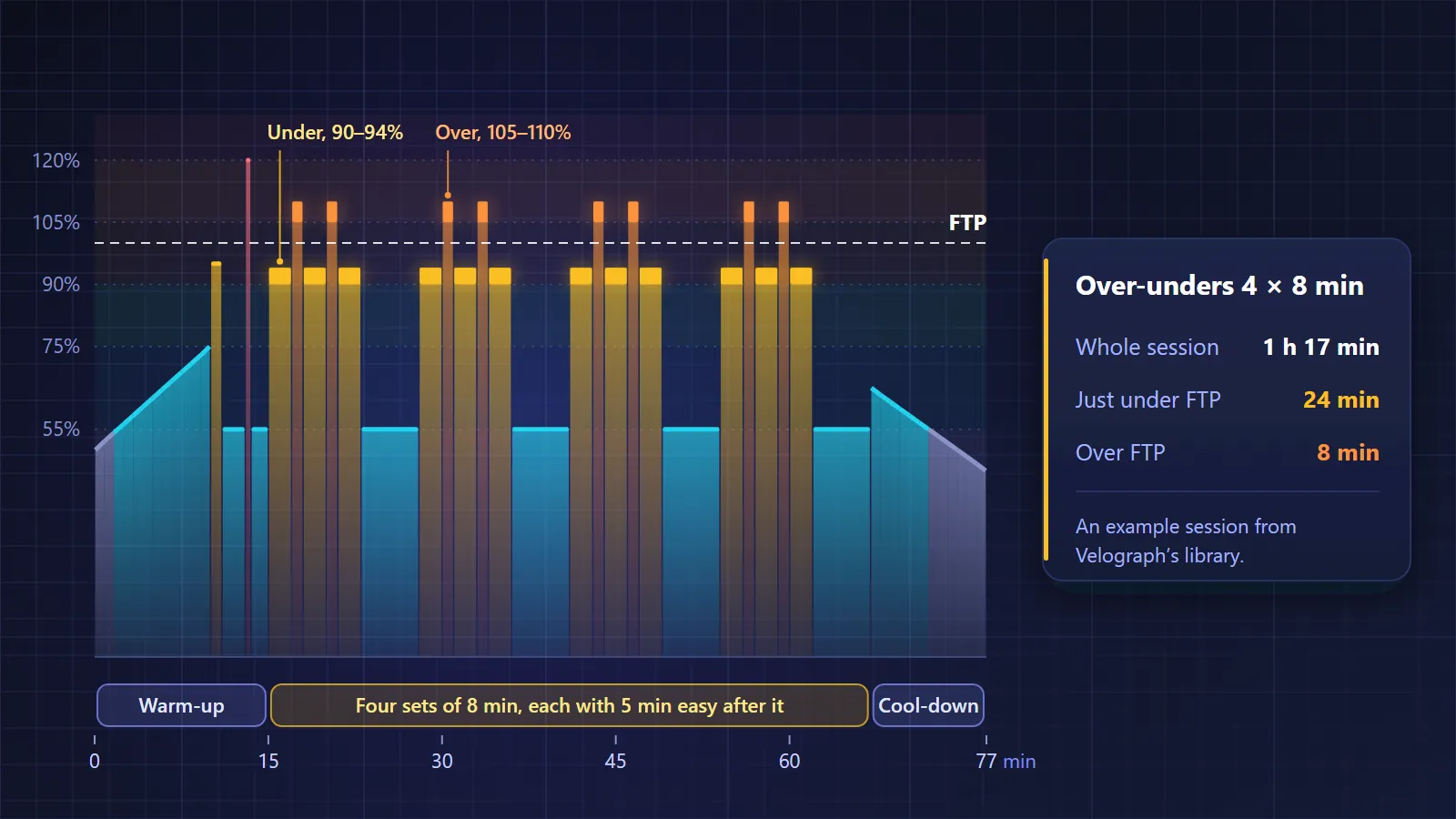
| Over-unders 4 × 8 min | 4 sets of 2 min under, 1 over, 2 under, 1 over, 2 under; 5 minutes easy after each set | 90 to 94% under, 105 to 110% over | 225 to 235 W, 263 to 275 W | 77 min |
| VO2max pyramid | 1, 2, 3, 4, 3, 2 and 1 minutes, each followed by the same time easy | 110 to 120% | 275 to 300 W | 62 min |
| 30/15s 3 × 13 | 3 sets of 13 × 30 seconds on and 15 seconds off, 3 minutes easy after each set | 115 to 125% on, 50% off | 288 to 313 W on, 125 W off | 68 min |
| Sprints 8 × 15 s | 8 sprints of 15 seconds, 4 min 45 s easy after each, then 10 minutes of endurance | All-out | As hard as you can | 75 min |
| Openers | 10 minutes at 60 to 70%, 3 × 1 minute with 2 minutes easy, then 2 sprints of 10 seconds | 110%, then all-out | 275 W, then flat out | 45 min |
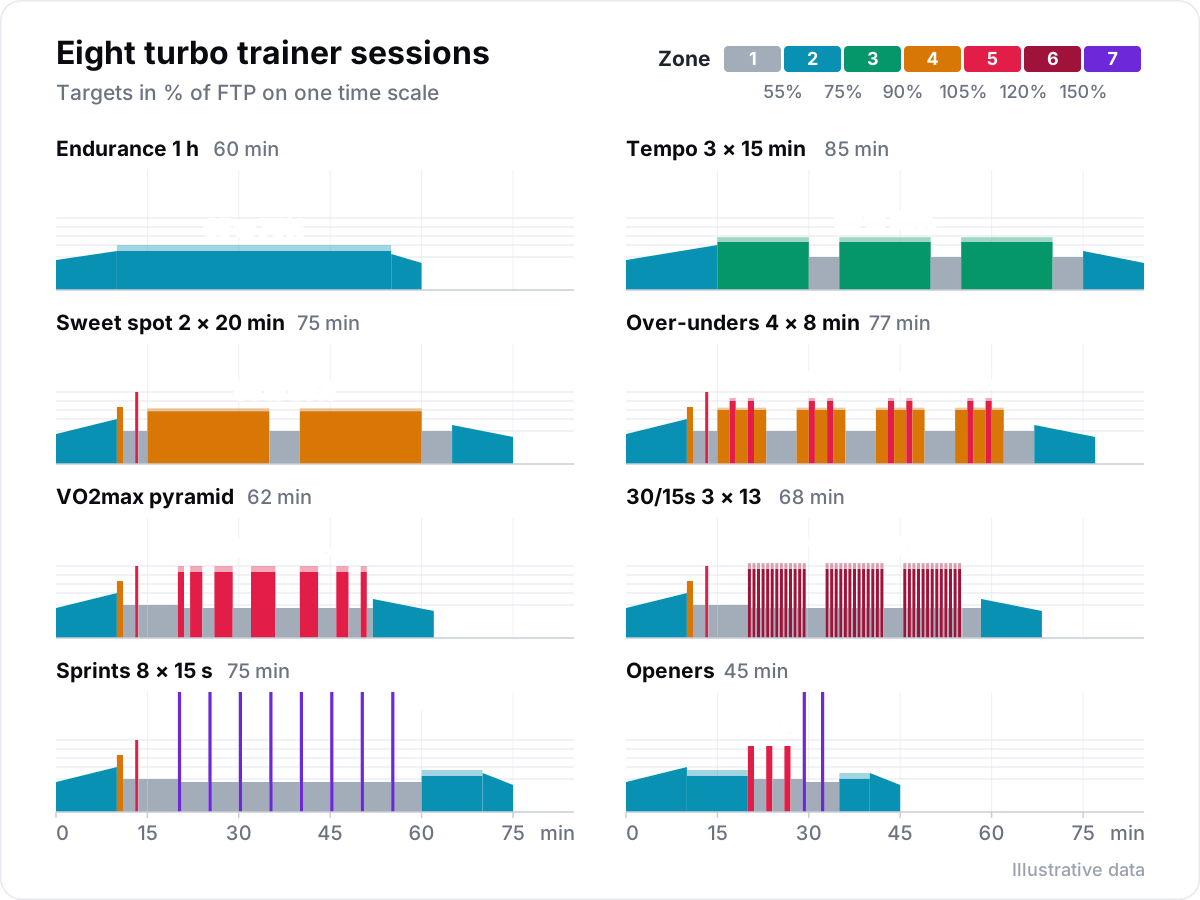
Steady sessions: endurance, tempo and sweet spot
Endurance builds the aerobic base, and indoors an hour of it means an hour of pedalling with no freewheeling. Tempo is comfortably hard, so you can still talk in short sentences, and it trains long efforts with less fatigue than threshold work. Sweet spot sits a little below threshold, here at 88 to 93% of FTP, so you can spend a long time near FTP with less fatigue than threshold work brings. Ride all three seated, smooth and at the same power from start to finish.
A race-shaped session: over-unders
The overs take you a little above threshold, and the unders ask you to keep riding hard while you recover from them. That is how a race feels when the pace rises over a climb and does not drop afterwards. Change gear or cadence a few seconds before each over, so the jump in power does not catch you out.
Hard intervals: the VO2max pyramid and 30/15s
The pyramid climbs from 1 minute to 4 and back down, at 110 to 120% of FTP, with each easy part as long as the effort before it. The 4 minutes in the middle are the hardest, so save something for the way down. The 30/15s come from Bent Rønnestad and colleagues' studies of short intervals in elite cyclists, which the guide to structured training plans describes. Stay seated for the 30-second efforts and keep the 15-second rests easy.
Sprints and openers
Sprint from a rolling start, out of the saddle, and recover fully. Quality counts more than the number of sprints, so stop when one is clearly slower than the first. Openers are for the day before a race: three short efforts and two sprints wake your legs up without tiring them.
What is a good 45-minute turbo trainer workout?
A good 45-minute turbo trainer workout keeps a short warm-up and cool-down and shortens the main set. Three versions fit: two 12-minute sweet spot blocks, two sets of 30/15s, or the openers session as it stands, for the day before a race.
Sweet spot 2 × 12 minutes, 45 minutes in all:
- 10 minutes rising from 50 to 75% of FTP (125 to 188 W).
- 12 minutes at 88 to 93% (220 to 233 W).
- 4 minutes easy at 55% (138 W).
- 12 minutes at 88 to 93% (220 to 233 W).
- 7 minutes easing from 65 to 45% (163 to 113 W).
30/15s 2 × 13, 45 minutes in all:
- 10 minutes rising from 50 to 75% of FTP, then 30 seconds at 120% (300 W) and 90 seconds easy.
- 13 × 30 seconds at 115 to 125% (288 to 313 W), each followed by 15 seconds at 50% (125 W). The set takes 9 minutes 45 seconds.
- 3 minutes easy at 50%.
- A second set of 13, the same as the first.
- 10 minutes 30 seconds easing from 65 to 45%.
Should you use ERG mode for these sessions?
Use ERG mode for endurance, tempo, sweet spot, over-unders and the pyramid, where holding a target is the whole job. Ride sprints and the openers' sprints in resistance or slope mode. For 30/15s, choose resistance mode if your trainer is slow to change, because ERG reacts slowly to big jumps in target power.
In ERG, start each hard effort at a comfortably high cadence, around 90 rpm or more. If your cadence sinks as you tire, the trainer adds resistance to hold the watts and your cadence sinks further. The article on indoor cycling training explains that spiral, why your trainer may read lower than your power meter, and why a fan matters so much indoors.
A rating of perceived effort from 0 to 10 helps you judge each session. As a guide, endurance should feel like 3 or 4 out of 10, tempo 5 or 6, sweet spot about 7, over-unders 7 or 8, and the pyramid and 30/15s 8 or 9 by the last efforts. The sprints are flat out but short, and openers should feel easy overall.
How do you know a trainer session is too hard?
A trainer session is too hard when you cannot hold the bottom of the target range in the last repetition, or your cadence keeps falling in ERG. It is also too hard when the session feels two points harder than its guide rating. Then lower the target by 3 to 5% or drop a repetition.
Watch for these signs:
- Power. Most of the last repetition falls below the bottom of the range, or you stop it early.
- Cadence. In ERG, your cadence drifts under about 75 rpm and does not come back.
- Recoveries. Your breathing has not settled by the end of an easy part.
- The next day. Your legs feel heavy and the following key session fails as well.
One hard day means little; the same sign in two or three sessions means something should change. Change one thing at a time: the target, the number of repetitions, the length of the recoveries, or your FTP after a new test. Check the room too, because heat lowers the power you can hold. Dizziness, chest pain or an unusual heartbeat are a reason to stop at once and see a doctor, not a training signal.
How many turbo trainer workouts should you do a week?
Two hard turbo trainer workouts a week are enough for most riders, with easy or endurance riding between them and an easy day after each. A third, moderate session, such as tempo, fits in a week of about 4 hours 30 minutes or more.
Two example weeks, built from the sessions above:
| Day | About 3 hours 30 minutes a week | About 4 hours 45 minutes a week |
|---|---|---|
| Tuesday | 30/15s 3 × 13 (68 min) | VO2max pyramid (62 min) |
| Thursday | Sweet spot 2 × 20 min (75 min) | Over-unders 4 × 8 min (77 min) |
| Saturday | Endurance 1 h | Tempo 3 × 15 min (85 min) |
| Sunday | Rest, or a ride outdoors | Endurance 1 h |
Over a few weeks, lengthen the main set before you raise the target, and swap the sessions round so the same one does not come back every week. All eight sessions are in Velograph's session library, where their watts follow each rider's own FTP. Training plans are part of Rider Plus, a paid plan; the riders page says what the free Rider plan keeps.
Further reading
- Power training levels, by Andrew Coggan, TrainingPeaks, 2016.
- Superior performance improvements in elite cyclists following short-interval vs effort-matched long-interval training, Scandinavian Journal of Medicine and Science in Sports, 2020.
Velograph is not affiliated with, sponsored by or endorsed by any team, rider or company named in this article. Names are used only to refer to publicly reported work.