Every Zwift Academy winner from 2016 to 2024 with the team that signed them, who went furthest, and what an indoor talent search can and cannot show.
Zwift Academy winners have signed a professional or development-team contract after every edition from 2016 to 2024: nine women with CANYON//SRAM's teams and eight men with teams run by Dimension Data, NTT and Alpecin. Jay Vine and Neve Bradbury have gone furthest. Vine has won stages of the Vuelta a España, and Bradbury a stage of the Giro d'Italia Women. The Academy did not run in 2025, and Zwift said it would return in 2026.
How does Zwift Academy work?
Zwift Academy is a talent search held on the indoor cycling platform Zwift. Riders complete set workouts and races on a smart trainer, a handful of finalists usually go to a camp with the partner teams, and the teams' staff choose one woman and one man for a contract the following season.
The format changes a little each year, but the shape has stayed the same. In the 2023 edition, Zwift set six workouts, designed by Dig Deep Coaching, and two races. The long versions of the workouts lasted an hour to 90 minutes, and the races tested sprint power and recovery from climbs. Riders hoping for a contract had to wear a heart rate monitor and ride the long versions.
For the 2024 edition, Zwift listed what a rider needed to be considered for a contract:
- Age: 18 or older on 1 January 2025.
- Equipment: a smart trainer or smart bike accurate to within 2.5%, and a heart rate monitor for every Academy event.
- Body data: height and weight entered accurately in Zwift before starting.
- Work done: all six structured workouts, and both races in category A or B.
The field is large and the final is small. Zwift reported more than 150,000 riders in 2021, more than 160,000 in 2022, more than 108,000 in 2023 and more than 100,000 in 2024. From 2021 to 2024, between six and ten finalists reached the camps each year. At the 2024 edition's finals, the four women trained with CANYON//SRAM zondacrypto in the Algarve and the four men with Alpecin-Deceuninck in Denia, Spain. They rode challenges and races on the road and on Zwift, and the last challenge repeated a test from four days earlier, this time on tired legs.
Who has won Zwift Academy?
Seventeen riders won Zwift Academy from 2016 to 2024: nine women, who joined CANYON//SRAM's professional or development team, and eight men, who joined teams run by Dimension Data, NTT and Alpecin. The first edition, in 2016, was for women only; the men's Academy began in 2017.
| Edition | Women's winner | Team that signed her | Men's winner | Team that signed him |
|---|---|---|---|---|
| 2016 | Leah Thorvilson (USA) | CANYON//SRAM Racing | none | none |
| 2017 | Tanja Erath (Germany) | CANYON//SRAM Racing | Ollie Jones (New Zealand) | Dimension Data for Qhubeka, under-23 team |
| 2018 | Ella Harris (New Zealand) | CANYON//SRAM Racing | Martin Lavrič (Slovenia) | Dimension Data for Qhubeka, under-23 team |
| 2019 | Jessica Pratt (Australia) | CANYON//SRAM Racing | Drew Christensen (New Zealand) | NTT Continental Team |
| 2020 | Neve Bradbury (Australia) | CANYON//SRAM Racing | Jay Vine (Australia) | Alpecin-Fenix |
| 2021 | Maud Oudeman (Netherlands) | CANYON//SRAM Racing | Alex Bogna (Australia) | Alpecin-Fenix |
| 2022 | Alex Morrice (Great Britain) | CANYON//SRAM Racing | Luca Vergallito (Italy) | Alpecin-Deceuninck Development Team |
| 2023 | Maddie Le Roux (South Africa) | CANYON//SRAM Generation | Louis Kitzki (Germany) | Alpecin-Deceuninck Development Team |
| 2024 | Emily Dixon (Australia) | CANYON//SRAM zondacrypto Generation | Noah Ramsay (Canada) | Alpecin-Deceuninck Development Team |
Team names are those used in Zwift's announcements and its 2020 update. Winners joined the team for the season after their edition; the 2023 and 2024 winners were announced in February 2024 and March 2025.
Winners have ranged in age. Zwift gave Emily Dixon's age as 18 and Noah Ramsay's as 22 when they won, and Luca Vergallito was 25. Since the 2022 edition the men's winners have joined Alpecin's development team, and since 2023 the women's winners have joined CANYON//SRAM's. A development team is a step towards the WorldTour rather than a place in it.
Which Zwift Academy winners went furthest?
Jay Vine and Neve Bradbury, both 2020 winners, have gone furthest. Vine won two stages of the 2022 Vuelta a España, the 2023 Tour Down Under and the Vuelta's mountains classification in 2024 and 2025. Bradbury won the Blockhaus stage of the 2024 Giro d'Italia Women and finished third overall.
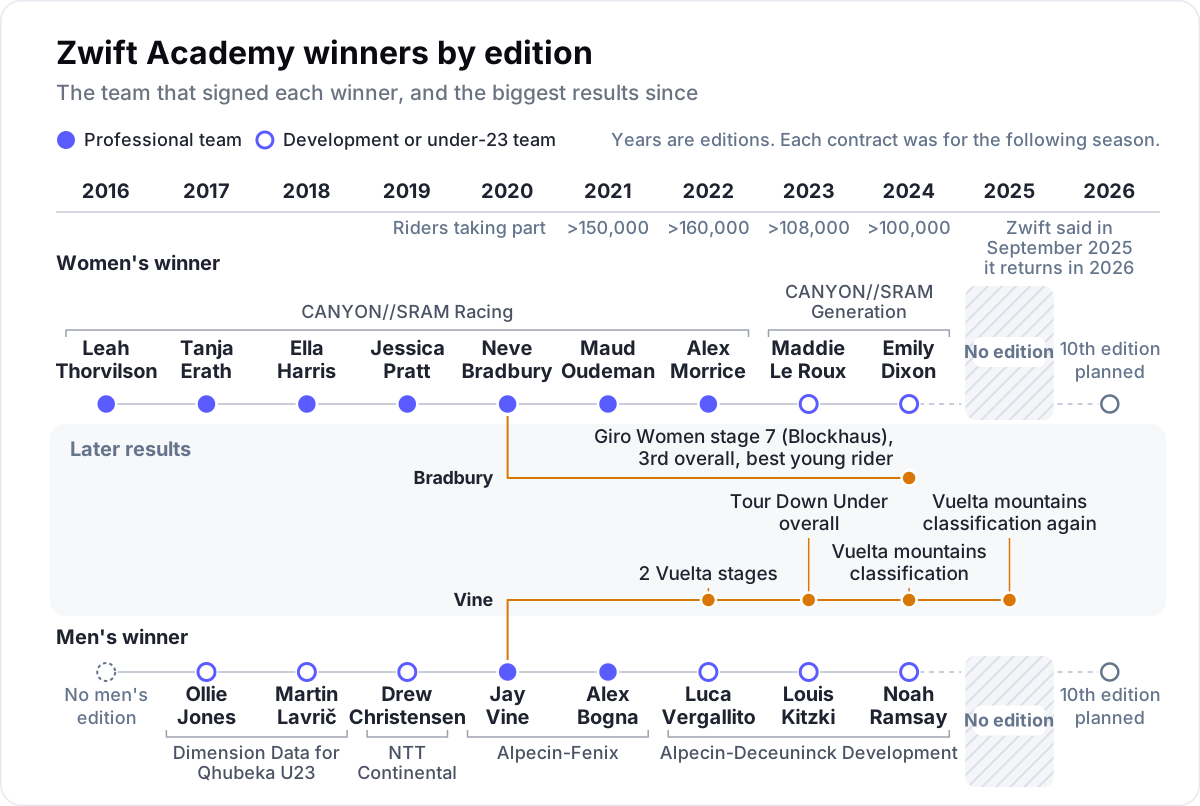
- Jay Vine joined Alpecin-Fenix for 2021 and won his two Vuelta stages in 2022 with the same team, by then called Alpecin-Deceuninck. He then moved to UAE Team Emirates, won the Tour Down Under in January 2023, and won the Vuelta's mountains classification two years running, in 2024 and 2025, according to the race's organisers.
- Neve Bradbury joined CANYON//SRAM for 2021. In July 2024, aged 22, she won stage 7 of the Giro d'Italia Women on the Blockhaus, finished third overall and won the best young rider's jersey, AusCycling reported.
- Tanja Erath rode three seasons for CANYON//SRAM and then moved to TIBCO-SVB, Zwift said in 2020. She finished third at the German road championship that year.
- Luca Vergallito moved up from Alpecin-Deceuninck's development team to its WorldTeam for 2024, the German site Radsport-News reported.
A first contract is a start, not a career. Zwift's 2020 update shows that Jessica Pratt and Ollie Jones each rode one season with the team that signed them, and Leah Thorvilson two.
Have esports cyclists turned pro without the Academy?
Yes, at least one esports champion has. Jason Osborne, a German Olympic rower, won the first UCI Cycling Esports World Championships on Zwift in December 2020 and later rode for Alpecin-Deceuninck's WorldTeam. He left the team in September 2024 to focus on esports, and Escape Collective reports that he won the world title again in 2024 and 2025.
Osborne took silver in the lightweight double sculls at the Tokyo Olympics while also training on Zwift and on the road. He rode in the breakaway at Liège-Bastogne-Liège in 2023. In 2024 he said that road racing was no longer his passion and that he wanted to race esports and gravel, Stickybottle reported. Our guide to indoor cycling training covers how esports grew on Zwift.
What can an indoor talent search measure, and what can't it?
An indoor talent search measures power and heart rate under set conditions: how much power a rider produces for each effort, how they recover and how they race other riders on screen. It cannot show bike handling, positioning in a bunch, descending or racing in wind and rain, which is why the finals move onto the road.
The teams' own words show the split. Zwift's releases quote staff praising Emily Dixon's power numbers, riding technique and composure under pressure, and Noah Ramsay's bike handling, power data, tactical thinking and capacity to improve with coaching. Maddie Le Roux stood out in the finals' Zwift race by working for her designated leaders. Alpecin-Deceuninck chose Louis Kitzki partly because he was young and saw his weak points as things to work on. Only part of each list is something a trainer can record.
Trainer numbers also carry error. A trainer accurate to within 2.5% can be 7.5 W out either way at 300 W, so a reading of 300 W means about 292 to 308 W. For a 65 kg rider, that is about 4.49 to 4.74 W/kg, a spread of 0.25 W/kg from the trainer alone. If the same rider weighs 66 kg but enters 65 kg, 300 W shows as 4.62 W/kg instead of 4.55. Two riders 0.2 W/kg apart on a leaderboard may be equal on the road. Our guide to watts per kilo explains why the number matters most on climbs.
What indoor data shows well is change over time, measured the same way. That is why talent research leans on progress across seasons rather than one test, as our article on talent identification in cycling shows.
What can an amateur take from Zwift Academy?
An amateur can borrow the Academy's method: test the same way each time, on the same trainer, with an honest weight, repeat a key effort when tired, and race to learn tactics. Then ride outside in groups, because the road skills that the finals test cannot be learnt on a screen.
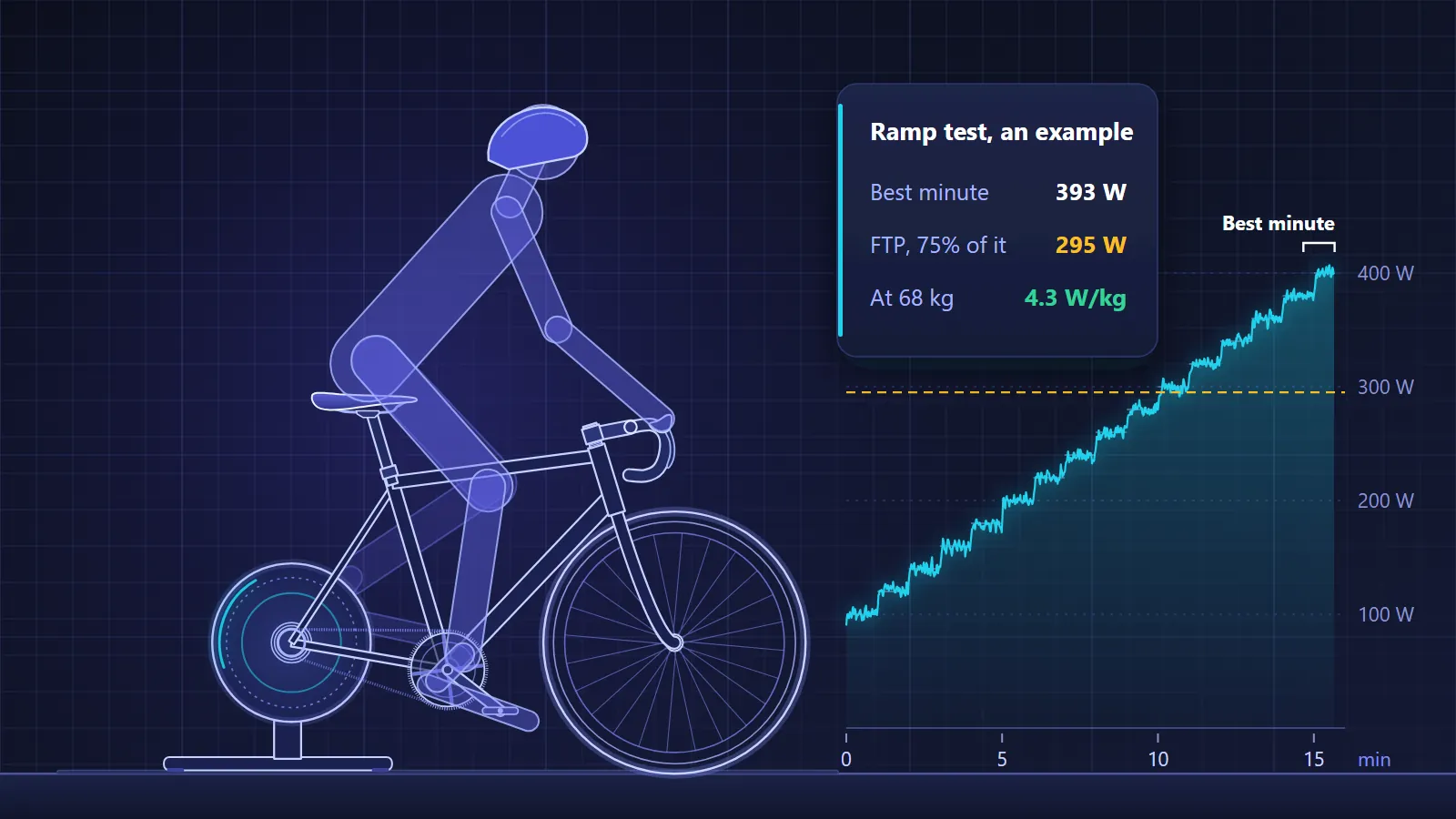
- Test the same way every time. Use the same trainer, calibrated before the test, with the same fan at the same time of day. A 20-minute test or a ramp test every four to eight weeks is enough; our guide to what FTP is explains both.
- Weigh yourself the same way. Use the same scale each morning before breakfast, and take the average of a week rather than one reading.
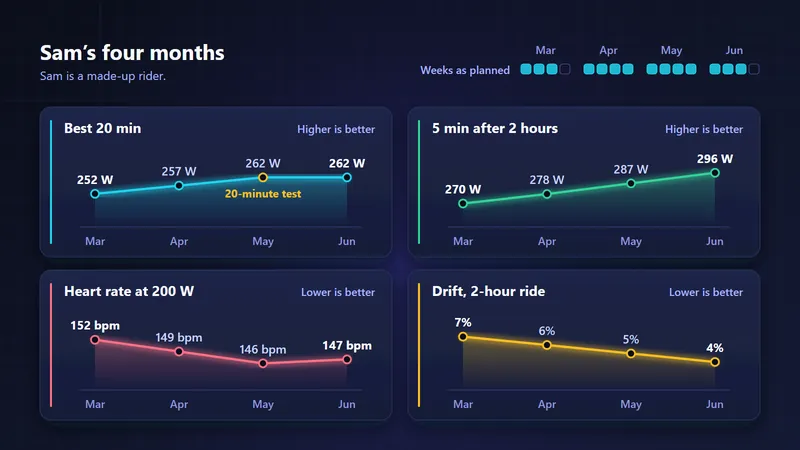
- Repeat an effort on tired legs, as the 2024 finals did. Ride a 5-minute effort fresh, then the same effort after 2 hours of steady riding. If the first is 320 W and the second 300 W, you kept about 94% of your fresh power. That share is your durability, and our guide to durability in cycling shows how to train it. Velograph, for example, shows how much of your best power is left after hours of riding.
- Race to learn, not only to score. A weekly race on screen teaches when to follow and when to save energy.
- Ride with a group outside every week, for the handling, cornering and positioning a trainer cannot teach.
- Keep every test in one place, so the trend over a season is visible. Our page for riders says what a rider can keep on their own.
Further reading
- Zwift Academy past winners update, Zwift, 2020.
- Zwift Academy winners awarded life-changing professional cycling contracts for 2025, Zwift, 2025.
- Giro d'Italia: Neve Bradbury climbs to stardom with queen stage win and GC podium, AusCycling, 2024.
- Moolman Pasio and Osborne make history in Watopia, UCI, 2020.
Velograph is not affiliated with, sponsored by or endorsed by any team, rider or company named in this article. Names are used only to refer to publicly reported work.