What a cyclocross race asks, a training week in the build and in season, the key sessions and skills drills, and how to read your race file lap by lap.
Cyclocross training prepares you for a race of 40 to 60 minutes, ridden as hard as you can sustain, with an acceleration out of every corner, a few dismounts and short runs with the bike. A good week mixes short, repeated efforts above threshold, race starts, skills on grass and a little running, on top of the endurance you built over the summer.
What does a cyclocross race ask of your body?
A cyclocross race asks you to ride hard for 40 to 60 minutes while you accelerate out of every corner, get off and run over obstacles, and remount. Each effort above your critical power drains a limited reserve, and the easier seconds between efforts refill only part of it.
The UCI, cycling's world governing body, asks for races as close as possible to 60 minutes for elite men, 50 for under-23 men, 45 for under-23 women and 40 for juniors. Elite women race 50 minutes on their own, or 45 when junior women race with them. From July 2027, they race 50 minutes in every case. National federations set the rest; in Belgium, amateur and masters races last 40 minutes.
A UCI lap is 2.5 to 3.5 km, and at least 90% of it must be rideable. It may have up to six artificial obstacles: planks, steps and sand pits. None may be longer than 80 metres or higher than 40 cm, and the planks come as a pair, 4 to 6 metres apart.
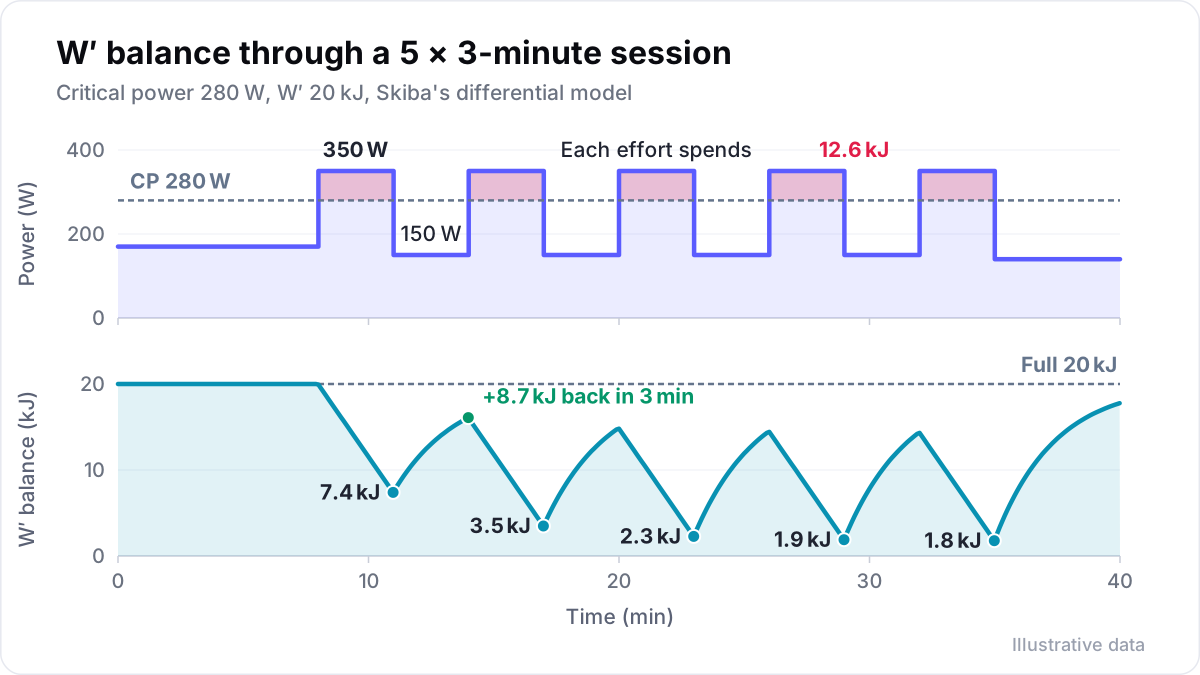
Two numbers explain why cross hurts. Critical power is the boundary between efforts you can sustain and efforts that tire you within minutes. W′ (W-prime) is the fixed amount of work you can do above it. Every surge spends W′, and easier riding refills it slowly. A cross race repeats this pattern with shorter efforts and gaps. The guide to critical power and W′ explains how to estimate both.
The start matters. Arthur Bossi and colleagues studied 329 riders in five editions of the UCI Cyclo-cross World Championships, from 2012 to 2016. Starting fastest and then slowing was the most common pattern, and most changes of position came in the first laps. At World Cups and World Championships, riders who fall too far behind the leader are also pulled out of the race.
Running loads the legs in a way pedalling does not. In a study by Brian Tolly and colleagues with 25 cyclocross riders, jumping two barriers on flat ground produced peak forces of 2.9 times body weight.
How should you structure a cyclocross training week in season?
In season, build the week around the race: one hard session early in the week, an endurance ride, a skills session and short openers the day before. When you race on both Saturday and Sunday, the two races are your hard sessions, so midweek keeps one short quality session and the skills.
| Day | One race, on Sunday | Two races, Saturday and Sunday |
|---|---|---|
| Monday | Rest | Rest |
| Tuesday | 30/30s, 3 sets of 8, about 60 minutes | 60 to 75 minutes of endurance with 4 race starts |
| Wednesday | 75 to 90 minutes of endurance, then a 10- to 15-minute run | 30/30s, 2 sets of 8, about 45 minutes |
| Thursday | Skills on grass with 4 race starts, 60 minutes | Easy skills, 45 minutes |
| Friday | Rest | Openers, 30 to 40 minutes |
| Saturday | Openers and a look at the course, 45 minutes | Race |
| Sunday | Race | Race |
Openers are a short ride with 3 × 1 minute at 110% of FTP and two race starts. FTP (functional threshold power) is the highest power you can hold in a steady effort, for most trained riders between 30 and 70 minutes. Warm up for 20 to 30 minutes before each race, because it starts at full speed.
What does a cyclocross training plan look like in the build?
In the eight weeks before your first race, keep the summer's endurance riding, add one session of race-like intervals and one of skills each week, and start running a little. A build week for a rider on about 7 to 8 hours has five rides, two short runs and one short strength session.
| Day | Session | Time | Target, % of FTP |
|---|---|---|---|
| Monday | Rest | ||
| Tuesday | 3 × 10 minutes at threshold, 5 minutes easy between | 65 min | 95 to 100% |
| Wednesday | Endurance ride, then a run on grass | 90 min, then 10 to 20 min | 56 to 75% |
| Thursday | Skills on grass, then 6 × 20-second hill sprints | 60 min | Sprints all-out |
| Friday | Strength work, then a run on grass | 30 min, then 10 to 20 min | |
| Saturday | Long ride on the road or gravel | 2.5 to 3 hours | 56 to 75% |
| Sunday | 30/30s, or a local cross or mountain bike race | 60 to 75 min | 125 to 135% on |
Build the running slowly, because your legs are used to pedalling, not landing. Run 10 minutes on grass twice a week for two weeks. Then run 15 minutes and add four run-ups with the bike on your shoulder. From week five, run 20 minutes and add barriers. If your shins, Achilles tendons or knees start to hurt, stop running and see a physiotherapist.
A one-hour race asks less of durability, the power left late in a long ride, than a road race does. The long Saturday rides still build the aerobic base that helps you recover between surges.
Which cyclocross intervals should you do?
Four sessions cover most of what a cross race asks: 30/30s for repeated efforts above threshold, race starts, short hill repeats and laps at race pace. In season, do one or two of them a week, not all four.
Each session starts with a 15-minute warm-up rising from 50 to 75% of FTP and ends with 10 minutes easy.
| Session | Main set | Target, % of FTP | Watts at FTP 250 W | Total |
|---|---|---|---|---|
| 30/30s | 3 sets of 8 × 30 seconds hard, 30 seconds easy; 5 minutes easy between sets | 125 to 135% on, 50% off | 313 to 338 W on, 125 W off | About 60 min |
| Race starts | 6 × 15 seconds all-out from a standstill, then 45 seconds hard; 4 minutes easy after each | All-out, then 110 to 120% | Flat out, then 275 to 300 W | 55 min |
| Hill repeats | 8 × 30 seconds up a short, steep hill, 2 minutes easy back down; carry the bike up every second one | 130% or more | 325 W or more | About 45 min |
| Race-pace laps | 4 × 6 minutes on a grass loop with a dismount, 4 minutes easy between | About 100 to 110% | About 250 to 275 W | 61 min |
The 30/30s copy the race, with recoveries that are never quite long enough. Keep the 30 seconds off easy. The 30/15s in the guide to turbo trainer workouts are a harder version with shorter rests.
Ride the race starts in a gear you can turn from a stop, and clip the second foot in without looking down. Count your clean clip-ins out of six, because starts are a skill as much as fitness.
How do you train cyclocross skills?
Train cyclocross skills once a week, on grass, for 45 to 60 minutes, with short repeats of one skill at a time. Practise each one slowly first, then at race speed, then when you are out of breath, as you will be in a race.
| Skill | Drill | Repeats |
|---|---|---|
| Dismount and remount | Unclip the left foot, then the right, swing the right leg behind the saddle and step down on the left. Walking pace first, then race speed. | 3 sets of 10 |
| Planks | Two boards 4 to 6 metres apart, low at first. | 10 to 15 runs |
| Corners | A slalom of six cones and one U-turn. Brake before the turn and look through it. | 10 laps |
| Off-camber | Ride across a slope with your weight on the outside pedal and your eyes on the exit. | 10 runs |
| Sand | 20 to 40 metres in a straight line, seated, with your weight back and the power steady. | 10 runs |
| Run-ups | Shoulder the bike at the foot of a bank, run up and remount at the top. | 6 to 8 |
Finish with all of them in a row, as one lap.
How do you recover between weekend races?
Between a Saturday and a Sunday race, cool down with 15 minutes of easy spinning, eat and drink soon after the finish, clean the bike and sleep well. On Sunday, warm up for 25 to 30 minutes with three or four short efforts at race pace. After a double weekend, Monday is a rest day.
If your warm-up heart rate is higher than usual and your starts get slower, take a week with one race and two easy days. A chart of training load, fitness and form helps you see fatigue build through a busy season.
How do you read a cyclocross race file?
Read a cyclocross race file lap by lap, not by its averages. Running and coasting put zeros into the power, so the race average says little. Compare each lap's time, power, heart rate and surges above critical power, and look for where your reserve fell lowest.
Before the race, set the bike computer to record every second, turn auto-pause off and press the lap button each time you cross the line. A power meter sees nothing while you carry the bike, so the running shows up only in heart rate.
After the race, fill in one row per lap:
| Lap | Lap time | Average power | Average heart rate | Surges above CP | Lowest W′ | Where it hurt |
|---|---|---|---|---|---|---|
| 1 | ||||||
| 2 | ||||||
| 3 and on |
Then look for these patterns:
- The first lap is fastest and the rest fade slowly. That is the most common pattern, as the World Championships study found.
- A big drop after the first lap. The start probably emptied your reserve. Pace the first lap a little more evenly.
- Lap times rise while power stays the same. You are probably losing time in the technical parts or the running.
- The reserve hits its lowest point at the same place every lap. That run-up or climb decides your race.
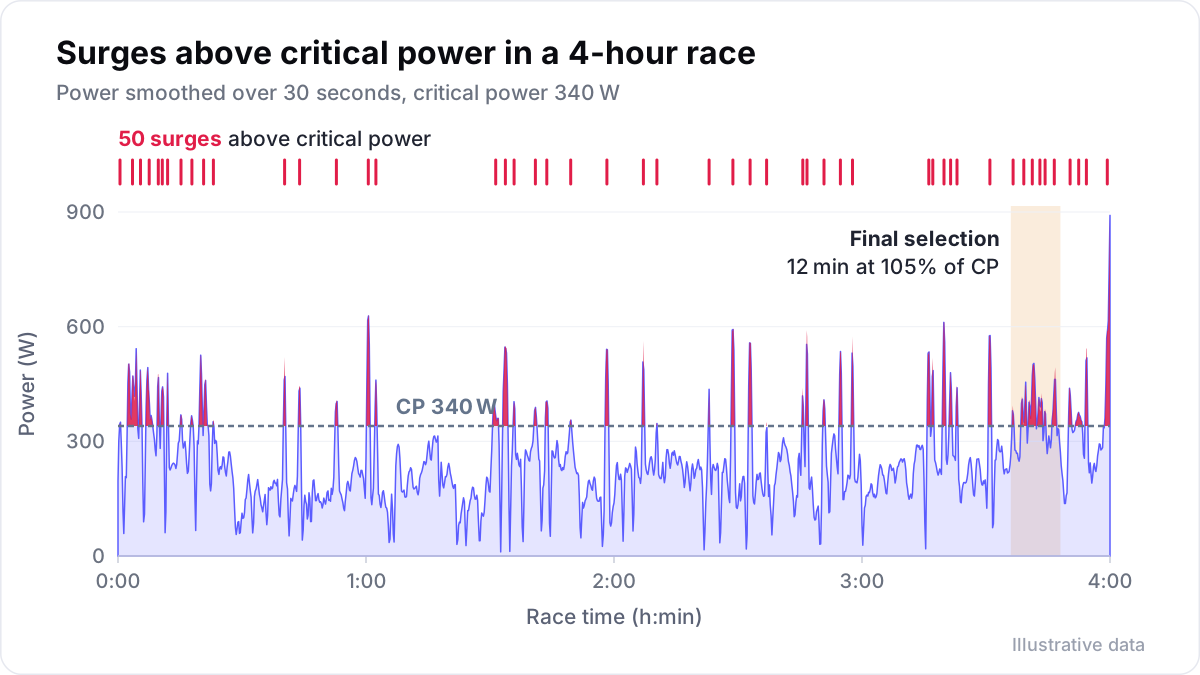
The guide to race analysis covers the method for any race. From a ride's FIT file, Velograph lists the laps you marked with each lap's time, average power and heart rate, and counts the surges above critical power and how low W′ went. Ride analysis is part of the free Rider plan; the riders page says what else it keeps. Over a season, cross racing also shows in your power curve, mostly from 5 seconds to a minute.
Further reading
- UCI Cycling Regulations, Part 5: Cyclo-cross, UCI, version of 1 July 2026.
- Pacing strategy and tactical positioning during cyclo-cross races, Bossi and colleagues, International Journal of Sports Physiology and Performance, 2018.
- Ground reaction forces and osteogenic index of the sport of cyclocross, Tolly, Chumanov and Brooks, Journal of Sports Sciences, 2014.
Velograph is not affiliated with, sponsored by or endorsed by any team, rider or company named in this article. Names are used only to refer to publicly reported work.