What makers' accuracy figures mean, how zero offset, temperature and one-sided meters shift your watts, and what a 2% error does to FTP, zones and load.
Power meter accuracy is good enough for training, as long as you use one meter the same way every time. Makers rate current meters at about ±1 to ±2%, and published tests find most close to that, though two meters rarely agree exactly. If you test and train on the same meter, a steady error moves your FTP, zones and training load together. Errors start to matter when you skip the zero offset, ride through a big change in temperature, rely on one leg or mix two meters.
How accurate are power meters?
Makers rate current power meters within about ±1 to ±2%, and independent tests find most meters close to that, with a few several per cent out. Two correctly set-up meters can still differ by a few per cent on one ride, so a small gap is normal.
Four makers' own figures, read on 30 October 2026, are below in alphabetical order. They are not test results, and the table is not a ranking.
| Maker and type | Stated accuracy | What the maker adds |
|---|---|---|
| Favero Assioma, pedals | ±1% | Temperature compensation from −10 to +60 °C |
| Quarq DZero, spider | ±1.5%, measuring both legs | Temperature compensation and an automatic zero during the ride |
| Stages, crank arm | ±1.5% in all conditions | Automatic temperature compensation |
| Wahoo KICKR, MOVE and CORE, smart trainers | ±1 to 2% | Newer models calibrate themselves |
Independent tests show a wider spread. In 2004, Andrew Gardner and colleagues found 19 factory-calibrated crank meters 2.3% high on average, with a wide spread between units. In 2017, Thomas Maier and colleagues found 54 meters 0.9% low on average, with 6 more than 5% out, as our guide to whether a power meter is worth it describes. Conditions matter too. In a one-rider test the same year, Anthony Bouillod and colleagues found two of three meters about 5% low at heavy intensity, and one 4.4% lower standing than seated.
Where a meter measures matters as well. In a 2025 test with 31 cyclists, a spider meter and power pedals recording the same efforts agreed within about 2 to 5 W on average. The smart trainer under them differed from the spider by 14 to 27 W on the seated steps.
What is zero offset on a power meter?
Zero offset is the reading a power meter takes with no force on the pedals, which it then subtracts from everything it measures, like taring kitchen scales. If the zero is wrong, every reading on the ride is off by the same amount of twisting force.
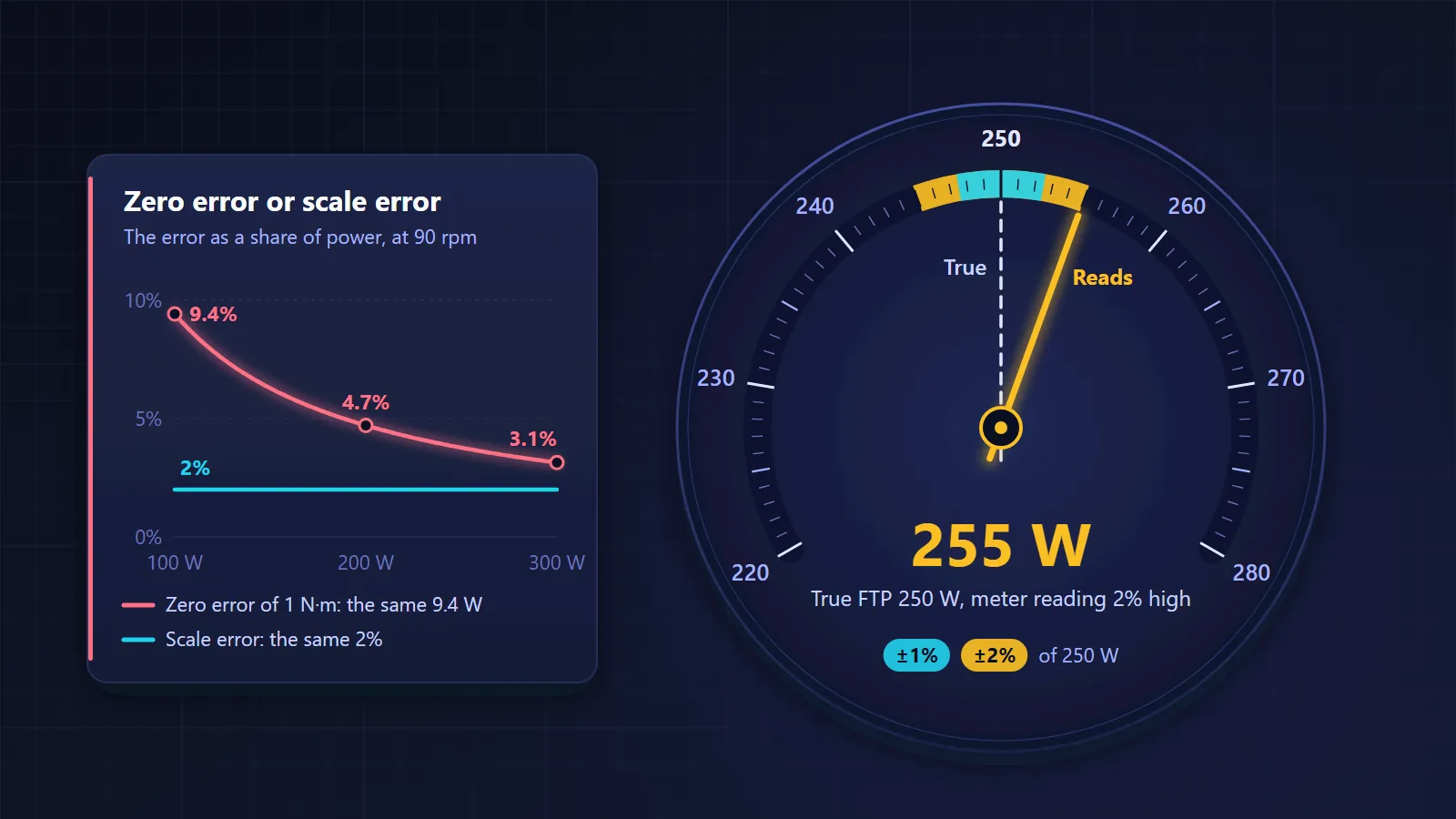
Power is the twisting force on the crank, called torque, multiplied by how fast the crank turns. So a zero error becomes a fixed number of watts at a given cadence. An error of 1 newton-metre (N·m) at 90 rpm adds or removes about 9.4 W, which matters most on easy rides:
| Uncorrected zero error, at 90 rpm | At 100 W | At 200 W | At 300 W |
|---|---|---|---|
| 0.5 N·m, about 4.7 W | 4.7% | 2.4% | 1.6% |
| 1 N·m, about 9.4 W | 9.4% | 4.7% | 3.1% |
On a meter that measures one leg and doubles it, the zero error is doubled too.
Makers' instructions differ, so follow your own. Stages recommends a zero reset before each ride and whenever the meter is fitted or removed, with the crank arms upright and nothing pressing on the pedals. It says the value should stay fairly steady from day to day. Quarq recommends a zero offset before every use, or MagicZero, which sets it while you ride on firmware version 10. Wahoo says its newer KICKR trainers calibrate themselves, while the KICKR v4 and earlier need it every two weeks or after a move.
What is the difference between calibration and zero offset?
Calibration sets a meter's scale, which is how many watts each bit of measured flex is worth, and it is done at the factory. Zero offset sets where the scale starts, and you do it before rides. A scale error is the same percentage at every power, while a zero error is the same number of watts.
Many bike computers call the zero offset "calibrate", which is why the two get mixed up. SRM says each of its meters gets its own scale when it is calibrated, and recommends recalibration after a change to or from a solid time-trial chainring. Quarq says its Bluetooth meters need no periodic factory calibration, because that scale stays stable. Meters on the bike measure the flex with strain gauges, as the first SRM did; our history of power meters tells that story.
Does temperature affect power meter accuracy?
Yes, temperature changes the reading of the strain gauges that measure the flex in a power meter, so a meter can drift as it warms or cools. The meters above correct for this automatically, but Stages says the zero value still shifts a little with temperature, so zeroing at riding temperature matters.
Stages explains that strain gauges are made of metal elements that react to even slight changes in temperature, and that its firmware corrects for this through the ride. Older meters show what happens without such correction. In Gardner's 2004 tests, readings changed by 5.2% on a crank meter and 8.4% on a hub meter between 8 °C and 21 °C, and the authors advised calibrating at the temperature of the ride.
In practice, if you carry the bike from a warm hallway into 5 °C air and your meter takes a manual zero, let it sit outside for a few minutes first. If it sets its own zero, follow your maker's advice on when it does so.
Is a dual-sided power meter more accurate?
Not always, but a dual-sided meter measures both legs instead of doubling one. A single-sided meter is right only when your legs share the work equally, and that share differs from rider to rider and can change with effort and cadence.
Smak, Neptune and Hull measured both legs of 11 riders at 260 W and 60 to 120 rpm. The difference between legs varied widely between riders, and only 4 of the 11 changed significantly with cadence, in different directions. In 10 competitive cyclists tested by Rodrigo Bini and Patria Hume, the gap between legs in peak torque at the crank grew with power, from 7% to 33%.
A single-sided meter is fine for training against yourself, as long as you stay with it. A dual-sided meter is the better choice when you want to see your left-right balance. An imbalance that comes with pain belongs with a physio.
How does a 2% error change your FTP, zones and load?
A 2% error changes nothing if you test and train on the same meter, because your FTP, zones and load all move with it. It matters when you mix meters. An FTP set on a meter reading 2% high makes intervals about 2% harder on an accurate meter, and their load reads about 4% low.
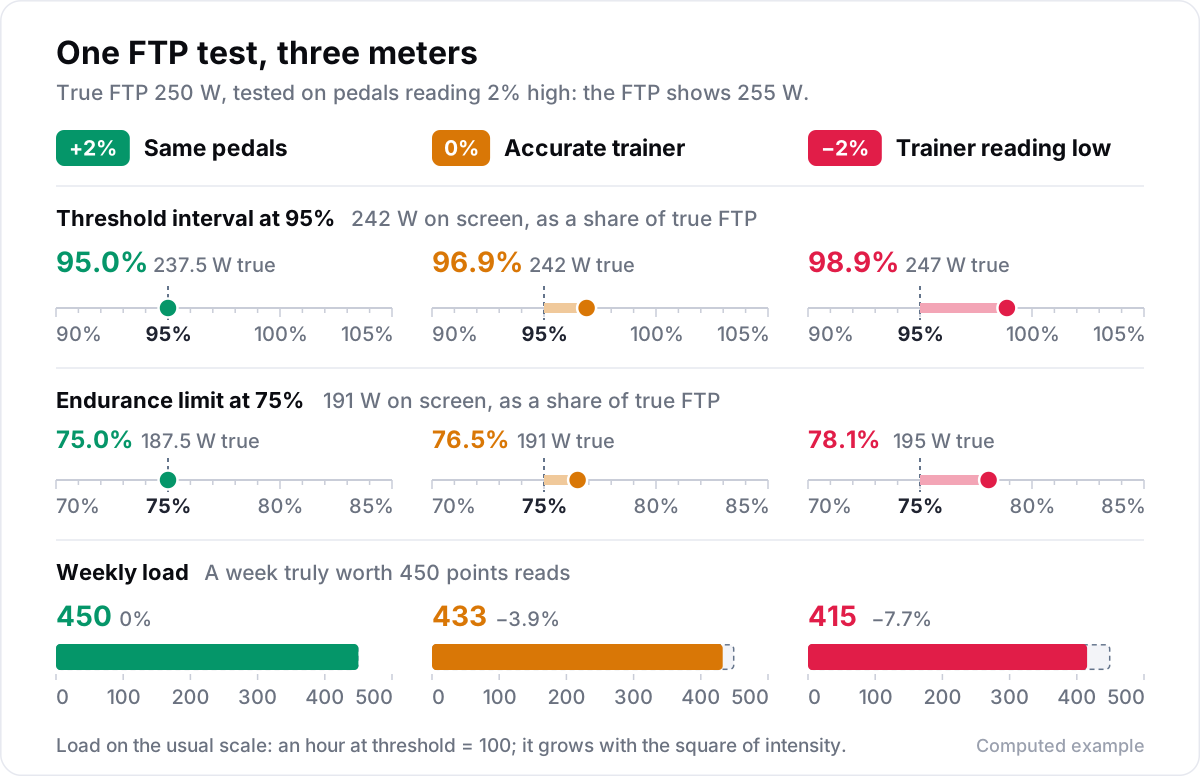
Take a rider whose true FTP of 250 W shows as 255 W on pedals reading 2% high. A threshold interval at 95% then has a target of 242 W, and the endurance limit of 75% is 191 W.
| Where the rider trains | 242 W target, share of true FTP | 191 W limit, share of true FTP | A week worth 450 points reads |
|---|---|---|---|
| The same pedals | 95% | 75% | 450 |
| An accurate trainer | 96.9% | 76.5% | 433 |
| A trainer reading 2% low | 98.9% | 78.1% | 415 |
The load falls about twice as much as the power, because on the usual scale, where an hour at threshold scores 100, load grows with the square of intensity. Our guide to training load, fitness, fatigue and form explains the scale. A retest on the accurate trainer would also show an FTP 2% lower, which looks like lost fitness. Three habits prevent this:
- Test on the meter you train with most. If your indoor and outdoor numbers differ, keep two FTPs; our guide to what FTP is explains the tests.
- Test again after a change of meter or crankset, and note the date.
- Compare power curves from one meter only. A new best on a new meter may be the meter, as our guide to the power curve warns.
A drift can show up without a test. Velograph's fitness review, for example, notes when endurance rides in the second half of a period give at least 3% less power for the same heart rate, and names a new power meter as one possible cause, along with fatigue, heat and illness.
How do you compare a smart trainer with power pedals?
Record one ride on both at once and compare steady blocks. Pair the pedals with your bike computer and the trainer with its app, ride five minutes at each of three steady powers, and compare the averages of each block without its first minute.
- Prepare. Warm up for 10 minutes, zero the pedals and calibrate the trainer if your model asks for it.
- Ride three steps. Ride 5 minutes each at about 60%, 80% and 100% of FTP, at a steady 90 rpm.
- Compare. Average minutes 2 to 5 of each step on both devices, then read the pattern:
| Pattern | Example, pedals and trainer | Likely cause |
|---|---|---|
| The same percentage at every step | 152 and 148 W, 203 and 198 W, 254 and 248 W: about 2.5% each time | A scale difference, or the chain's small loss before the trainer |
| The same watts at every step | 158 and 150 W, 208 and 200 W, 258 and 250 W: 8 W each time | A zero error on one device |
| A gap that changes from ride to ride | Calibration, temperature or a dirty drivetrain |
Then judge the gap against both tolerances. Wahoo's support page says a trainer's tolerance adds to the other meter's, so a ±1 to 2% trainer and a ±3% meter can differ by 4 or 5%. By that logic, devices rated ±1% and ±1.5% can differ by 2.5% and both be within specification. Wahoo adds that pedal and crank meters read a little higher than meters at the hub, after the drivetrain's loss.
Choose one device as the source of your zones, as our guide to indoor cycling training recommends. If you want your rides and power curve kept in one place, see what a rider gets on their own.
Further reading
- Accuracy of SRM and Power Tap power monitoring systems for bicycling, Gardner and colleagues, Medicine and Science in Sports and Exercise, 2004.
- Accuracy of cycling power meters against a mathematical model of treadmill cycling, Maier and colleagues, International Journal of Sports Medicine, 2017.
- Validity of the Quarq cycling power meter, Oteo-Gorostidi and colleagues, Sensors, 2025.
- The influence of pedaling rate on bilateral asymmetry in cycling, Smak, Neptune and Hull, Journal of Biomechanics, 1999.
Velograph is not affiliated with, sponsored by or endorsed by any team, rider or company named in this article. Names are used only to refer to publicly reported work.