What research shows about cycling after 40 and 50: what age changes, recovery, keeping intensity, strength and bone, protein, a sample week and your bike fit.
Masters cycling training should keep the hard sessions, give recovery more room and add strength work, rather than make every ride easier. In a review of masters athletes, endurance performance held until about 35, fell modestly until 50 or 60 and more steeply after that. The falls were tied most closely to a drop in how hard and how much the athletes trained. Below are the research, a sample week, and how to read your HRV, your form chart and your bike fit as the years pass.
What changes in your body as you get older?
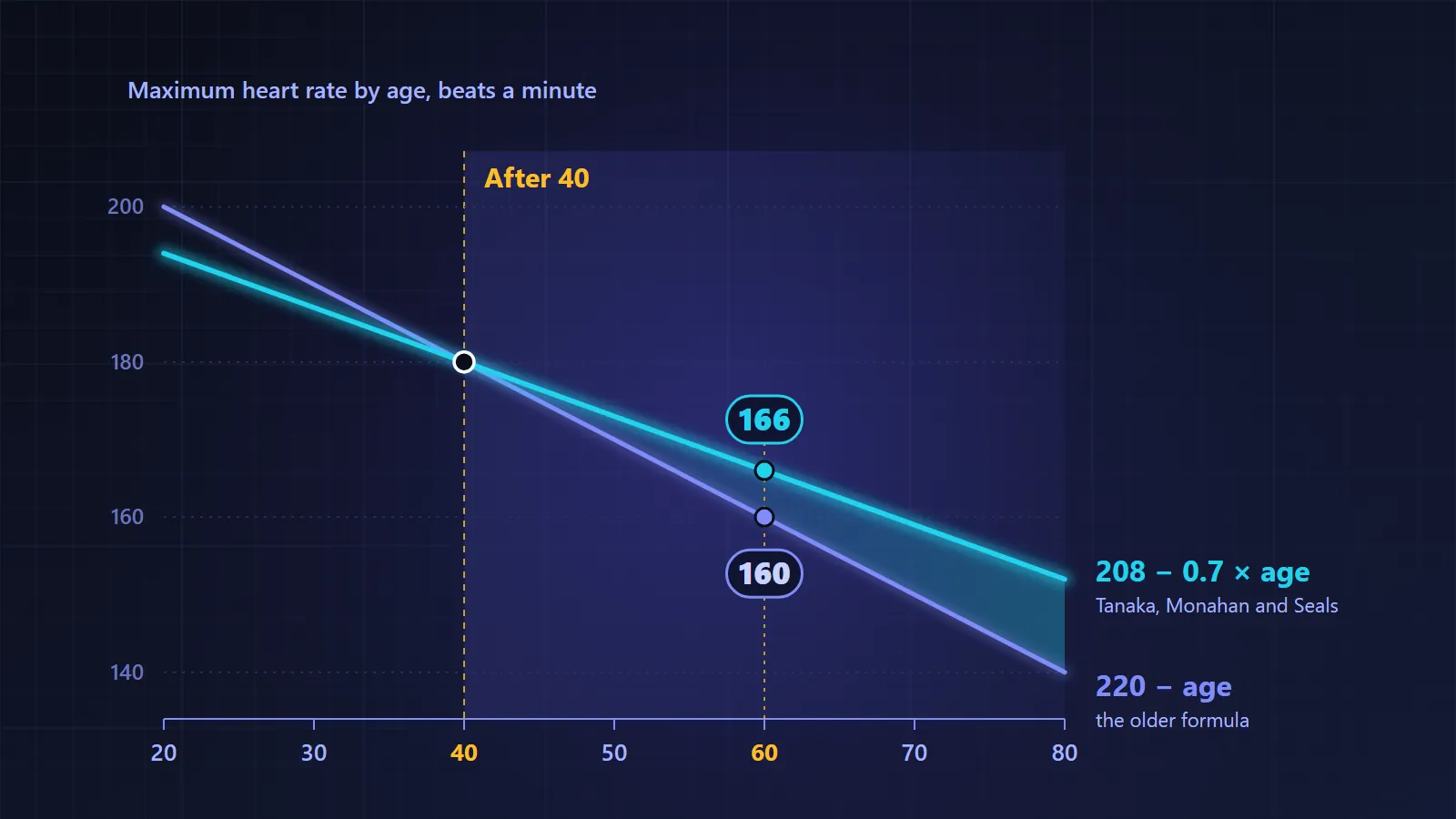
VO2max, the most oxygen your body can use, falls with age, and it is the clearest cause of slower endurance performance. Maximum heart rate falls by about 0.7 beats a minute each year. In endurance-trained adults, economy, the oxygen a steady effort costs, does not change with age, and riders of the same age differ widely.
Hirofumi Tanaka and Douglas Seals reviewed the research on masters athletes in 2008. They named the fall in VO2max as the most clear and consistent contributor to slower endurance performance. It comes from a heart that pumps less blood at maximum and muscles that take up a little less oxygen from it. Power at the lactate threshold falls too, but mostly because VO2max falls. As a share of VO2max, the threshold changes little. Economy was preserved in trained older athletes.
Age explains less about any one rider than you might expect. Pollock and colleagues tested 125 amateur cyclists aged 55 to 79. The men could ride 100 km in under 6 hours 30 minutes, and the women 60 km in under 5 hours 30 minutes. VO2max was the measure most closely linked to age, yet no measure could reliably tell a rider's age. The authors called the link between function and healthy ageing complex and likely highly individual.
So compare yourself with yourself. Your power curve and your test results against last year say more than any table for your age, and our guide to measuring cycling progress shows which numbers to trust.
Do older cyclists need more recovery?
Older cyclists may need more recovery in how they feel than in what their legs can do. In two small studies of well-trained cyclists, older riders recovered their performance as fast as younger ones, while the masters riders in the second study felt more tired and sore two days after hard intervals.
- Three days of time trials. Fell and colleagues had 9 veteran cyclists, aged 45 on average, and 9 young ones ride a 30-minute laboratory time trial on three days in a row. Both groups held their power across the three days, averaging about 3.5 W/kg together.
- Hard intervals. Borges and colleagues gave 9 masters cyclists, aged about 56, and 8 young cyclists six very hard 30-second efforts. Sprint power fell an hour later in both groups and came back at similar rates. 48 hours later, though, the masters riders reported more fatigue, more soreness and lower motivation, which the authors said could make it harder to keep training.
Take that feeling seriously, because it can stop you training, but check it against what your legs can do. Put an easy day after every hard one. If three loading weeks in a row leave you flat, use two loading weeks and one easier week, as our annual training plan suggests for riders who recover slowly.
Should masters cyclists still do high-intensity training?
Yes, hard sessions are worth keeping if your health allows them. Tanaka and Seals concluded that the fall in performance and VO2max with age was tied most closely to lower training intensity and volume. Keep one or two hard sessions a week and make most of the rest easy.
Our guide to polarised training shows how to split easy and hard riding on 6 to 10 hours a week.
Heart rate zones need care after 40. A meta-analysis by Tanaka, Monahan and Seals gave maximum heart rate as 208 minus 0.7 times age. It found that the older formula, 220 minus age, underestimates it in older adults. At 60, the two formulas give 166 and 160 beats a minute. Both are averages, and individual riders differ from them, so set your zones from a threshold test, as our guide to cycling training zones describes.
Before hard intervals or heavy lifting, talk to your doctor if you have a heart condition or another long-term health condition, or if you get chest pain, dizziness or unusual breathlessness when you ride.
Is strength training worth it for cyclists over 50?
Strength training is worth it for cyclists over 50. In one small study, masters endurance athletes gained more strength from three weeks of leg training than young athletes did, and became more efficient on the bike. Bone is a separate question, because road cycling on its own appears to do little for it.
In that study, by Louis and colleagues, the strength of the thigh muscles that straighten the knee rose by 17.8% in the masters group, against 5.9% in the young group. Our guide to strength training for cyclists has the season plan, the lifts and how to fit them around riding.
A 2012 systematic review of 31 studies, by Olmedillas and colleagues, found low bone mineral density in key regions such as the lumbar spine in adult road cyclists who train regularly. It concluded that road cycling does not appear to give bone any significant benefit, possibly because of long hours in a weight-supported position. Mountain biking, or combining cycling with other sports, could reduce the effect, so a second sport deserves a place in an older rider's week.
How much protein do older cyclists need?
Older muscles may need more protein at a time. In a 2015 pooled analysis of healthy men, muscle building after a single protein dose levelled off at about 0.40 g of protein per kilo of body weight in older men, aged about 71. In young men it levelled off at 0.24 g.
For a 75 kg rider, that is about 30 g of protein in a meal against 18 g. The authors concluded that older men need a greater relative protein intake in a single meal to get the full response. The study was in men only. For an eating plan built around your own needs, and any medical condition, talk to a registered sports dietitian.
What does a training week look like for a masters cyclist?
A good masters week has one or two hard sessions with easy days around them, one long ride, one or two strength sessions and at least one full rest day. The example below has 7 hours of riding and 45 minutes in the gym, for a winter build.
| Day | Session | Time |
|---|---|---|
| Monday | Rest, or a walk | |
| Tuesday | VO2max 5 × 4 min at 108 to 118% of FTP, 4 minutes easy between | 1 h 15 min |
| Wednesday | Gym: squat, single-leg leg press, Romanian deadlift, calf raise | 45 min |
| Thursday | Endurance in zone 2 | 1 h 15 min |
| Friday | Rest | |
| Saturday | Long ride with 3 × 15 minutes of tempo | 3 h |
| Sunday | Easy, or a steady group ride | 1 h 30 min |
In the racing season, drop to one gym session a week and add a second interval day only if you recover well from the first. After a break from riding, start lower than this; our guide to how fast you lose fitness shows a four-week way back.
How should older cyclists read HRV and the form chart?
Compare your HRV only with your own normal range, never with a table for your age or a younger friend's number. Trust the 7-day average more than one morning. Read the form chart as a record of training load, and check it against how you feel and what your legs can do.
Heart rate variability, the small changes in time between heartbeats, is lower at older ages on average. Voss and colleagues studied 1,906 healthy adults aged 25 to 74 in Germany. Their average rMSSD, a common HRV measure, was about 40 ms at 25 to 34 and about 19 ms at 65 to 74. A low number for your age therefore tells you little. A drop from your own normal tells you more.
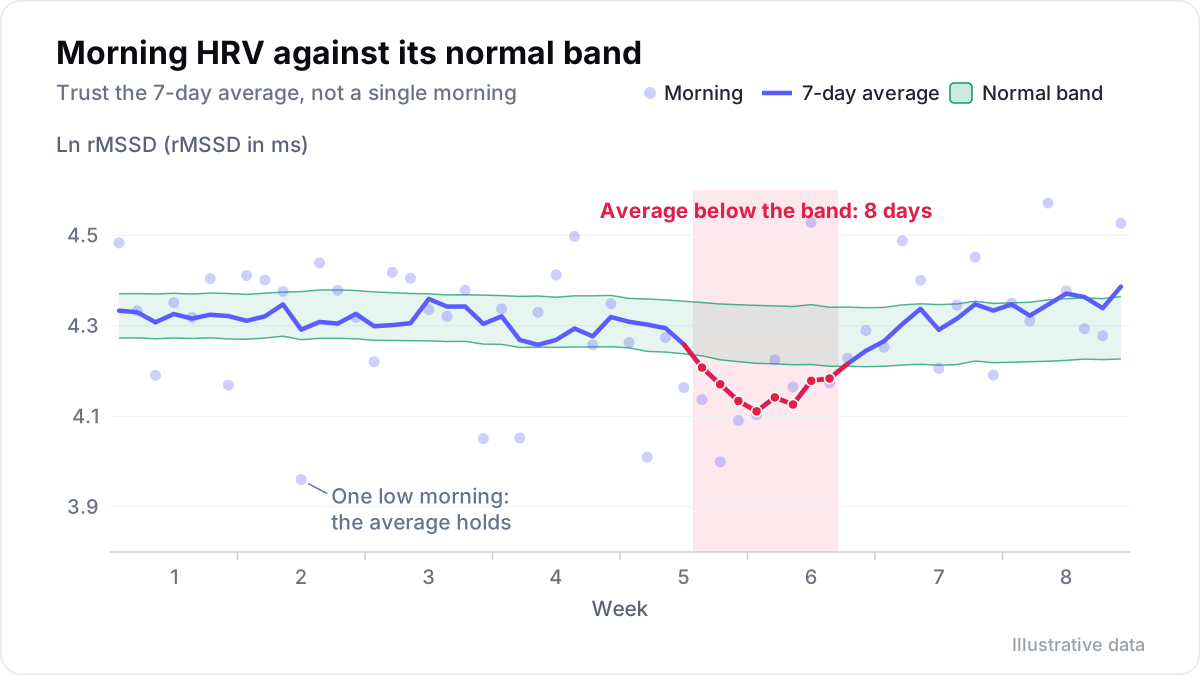
Our guide to HRV training explains how to take a clean morning reading. In Velograph, your own home page shows your morning HRV and resting heart rate, read from intervals.icu, against your own normal range.
The form chart counts training load and knows nothing about your age; the guide to fitness, fatigue and form explains its three lines. When you feel more tired than the chart suggests, ride the warm-up of your planned session. If your power there is normal, go ahead. If it is down as well, make the day easy.
When does your bike fit need a look as you get older?
Look at your fit when your body changes: after an injury or an operation, when your back, hips or neck feel stiffer than they did, or when you stop using the drops. Often the answer is a higher or closer handlebar, changed in small steps and written down with the reason.
- Neck, shoulders and hands. If they ache or go numb after two hours, the front may be too low or too far away.
- The drops. If you never use them, the handlebar drop can often come up with spacers or a different stem.
- Hips. If they rock on the saddle, it may now be too high for your flexibility.
- Knees. For new discomfort at the knee or hip, check saddle height and cleats before anything else.
Change one thing at a time, by about 10 mm, and ride it for a week or two. A bike fitter can do it with you and measure each step. Keep every change with its date, because the next fitter starts from it; our article on bike fit history explains why. In Velograph, every fit you or your fitter records stays in the free Rider plan, and the riders page lists what else a rider keeps there.
Further reading
- Endurance exercise performance in Masters athletes: age-associated changes and underlying physiological mechanisms, Tanaka and Seals, Journal of Physiology, 2008.
- An investigation into the relationship between age and physiological function in highly active older adults, Pollock and colleagues, Journal of Physiology, 2015.
- Age-related changes in physical and perceptual markers of recovery following high-intensity interval cycle exercise, Borges and colleagues, Experimental Aging Research, 2018.
- Cycling and bone health: a systematic review, Olmedillas and colleagues, BMC Medicine, 2012.
- Protein ingestion to stimulate myofibrillar protein synthesis requires greater relative protein intakes in healthy older versus younger men, Moore and colleagues, Journals of Gerontology Series A, 2015.
Velograph is not affiliated with, sponsored by or endorsed by any team, rider or company named in this article. Names are used only to refer to publicly reported work.