What research shows for one, two and four weeks off the bike, after illness and in the off-season, what comes back first, and how to return to training.
How fast do you lose fitness when you stop riding? For trained endurance athletes who stop completely, VO2max falls by about 7% in three weeks, and young top-level road cyclists lost about 9% of it in five weeks. Power at threshold falls faster than that, while some adaptations, such as the extra capillaries in your leg muscles, hardly fade at all. A little training keeps most of it: in a 2021 review of studies in general populations, two sessions a week at the usual intensity held endurance for up to 15 weeks.
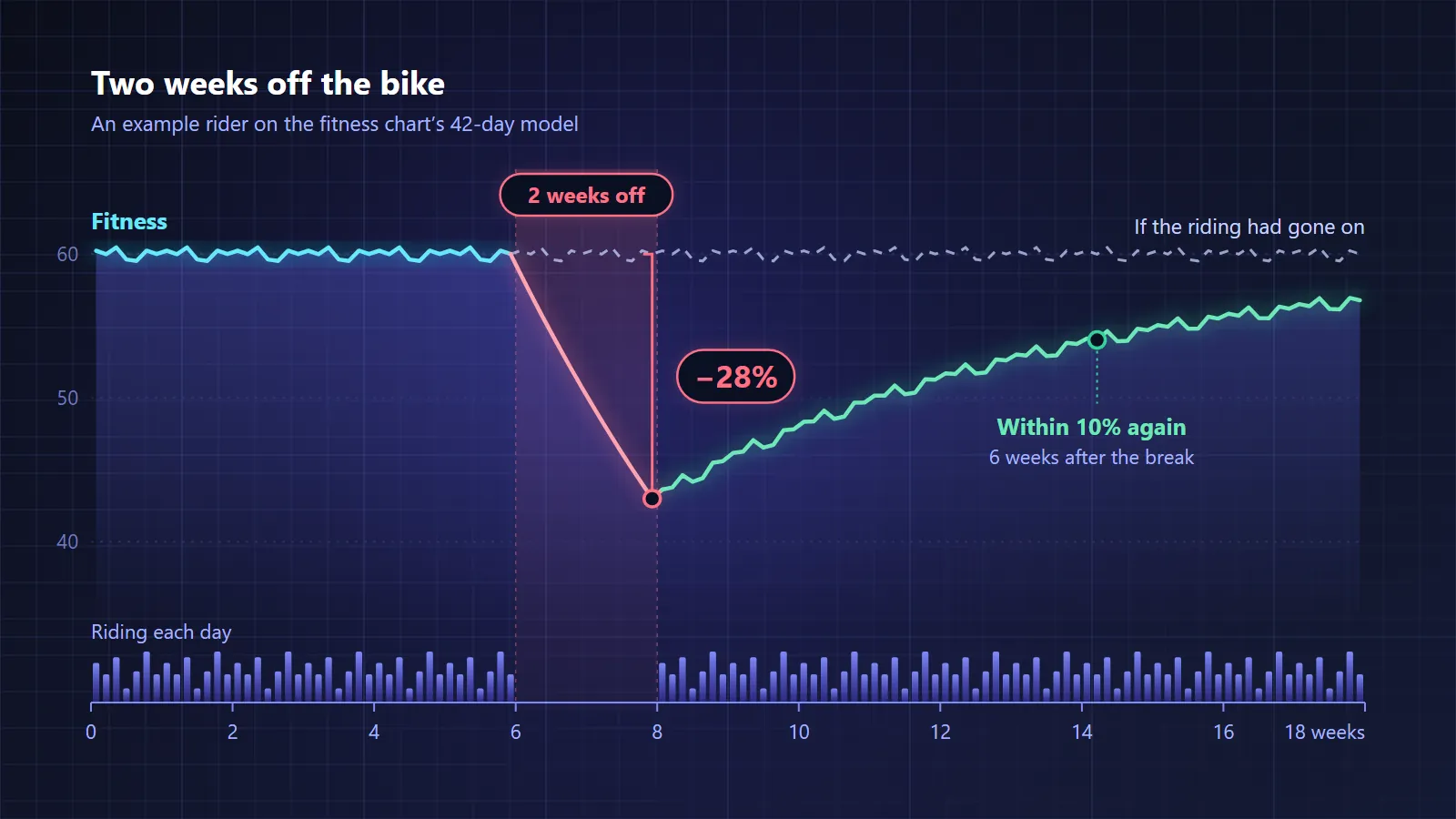
The fitness line on a training app's chart falls much faster than this. It is a running average of your training load, not a measure of what your body can do.
How fast do you lose cycling fitness?
Trained endurance athletes who stopped training lost about 7% of their VO2max in three weeks, and young top-level road cyclists lost about 9% in five weeks, with power at their lactate thresholds down 12 to 13%. In one study, VO2max levelled off after about two months.
Mujika and Padilla reviewed the research in 2000 and split detraining at four weeks. Within four weeks, highly trained athletes lose VO2max and blood volume quickly. The heart pumps less blood with each beat, and heart rate rises but does not fully make up for it. People who started training only recently lose less in the short term. After four weeks, an athlete's VO2max keeps falling but stays above that of people who never trained, while a recent starter's gain disappears.
The clearest time course is still a 1984 study by Coyle and colleagues of seven endurance-trained people who stopped training:
- VO2max fell 7% in the first 21 days, then levelled off by day 56 at 16% below its trained value.
- Stroke volume, the blood pumped with each beat, fell early to the level of sedentary people.
- Muscle enzymes that use oxygen to release energy fell quickly, half of their loss coming in about 12 days, then settled 50% above sedentary levels.
- Capillaries in the muscles did not decline at all and stayed 50% above sedentary levels.
After 84 days, the former athletes' VO2max was 50.8 ml per kilo per minute, still above the 43.3 of people who had never trained.
What happens in one, two and four weeks off the bike?
The earliest measurements in these studies came after 12 days, so a single week off is the least studied part. By three weeks, VO2max is clearly lower. By four to five weeks of no training, power at the lactate thresholds has fallen by more than maximal power, and in one study body weight went up.
A short, deliberate cut in training is not the same as stopping. Two weeks of much lighter training before a race improves performance on average, as the taper section of our guide to fitness, fatigue and form shows, so what you can do on the bike does not vanish in days.
| Time off | What studies found | Study |
|---|---|---|
| About 3 weeks, no training | VO2max about 7% lower in trained athletes | Coyle and colleagues, 1984 |
| 4 weeks of under 2 hours a week | Plasma volume 6% lower, VO2max unchanged | Pedlar and colleagues, 2018 |
| 5 weeks, no training | VO2max 9% lower, power at lactate thresholds 12 to 13% lower, body mass 2.3% higher | Maldonado-Martín and colleagues, 2017 |
| 8 weeks, no training | VO2max levelled off at 16% below its trained value | Coyle and colleagues, 1984 |
What does a break do to your fitness chart?
On a fitness chart, a complete break lowers the fitness line by about 15% in one week, 28% in two and 49% in four, because the line is a running average of your training load. VO2max and power measured in studies fall far more slowly, so the chart overstates what a short break costs your body.
The fitness line averages the last six weeks or so of training load, and fatigue averages about the last week. Stop training and both decay towards zero every day. For a rider whose fitness and fatigue lines are both at 60:
| Days off | Fitness line | Fatigue line | Form |
|---|---|---|---|
| 7 | 51 (15% lower) | 22 | +29 |
| 14 | 43 (28% lower) | 8 | +35 |
| 28 | 31 (49% lower) | 1 | +30 |
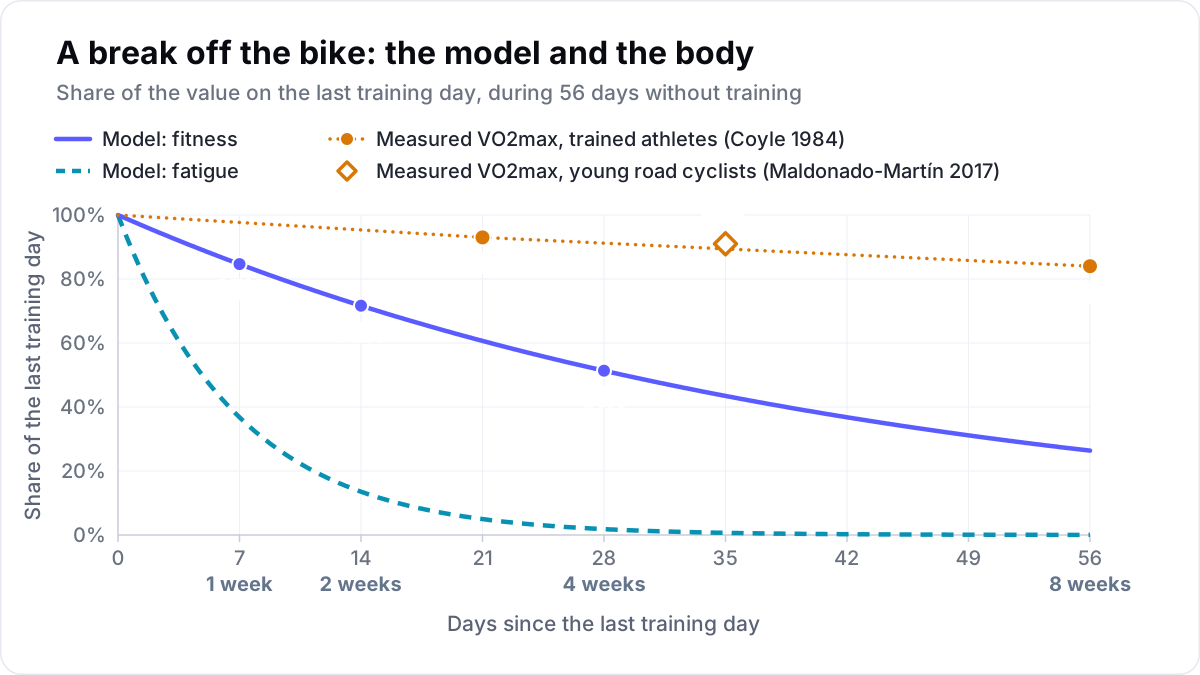
The chart counts how much you trained, not what you can do. A rider who misses two weeks has not lost 28% of their FTP; they have stopped adding load. Use your power curve and an occasional test to see what changed. Velograph's fitness review points out any run of six or more days without training and asks whether the break was planned.
How much training keeps your fitness?
Keep the intensity and cut the rest. In a 2021 review, endurance held for up to 15 weeks with as few as two sessions a week, or with sessions a third to two thirds shorter, as long as the intensity stayed the same. Those studies were in general populations, not trained cyclists.
Barry Spiering, Iñigo Mujika and colleagues wrote that review. Strength held even longer in younger adults, for up to 32 weeks on one session a week. Mujika and Padilla's earlier review reached the same rule for athletes: keep the intensity, reduce how often you train only moderately, and cut the volume substantially.
Two studies show what lighter training does in practice:
- Recreational runners. Charles Pedlar and colleagues followed 21 runners who had trained about 7 hours a week for a marathon, then kept to under 2 hours a week for 8 weeks. Their VO2max did not change, but time to exhaustion on a treadmill fell from 17.8 to 17.1 minutes and plasma volume fell 6% in the first 4 weeks.
- Professional cyclists. Xabier Muriel and colleagues followed 18 professionals through a 7-week COVID-19 lockdown, riding indoors. Their volume fell by 34%, to about 12 hours a week, with 2 hours above threshold. Every rider's best 5 and 20-minute power fell, by between 1% and 19%.
So a little training keeps most of your fitness, but not the top end you need to race at full strength. When you have little time, a week like this keeps most of it:
- One hard session: 45 to 60 minutes with 3 × 5 minutes hard or 2 × 10 minutes at threshold. Our turbo trainer workouts suit a short evening.
- One longer easy ride: 60 to 120 minutes in zone 2.
- One strength session, if you already do one, as in the keep phase of our guide to strength training for cyclists.
If you cannot ride, Mujika and Padilla note that cross-training helps keep adaptations, most of all in a sport close to your own.
Does the off-season make you lose fitness?
A complete off-season stop does. Young top-level road cyclists who stopped for five weeks lost about 9% of their VO2max and 12 to 13% of their power at their lactate thresholds, and their body mass rose by 2.3%. The authors suggested a shorter stop, or reduced training in its place.
Sara Maldonado-Martín and colleagues tested 10 riders, aged 20 on average, who usually trained 18 to 22 hours a week. Their maximal power in a ramp test fell from 396 to 370 W, or from 5.8 to 5.3 W/kg. Losses were larger per kilo because body mass rose by about 1.7 kg, and power at threshold fell more than maximal power did.
A break after a long season is still worth taking, for the head as much as the legs. A plan that keeps it short:
- One to two weeks: no structured training. Walk, swim or ride for fun if you like.
- Two to four weeks: three or four easy sessions a week, any sport, with a few short efforts.
- Then: start the base phase of your annual training plan.
How do you come back after illness or a break?
Come back with easy rides and build hours before intensity; as a cautious guide, take about as many weeks to return to full training as you were away. After an illness, start once you feel well. If you had a fever, chest pain or breathlessness, or were ill for over a week, see a doctor before hard training.
Some things return fast. In a 1991 study, a single session of eight 4-minute efforts at 85% of VO2max raised plasma volume by about 10% within 24 hours. Capillaries, as Coyle found, hardly left. Less is known about how fast the rest returns, so let the numbers guide you:
| Time away | Week 1 back | Week 2 | Week 3 | Week 4 |
|---|---|---|---|---|
| About 1 week | A normal week without the hardest session | Normal | Normal | Normal |
| 2 weeks | About 60% of usual hours, all easy | About 80%, short efforts once | Normal hours, one interval session | Normal |
| 4 weeks or more | About 50%, all easy | 60 to 70%, some tempo | About 80%, one interval session | Normal hours, then retest |
After an illness, add an extra easy week at the start. Watch your morning resting heart rate or heart rate variability: if either stays well away from your normal range, keep the day easy. Retest your threshold after three or four weeks back, as our guide to what FTP is describes, before you set new interval targets. Your bikes, fits and rides, with ride analysis, stay in the free Rider plan while you are away; see what a rider gets on their own.
Further reading
- Detraining: loss of training-induced physiological and performance adaptations. Part I, Mujika and Padilla, Sports Medicine, 2000.
- Detraining: loss of training-induced physiological and performance adaptations. Part II, Mujika and Padilla, Sports Medicine, 2000.
- Time course of loss of adaptations after stopping prolonged intense endurance training, Coyle and colleagues, Journal of Applied Physiology, 1984.
- Effects of long-term training cessation in young top-level road cyclists, Maldonado-Martín and colleagues, Journal of Sports Sciences, 2017.
- Maintaining physical performance: the minimal dose of exercise needed to preserve endurance and strength over time, Spiering and colleagues, Journal of Strength and Conditioning Research, 2021.
Velograph is not affiliated with, sponsored by or endorsed by any team, rider or company named in this article. Names are used only to refer to publicly reported work.