What studies of WorldTour teams show about pros' hours, easy riding and intensity, and which of their habits a rider on 8 hours a week can copy.
To train like a pro cyclist on an amateur's time, copy the shape of their training, not its size. In a 2026 study of one WorldTour team, the men trained about 19 hours a week and the women about 17 in the ten weeks before their first race. By power, most of that time was easy, a quarter to a third was moderate and less than a tenth was hard, and the last week was lighter. A rider with 8 hours can copy that pyramid, the easier week and the slow growth over seasons, but not the hours or the racing.
How many hours do pro cyclists train?
In the ten weeks before their first race, the WorldTour men in a 2026 study trained about 19 hours a week and the women about 17 hours, in about six sessions a week. Their busiest week, the ninth, averaged 22.5 hours for the men and 20.1 hours for the women.
Manuel Mateo-March and colleagues analysed the power and heart-rate files of 16 men and 16 women from one WorldTour team, from October to December 2018. Strength training and other work off the bike were not counted, so these are hours on the bike. An older study of four professional men by Alan Metcalfe and colleagues followed their whole season up to the 2015 world team time trial championships.
| Riders | Period | Hours a week |
|---|---|---|
| 16 WorldTour men (2026 study) | 10 weeks before the first race | 19.1 |
| 16 WorldTour women (2026 study) | 10 weeks before the first race | 16.7 |
| 4 professional men (2017 study) | October to January | about 14 |
| 4 professional men (2017 study) | February to May | about 20 |
| A busy amateur | A normal week | 8 |
The 2017 figures include race days and are our arithmetic from the study's totals: 240.5 hours over the four months from October to January, and 337.5 hours from February to May. An 8-hour week is about 42% of the WorldTour men's 19.1 hours, so the amateur has less than half the time to fill.
Do pro cyclists mostly train easy?
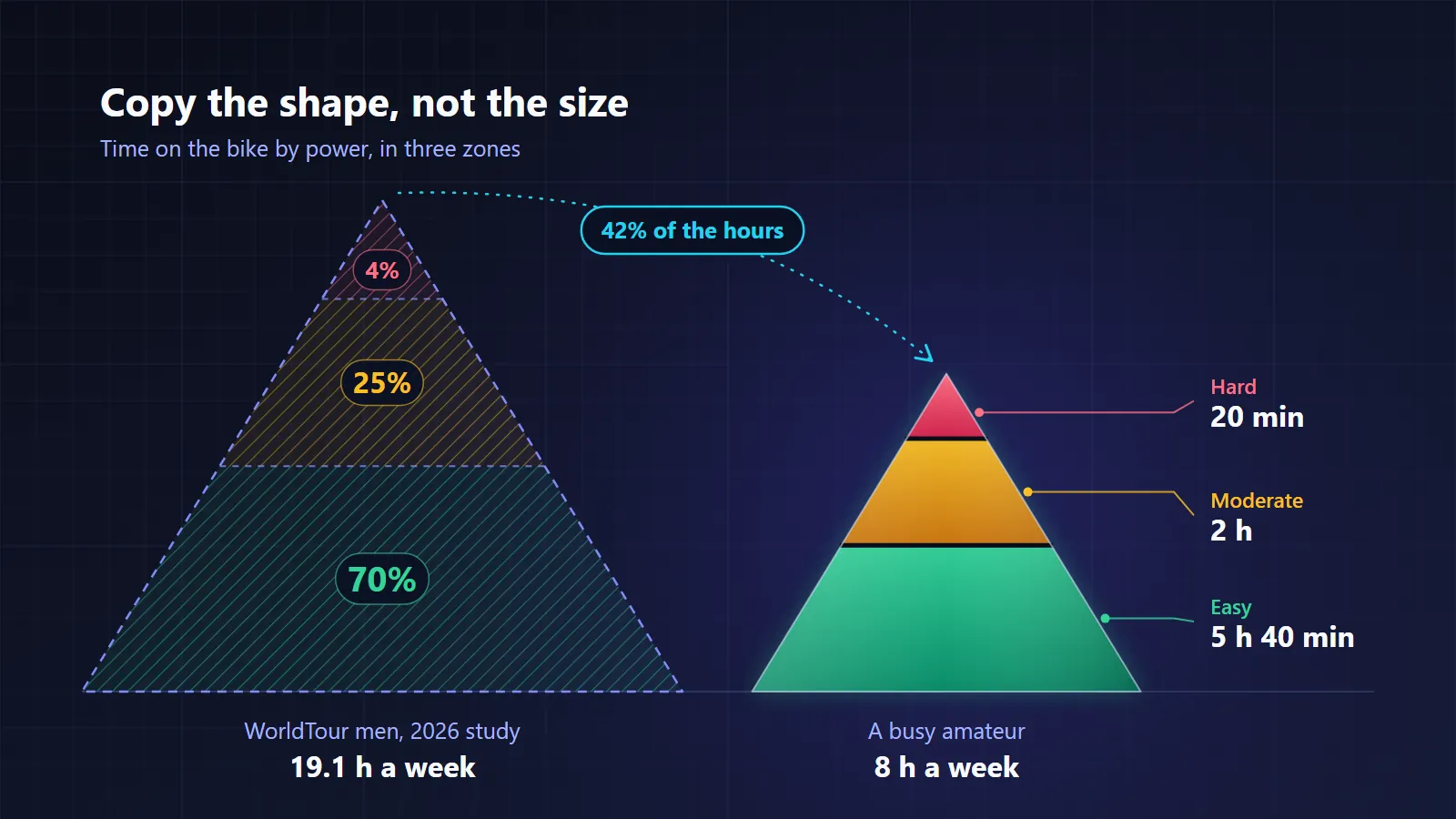
Yes, most of a professional's training is easy. By power, the WorldTour men in the 2026 study spent 70% of their time in the easiest of three zones, 25% in the middle zone and 4% in the hardest. The women spent 60%, 33% and 7%, so both followed a pyramid.
The study set the zones by critical power, the level a rider's best-power curve flattens towards in long efforts. Critical power and FTP are usually close together, and our comparison of critical power and FTP shows how far apart they can be for one rider. Easy meant below 70% of critical power, the middle ran from 70% up to critical power, and hard meant above it. The middle zone starts low, so it holds brisk endurance riding as well as tempo and threshold work.
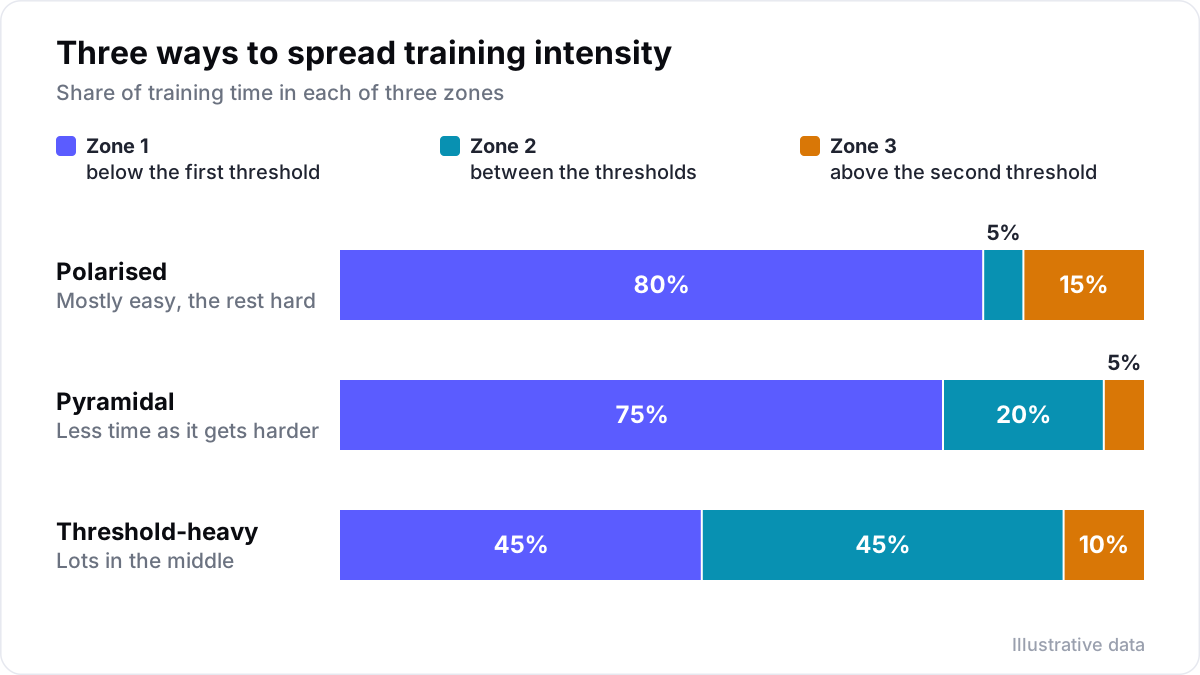
By power, the men's 70%, 25% and 4% are closest to the pyramid in the chart. Every rider in the study followed a pyramid by power, except one woman who spent more than half her time in the middle zone. None was polarised.
By heart rate, the same men had less time in the middle: 79% of their time was easy, 12% in the middle and 9% hard, still a pyramid. Heart rate lags behind short efforts and drifts on long rides, so the two measures split the same training differently. The debate between the two patterns is covered in our guides to polarised training and zone 2 training. This study shows what one team did, not which split is best for you.
Do women pros train differently from men?
In the two studies that compared them, professional women trained fewer hours than the men but at a higher share of intensity, so their total training load came out much the same. The authors of the earlier study suggested that women make up for their lower volume with higher intensity.
Teun van Erp, Dajo Sanders and Jos de Koning looked at four years of training by 20 men and 10 women professionals. The men rode more distance, more hours and more work, and spent more time in the two lowest zones. Total training load differed only trivially, while the load for each kilometre was moderately higher for the women. In the 2026 study, the women's load scores also matched the men's despite 2.4 fewer hours a week. Its authors concluded that the men's training leaned on volume and the women's on relative intensity. For an amateur with few hours, that is a useful pattern to know: when time is short, intensity makes up more of the load.
How do pros train before their first race?
They ease off in the final week. In the 2026 study, the men's training fell from 22.5 hours in the ninth week to 17.7 hours in the tenth, the last before racing, about 21% less. The women's fell from 20.1 to 11.2 hours, about 44% less.
The weeks before that are planned in blocks. On its own website in 2026, the WorldTour team Decathlon CMA CGM said its training blocks often last two to three weeks and are adjusted from the riders' power data. The team also holds a weekly meeting with its sports directors to adapt plans after falls, injuries, illness or a dip in form. These habits fit an amateur's year: a block of two or three building weeks, an easier week before an event, and a weekly look at what happened, as in our guide to the self-coached cyclist.
How do pro cyclists build up over the years?
Pro cyclists build up over seasons rather than weeks, if the published cases are a guide. In a six-year case study of one rider from age 18 to 23, who finished in the top ten of both the Tour de France and the Vuelta a España, yearly training time rose by 79% and training load by 83%.
Julien Pinot and Frédéric Grappe published the case in 2015, and our article on data-driven training describes how they measured it. The point for an amateur is the pace of growth. Spread evenly over the five steps from the first season to the sixth, a 79% rise is about 12% a year. For a rider on 8 hours a week, 12% more next season is about 9 hours.
Decathlon CMA CGM's head coach, Stephen Barrett, made the same point about the team's young riders. "Going from 500 to 1,000 hours of cycling per year can cause damage," he said on the team's website. A thousand hours a year is about 19 hours a week, the WorldTour men's figure above.
What can an amateur copy from pro training?
Copy the shape of pro training, which means mostly easy riding, a steady share of moderate work, a little hard work, an easier week before an event and growth over seasons rather than weeks. Leave the hours, the race days and the training camps to the professionals.
What does a pro-style 8-hour week look like?
Split 8 hours as the WorldTour men in the 2026 study did by power, and you get about 5 hours 40 minutes easy, 2 hours moderate and 20 minutes hard. Here is one way to ride it, with an easy or rest day before each harder session.
| Day | Session | Easy | Moderate | Hard |
|---|---|---|---|---|
| Monday | Rest | |||
| Tuesday | 1 h 15 min: warm-up, then 5 × 4 min at 106 to 120% of FTP with 3 min easy between | 55 min | 20 min | |
| Wednesday | 1 h easy | 1 h | ||
| Thursday | 1 h 15 min: 2 × 20 min of sweet spot, 88 to 93% of FTP | 35 min | 40 min | |
| Friday | Rest | |||
| Saturday | 3 h endurance with 4 × 15 min of tempo, 76 to 90% of FTP | 2 h | 1 h | |
| Sunday | 1 h 30 min easy with 20 min of tempo | 1 h 10 min | 20 min | |
| Total | 8 h | 5 h 40 min | 2 h | 20 min |
Warm-ups, recoveries and cool-downs count as easy time. If the moderate sessions leave you flat for Tuesday, move some of that time into easy riding, which turns the pyramid towards a polarised week.
Easy hours are not wasted hours. Joseph Spragg, Peter Leo and Jeroen Swart followed 30 professional riders under 23 through a season. More training below the first threshold went with bigger gains in 2-minute power late in rides, after 2,000 kJ of work, or nearly three hours at 200 W. A shift towards a more polarised split went with better late 12-minute power. These are links, not proof of cause, but they suggest the easy base supports power late in a ride, which is durability.
Fuel the long Saturday ride and protect your sleep. Our guide to carbohydrate on the bike covers fuelling, and a registered sports dietitian can work out the amounts that suit you.
What should an amateur not copy from pros?
Do not copy the hours, the racing or a pro's hard sessions squeezed into fewer days. A professional week rests on years of build-up and a life arranged around recovery, and racing asks more than training: in the 2017 study, the riders averaged 236 W in races and 197 W in training.
- The hours. Doubling your hours quickly is the jump Barrett warned about. Add time over seasons.
- The racing load. Racing asks more than training, as the 2017 figures show, and our article on pro cyclist power output describes what races ask for.
- A pro's hard days without their easy ones. Copying three pro sessions into a 4-hour week turns a pyramid into a week of hard days.
- The staff. Teams have analysts, coaches and sports directors around each rider, as how pro cycling teams use data shows. You have yourself and maybe a coach, so keep the plan simple enough to review in ten minutes a week.
To see whether your easy base is working, compare your best efforts late in long rides across a season. Velograph, for example, shows on each ride with power how much of your fresh 5-second, 1-, 5- and 20-minute power was left after each amount of work, once your weight is entered. The free Rider plan keeps your rides with ride analysis, with no end date; see what a rider gets on their own.
Further reading
- Training characteristics of male and female World Tour professional road cyclists before the competitive phase, Mateo-March and colleagues, Biology of Sport, 2026.
- Training characteristics of male and female professional road cyclists: a 4-year retrospective analysis, van Erp, Sanders and de Koning, International Journal of Sports Physiology and Performance, 2020.
- The relationship between training characteristics and durability in professional cyclists across a competitive season, Spragg, Leo and Swart, European Journal of Sport Science, 2023.
- A six-year monitoring case study of a top-10 cycling Grand Tour finisher, Pinot and Grappe, Journal of Sports Sciences, 2015.
- What are the secrets of the performance unit for optimizing riders training, Decathlon CMA CGM Team, 2026.
Velograph is not affiliated with, sponsored by or endorsed by any team, rider or company named in this article. Names are used only to refer to publicly reported work.