Who gains from a power meter and who does not, what it changes in training, the alternatives, how accurate meters are, and a plan for your first month.
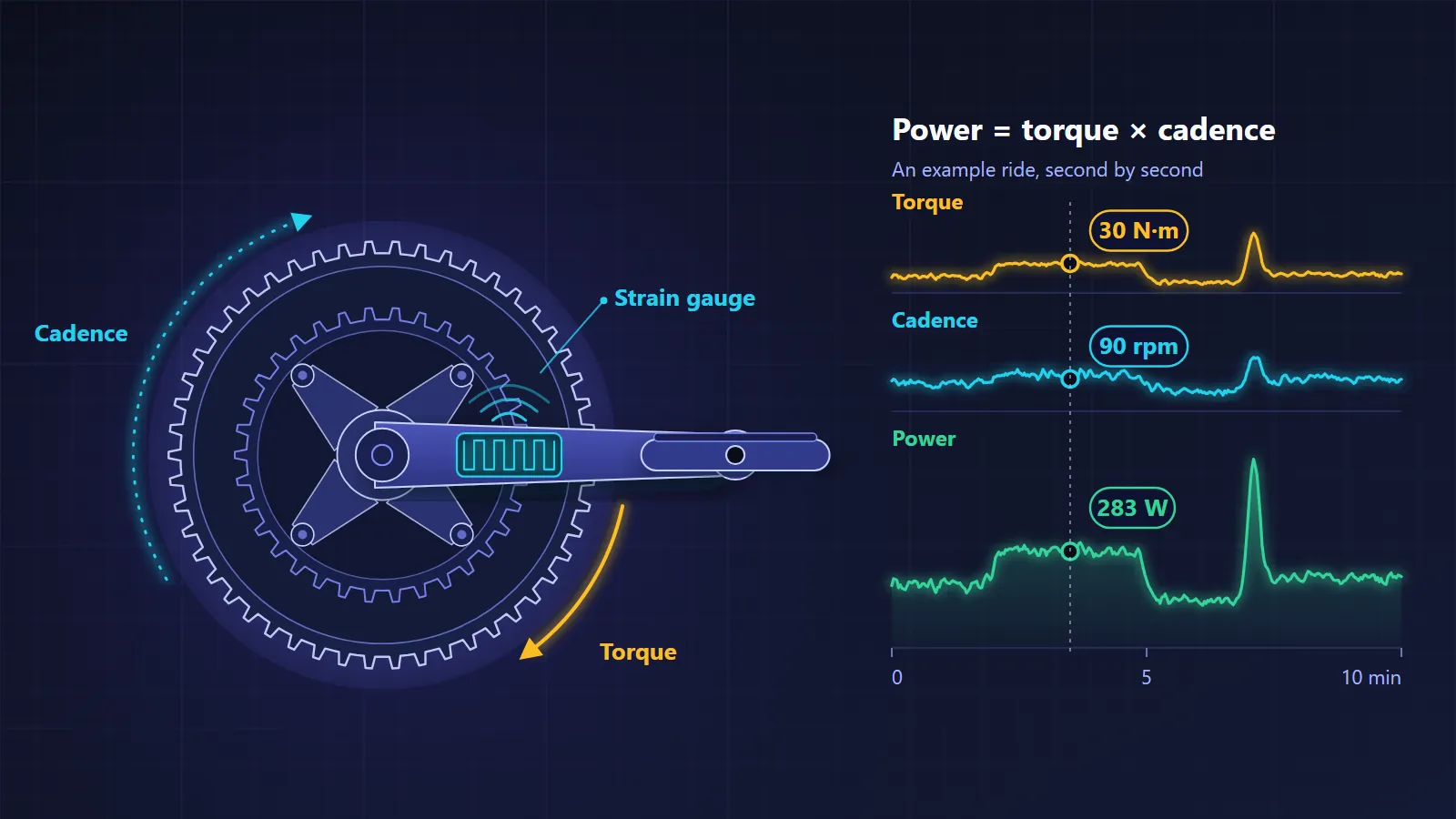
Is a power meter worth it? It is if you will use it to pace your efforts, set targets for intervals and look back at your training every week. A power meter measures the power you put through the pedals, in watts, every second. That shows what heart rate and feel cannot show on their own: an even effort up a climb, an interval at the intended level and a fitness gain you can test. If you ride for pleasure and never open the files, a heart-rate strap and a 0-to-10 rating of each ride give you most of what you need.
Do I need a power meter?
You need a power meter if you train to a plan with hard sessions, race time trials or triathlons, or work with a coach who reads your files. You do not need one to get fitter, because regular riding, enough easy hours and rest do that with or without numbers.
What you ride decides what power is worth to you.
| You | Is it worth it? | Why |
|---|---|---|
| Train to a plan with two or more hard sessions a week | Yes | Targets in watts stay the same on a hot day or a tired one |
| Race time trials, triathlons or long climbs | Yes | Power shows at once when you start too hard |
| Have a coach | Usually | Your coach can set every interval and check how it went |
| Ride mostly indoors | A smart trainer may be enough | The trainer measures your power indoors |
| Ride three or four hours a week, mostly easy | Not yet | Heart rate and a rating cover easy riding well |
| Ride for pleasure or to commute | No | The numbers would not change what you do |
| Are in your first season | Not yet | Regular riding builds more fitness than any number |
Two questions settle most cases. Will you look at your rides at least once a week? Will you change a session because of what you see? If both answers are yes, a power meter is likely to improve your training. If not, it adds a number to the screen and nothing to your riding.
What does training with a power meter change?
Training with a power meter changes how you pace efforts, set intervals, test your fitness, count your training and judge a change to your bike. It does not make you fitter by itself, and it does not show how tired you are.
- Pacing. Watts change the moment you push harder, so you can hold an even effort from the bottom of a climb to the top. Time trial pacing shows how riders use this against the clock.
- Interval targets. "Hard" becomes a number. A session written as a percentage of your FTP means the same on every day and every road.
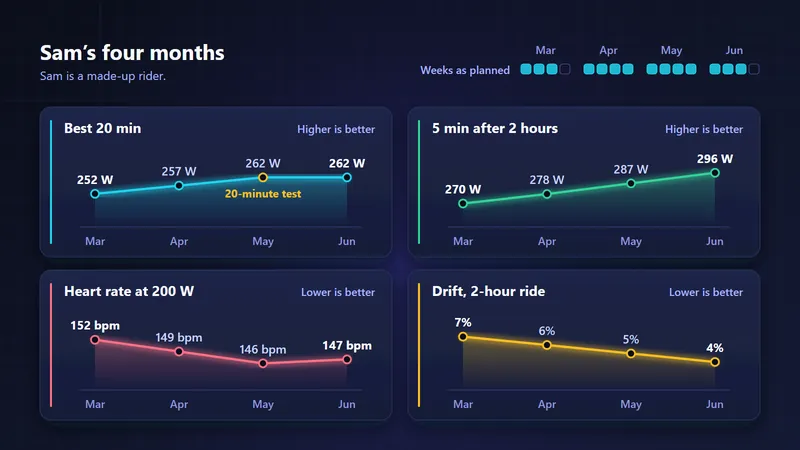
- Testing on the road. Your best efforts form your power curve, and every hard ride adds to it. In a 2014 study by Karsten and colleagues, 14 trained cyclists rode all-out for 3, 7 and 12 minutes on an outdoor velodrome. The critical power worked out from those efforts averaged 234 W, the same as from their laboratory tests.
- Training load. Software turns each ride's power into a load score, so a hard hour and an easy three hours can be compared. A 2009 review by Jobson and colleagues pointed out that models of training need both how much and how hard, and that hours alone leave out intensity.
- Fair comparisons. On the same meter, you can compare your power before and after a change, such as a new position or new tyres.
What can't a power meter tell you?
A power meter cannot tell you what an effort cost your body, how well you have recovered or whether you are coming down with something. Heart rate, sleep and how you feel answer those questions, so a heart-rate strap stays useful beside a power meter.
A power meter can also tempt you to ride every ride as a test. Easy days should stay easy, whatever the watts would allow on a good day.
Is heart rate or feel enough without a power meter?
Heart rate and how hard a ride feels are enough for most easy and steady riding, and they cost little or nothing. They fall short for short intervals and pacing, because heart rate lags behind changes in effort, and it rises with heat and fatigue at the same power.
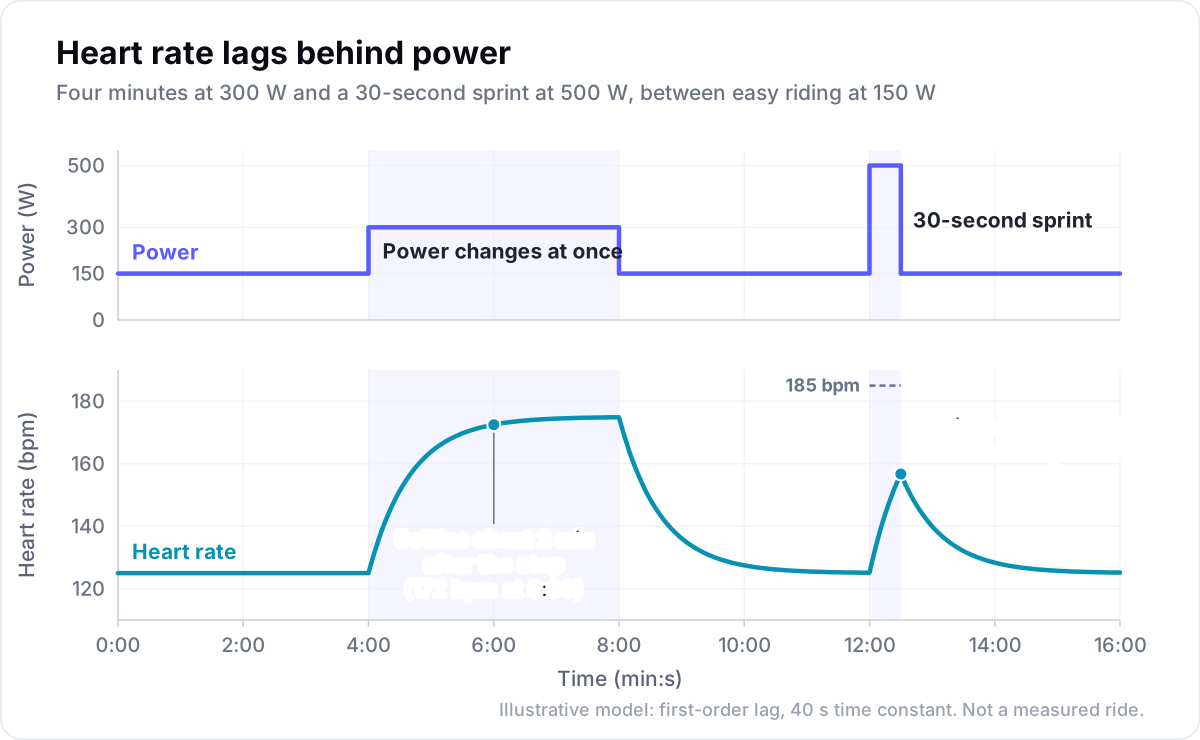
In the illustration, heart rate needs about two minutes to settle after power rises from 150 W to 300 W. When the 30-second sprint ends, heart rate has climbed only about halfway to where it was heading. Heart rate vs power explains the lag and the drift in detail. Each option without a power meter has its own strength:
- Heart rate. A chest strap shows what the work costs you, and an upper limit in beats per minute keeps an easy ride easy.
- Feel. A 0-to-10 rating of the whole ride, multiplied by its minutes, works as a training load on its own. Cycling training data shows how to keep it and what else is worth recording.
- A smart trainer. It measures your power indoors and can hold a target for you in ERG mode. For a rider who trains mostly indoors in winter, it is a natural first step. Indoor cycling training explains why its numbers can differ from a meter on the bike.
Which type of power meter suits a beginner?
The type matters less than riding one meter consistently. Pedal meters move easily between bikes, crank-arm meters are often single-sided, spider meters measure both legs together and hub meters measure at the rear wheel. Choose by how many bikes you ride and whether you want each leg measured.
| Type | Where it measures | Moving it to another bike | Both legs? |
|---|---|---|---|
| Pedals | In the pedal spindle or body | Easy, with a pedal spanner | Dual-sided pairs measure each leg |
| Crank arm | Strain gauges on one or both crank arms | Means moving the crank arm or crankset | Left-only models measure one leg |
| Spider | Between the crank and the chainrings | Means moving the crankset | Both legs, as one total |
| Rear hub | Inside the hub, after the chain | Means moving the wheel | Both legs, as one total |
| Smart trainer | Inside the trainer, after the chain | Indoors only | Both legs, as one total |
Pedal meters tie you to their cleat system. Hub and trainer meters measure after the chain has taken its small share, so they read a little lower than a meter at the cranks or pedals.
A single-sided meter measures one leg and doubles it. Suppose your legs split the work 48 to 52 and the meter is on the 48% side. At 250 W it sees 120 W and shows 240 W, which is 4% low. If your split stays the same from ride to ride, your numbers still compare fairly with each other.
How accurate are power meters?
Power meters are precise enough for training, but two meters can disagree by several per cent. In a 2017 study, repeated readings from one meter varied by about 1%, while 6 of 54 meters were more than 5% away from the study's reference. Compare your numbers with your own, on one meter.
Thomas Maier and colleagues tested the 54 meters, from nine makers, against a mathematical model of cycling on a treadmill. On average the meters read 0.9% low, but the spread was wide, with a standard deviation of 3.2%. For accurate measurements, the authors advised calibrating every meter against a reference based on first principles. A review by Louis Passfield and colleagues the same year concluded that mobile power meters measure power validly in the field.
Three habits keep your own numbers honest:
- Zero it. Do the zero offset your meter's maker describes. Stages, for example, asks for one before every ride, with the cranks vertical and no weight on the pedals.
- Keep one source. Set your zones on the meter you train with most, and do not mix trainer and pedal numbers in one comparison.
- Write down changes. Note the date of a new meter, battery or crankset, so a sudden jump in your numbers has an explanation.
What should you do in your first month with a power meter?
Spend the first month learning what your numbers mean before you change your training. Ride as usual in week 1, test in week 2, train to targets in week 3 and pace and review in week 4, all on the same meter.
Week 1: ride as usual. Fit the meter, pair it with your bike computer and zero it. Show three numbers on the screen: 3-second power, lap power and heart rate. Ride your normal week and check that every file has power and cadence from start to finish.
Week 2: test. After an easy day, ride an FTP test on a steady climb or on the trainer. Set your zones from the result; our guide to what FTP is explains the tests.
Week 3: train to targets. Ride two key sessions by power and keep the rest easy. For an FTP of 240 W, 3 × 10 minutes at 90 to 95% of FTP means 216 to 228 W. An endurance ride stays below 75% of FTP, or 180 W.
Week 4: pace and review. Ride one climb or a short time trial at even power. Then compare your rides with week 1. Is your heart rate lower at the same power? Which durations on your power curve moved?
After the first month, test again every six to eight weeks, and keep using heart rate and feel on easy days. If you would like your files kept in one place, Velograph's free Rider plan keeps your rides with ride analysis and shows your power curve and new bests, with no end date. See what a rider gets on their own.
Further reading
- Knowledge is power: issues of measuring training and performance in cycling, Passfield and colleagues, Journal of Sports Sciences, 2017.
- Accuracy of cycling power meters against a mathematical model of treadmill cycling, Maier and colleagues, International Journal of Sports Medicine, 2017.
- High agreement between laboratory and field estimates of critical power in cycling, Karsten and colleagues, International Journal of Sports Medicine, 2014.
- The analysis and utilization of cycling training data, Jobson and colleagues, Sports Medicine, 2009.
Velograph is not affiliated with, sponsored by or endorsed by any team, rider or company named in this article. Names are used only to refer to publicly reported work.