How the cycling power meter began with Ulrich Schoberer's SRM crankset in the 1980s, spread to hubs, pedals and smart trainers, and changed training.
The history of power meters begins in the laboratory. For most of the 20th century, a cyclist's power could be measured only on a stationary ergometer. In the 1980s the German engineer Ulrich Schoberer built strain gauges into a crankset, and his company SRM made the first power meter a rider could train and race with. Hubs, pedals, single crank arms and smart trainers followed, and power moved from national teams to club riders. Along the way it changed how riders test, pace and count their training.
How was cycling power measured before power meters?
Before the late 1980s, cycling power was measured only in laboratories, on stationary ergometers that braked the pedals against a known load. No device measured a rider's power on the road, so a lab test could not show what happened in training or in a race.
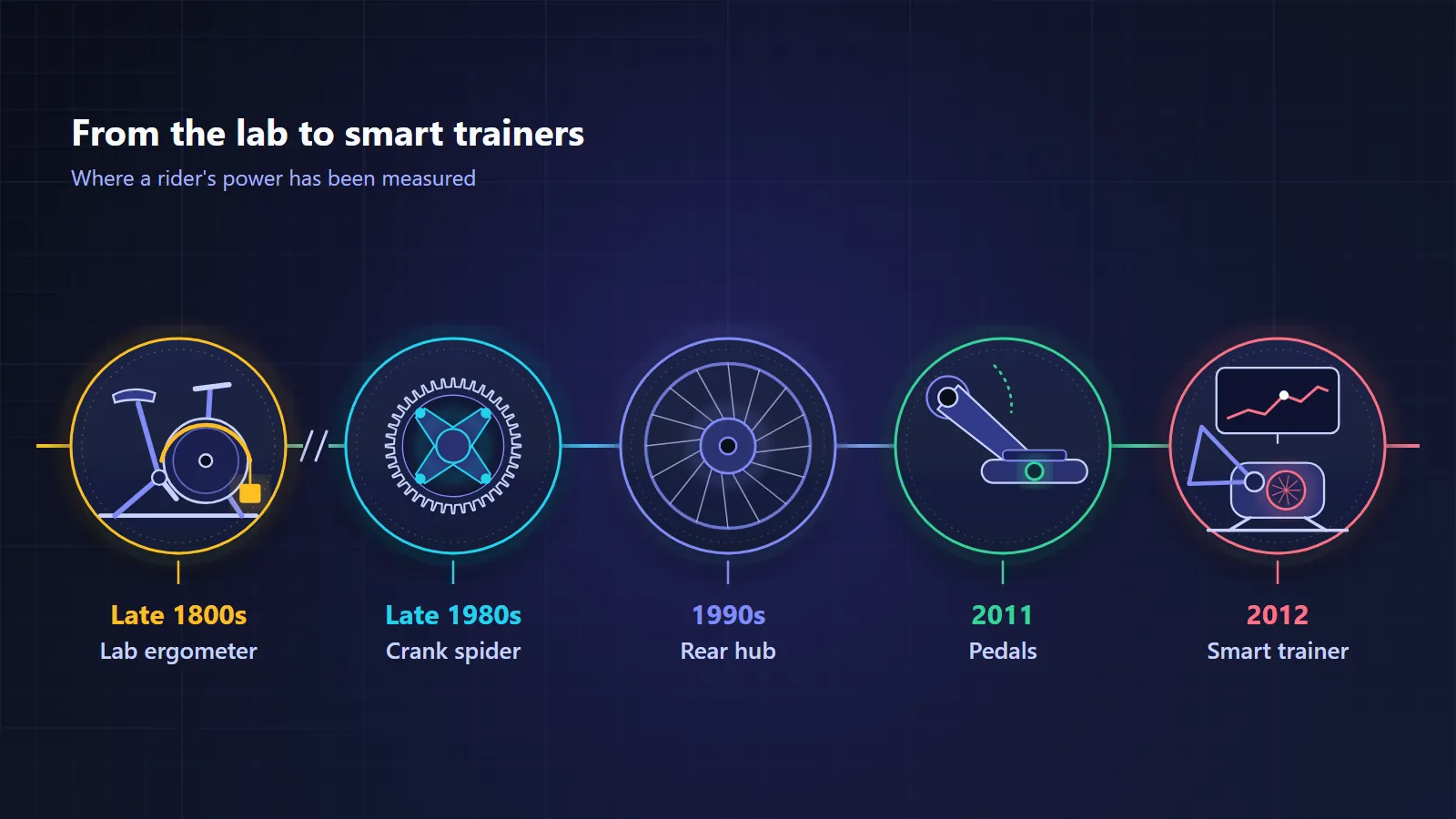
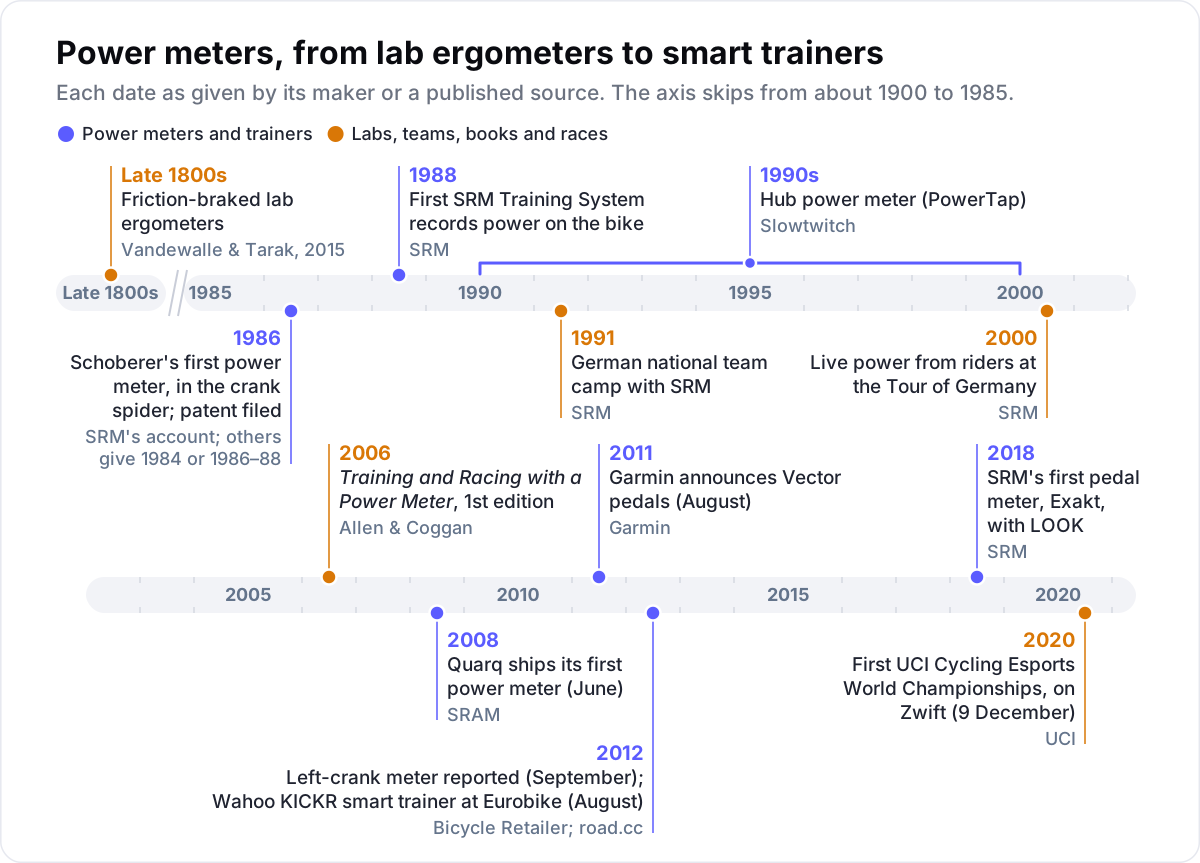
Friction-braked cycle ergometers go back to the end of the 19th century, according to a 2015 review by Henry Vandewalle and Driss Tarak. Ideas riders still use came from that lab work. Critical power, for example, comes from a 1965 study of work to exhaustion by Monod and Scherrer, as critical power and W′ explains. SRM's own history says athletes depended on ergometer tests until the 1980s, because no method could measure power during real rides and races.
Who invented the first power meter?
Ulrich Schoberer, a German medical technology engineer, invented the first power meter for use on the bike and founded SRM to make it. By SRM's own account, he built it and filed a patent for it in 1986. Other sources give other years, so the exact date depends on whom you read.
SRM stands for Schoberer Rad Messtechnik, roughly "Schoberer's bicycle measuring technology", and the company is based in Jülich, Germany. The sources disagree on the start:
- SRM's history page says Schoberer founded the company in 1986, and that in the same year he designed, built and filed a patent for the first power meter in a crank spider. A patent followed in 1987, and in 1988 SRM made its first cycling computer that recorded the data, the first SRM Training System.
- A 2012 Slowtwitch interview places his early development work between 1986 and 1988. It says the system began as his thesis project at the end of his studies.
- A review on the retailer bike-components' blog says he created the first power meter in 1984.
This article follows the company's own account. Schoberer tried other places before the spider. SRM says pedals, cranks and the spindle were all tested, and the spider gave the most durable and accurate measurement of torque. In the Slowtwitch interview he said he built a pedal meter very early, but pedals get hit, get dirty and come in too many cleat systems.
Who used the first power meters?
National teams and a few professionals used the first power meters. SRM's history records a German national team training camp in St. Moritz with SRM power meters in 1991, and names Greg LeMond that year as one of the first professionals to see the value of training with power.
In the Slowtwitch interview, Schoberer called LeMond the first professional to use SRM. He also described working with the German federation from 1988 until the 1996 Olympic Games in Atlanta. By 2012, he said, SRM sponsored several professional teams.
The early units recorded more as each generation came out. SRM says its fourth generation, in 1993, recorded every second and held up to 10 hours of data. In 2000, the company transmitted riders' power live from a motorbike at the Tour of Germany, which it calls the debut of its telemetry.
The files changed what scientists could know about racing. In a 2007 study, Vogt and colleagues analysed SRM files from 15 professionals over 148 mass-start stages of the 2005 Tour de France. Average power rose with the terrain, from 218 W on flat stages to 234 W on mountain stages.
How did power meters spread to amateur riders?
Power meters spread to amateurs as other makers put them in hubs, spiders, pedals and single crank arms, from the 1990s to the 2010s. Each new place to measure gave riders another way to fit one, and wireless standards such as ANT+ let bike computers read meters from different makers.
- Hubs, from the 1990s. PowerTap, developed by engineers from MIT, measured power in the rear hub. Slowtwitch called it the second power meter brand after SRM. Saris bought it in 2001, and SRAM in 2019.
- Wireless, 2008. SRM says its meters became fully wireless and ANT+ compatible in 2008, after a project that began in 2006.
- More spiders, 2008. Quarq, founded by Jim and Mieke Meyer and built in Spearfish, South Dakota, shipped its first power meter in June 2008. That date is from SRAM, which bought the company in 2011.
- Pedals, from 2011. Garmin announced its Vector pedals in August 2011. They measured the flex in the pedal spindle and showed the balance between left and right legs.
- One crank arm, 2012. In September 2012, Bicycle Retailer reported a power meter from Stages, in Boulder, Colorado, that fitted on the left crank arm alone.
- SRM's own pedals, 2018. SRM released its first pedal power meter, Exakt, with LOOK.
Pedal meters made power easy to move from one bike to another. Our guide to whether a power meter is worth it compares the types for a rider choosing one today.
When did smart trainers come out?
Smart trainers that measure power and take their resistance from an app arrived in the early 2010s. At Eurobike in August 2012, road.cc reported the Wahoo KICKR, a trainer with strain gauges inside that a phone or computer controlled. Electronically controlled trainers go back further, to 1986.
That earlier trainer was RacerMate's CompuTrainer, which Bicycle Retailer dates to 1986. The KICKR had no screen of its own. Software on a phone or computer set either a fixed resistance or a target power, which is now usually called ERG mode. Indoor cycling training explains how trainer power differs from a meter on the bike.
Indoor racing grew on top of that data. The UCI held its first Cycling Esports World Championships on Zwift on 9 December 2020. Zwift's online talent search had already put indoor numbers in front of professional teams, as our article on Zwift Academy winners describes.
How did power meters change training?
Power meters gave training a common unit. Coaches could set targets in watts, FTP and power zones gave every rider a scale, and software turned each ride into a training load. Riders could also test on the road as well as in the lab, because the meter measured the same work in both places.
Books and software followed the hardware. Hunter Allen and Andrew Coggan's Training and Racing with a Power Meter first came out in 2006, with a second edition in 2010 and a third in 2019 with Stephen McGregor. It set out the 20-minute test with its 95% rule and Coggan's power profile. Coggan tested his Performance Manager with riders in the 2005 and 2006 seasons, and it became TrainingPeaks' chart of fitness, fatigue and form. Our guides to what FTP is and to the power curve explain both ideas as riders use them today.
Science moved outdoors too. A 2017 review by Louis Passfield and colleagues opens with a plain verdict: "Mobile power meters provide a valid means of measuring cyclists' power output in the field." The same review said new methods were still needed to measure the effects of training loads.
Power also changed how riders test equipment and positions. A rider with a power meter can compare positions on a road loop instead of in a wind tunnel, as our guide to cycling aerodynamics shows. Changing one thing and measuring it in watts is the method behind marginal gains.
What does the history of power meters mean for riders today?
The history of power meters shows that a meter is only as useful as the person who reads its files. Schoberer said in 2012 that a rider needs a good coach who can read the data, because power set against heart rate alone can mislead. That holds for every rider with a meter today.
Three habits follow from it:
- Compare yourself with yourself. Your own files from one meter say more than another rider's numbers.
- Keep the conditions alike. A test on a new meter, a different climb or after a different warm-up measures the change as much as it measures you.
- Ask what a number means before you act on it. A low reading after a hard week may be fatigue, a missed zero offset or a new crankset.
Today a bike computer saves power in a file that a training platform can read second by second. Velograph's free Rider plan, for example, keeps your rides with ride analysis and shows your power curve and new bests, with no end date. See what a rider gets on their own.
Further reading
- The history of power meters, SRM, 2026.
- A chat with Uli Schoberer, Slowtwitch, 2012.
- Power output during the Tour de France, Vogt and colleagues, International Journal of Sports Medicine, 2007.
- Knowledge is power: issues of measuring training and performance in cycling, Passfield and colleagues, Journal of Sports Sciences, 2017.
- Garmin brings power to the people with Vector, Garmin, 2011.
Velograph is not affiliated with, sponsored by or endorsed by any team, rider or company named in this article. Names are used only to refer to publicly reported work.