Get a bike fit with a new bike, when something hurts or goes numb, after an injury or when your body or goal changes. How often, and when it can wait.
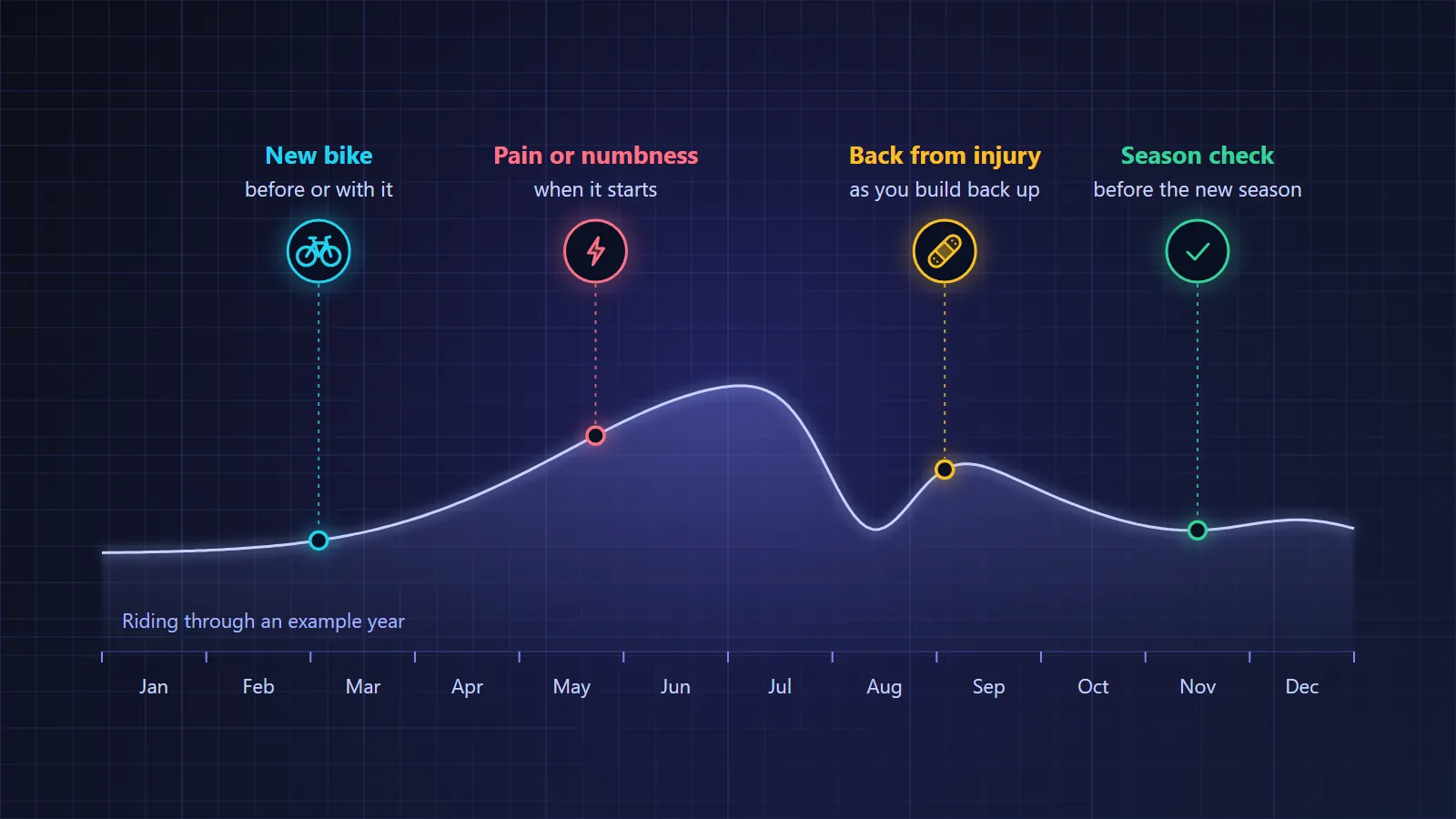
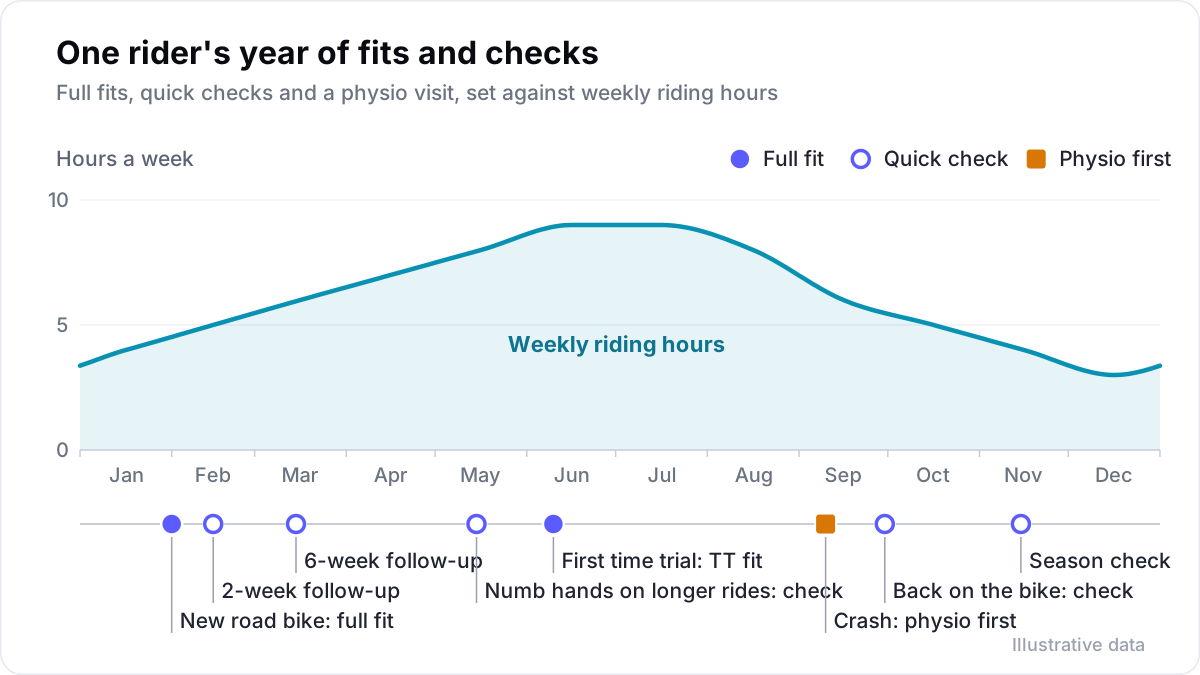
When to get a bike fit comes down to a handful of moments: with a new bike, when something hurts or goes numb, after an injury, when your body or your riding goal changes, and once a year as a check if you ride many hours. The riders who gain most have long weekly hours, a time trial or triathlon position, a recent injury or a body that is still growing. Between those moments, a bike that feels fine can wait. After any fit, a short check two to six weeks later shows whether the changes have settled.
When do you need a bike fit?
You need a bike fit when you start on a new bike, when something hurts or goes numb while you ride, after an injury, or when your body or riding goal changes. A yearly check suits riders who ride many hours. Otherwise, a comfortable bike can wait.
Each moment asks for a different kind of appointment:
| Moment | What to book | Why it pays off |
|---|---|---|
| Buying a new bike | A sizing fit before you buy, or a full fit or a transfer after | Frames, saddles and bars differ from bike to bike |
| Something hurts or goes numb | A full fit, after a physio or doctor if any sign below applies | Where it hurts tells the fitter what to check first |
| Back from an injury or surgery | A full fit, with your physio's findings | The body on the bike has changed |
| A change of body or goal | A full fit | Weight, flexibility, pregnancy, racing, longer days or a time trial each ask for a different position |
| A growing junior | A quick check every few months | Saddle height follows leg length |
| A season with more hours | A quick check before the season | Small errors repeat with every pedal stroke |
| After any fit | A follow-up two to six weeks later | It shows whether the changes settled |
What can a fit do? In a randomised trial, Dias Scoz and colleagues gave 162 amateur cyclists either a bike fit based on 3D motion capture or a handout of posture advice. Fifteen days later, the fitted riders reported more comfort, less fatigue and less pain than the handout group. Groin and back pain fell the most.
The follow-up was short. A 2022 systematic review by Visentini and colleagues found no strong evidence linking any single bike measurement to overuse pain, but moderate evidence linking load, meaning how much and how hard you ride, to symptoms. So a fit is most worth having when hours, pain or a change make the position matter.
When should I see a physio or doctor before a bike fit?
See a physio or doctor first if the pain came on suddenly or after a crash, if a joint is swollen, locks or gives way, if it hurts off the bike or at night, or if numbness or tingling stays after the ride. A fitter can then work from their findings.
Pain that builds slowly on the bike and settles off it is a fair reason to start with a fit, often alongside a physio. Our guides to knee pain in cycling and to how a physio and a bike fitter work together show how the two share the work.
In one clinic study, Viau and colleagues followed 76 recreational road cyclists with knee pain through a fit led by a physiotherapist, with training advice and exercises. Their worst knee pain while riding fell by about 2.5 points on a scale from 0 to 10 over 12 weeks. With no comparison group, it cannot say what caused the change.
How often should you get a bike fit?
Have a full fit when you start on a new bike or position, a follow-up two to six weeks later, a quick check once a year if you ride many hours, and a new full fit when something changes. We found no study that tests how often to refit, so this rhythm is practical rather than proven.
BikeRadar's guide suggests a repeat fit every few years. The case for checking more often rests on how much you ride. At 85 pedal revolutions a minute, eight hours a week is about 40,800 strokes for each leg every week, or nearly two million over a 48-week year. Two hours a week is about half a million. A small error in the position is repeated on every one of those strokes.
Bikes drift too. A saddle can slip on its rails, a seatpost can creep down and cleats wear, so a yearly look at the numbers catches the drift. Our article on bike fit follow-ups explains what a fitter asks at two and six weeks after a fit.
Growing riders need checks more often. Each centimetre of inseam adds about 9 mm to a saddle height worked out with the LeMond formula, 0.883 times the inseam. A junior whose inseam grows by 2 cm needs the saddle about 18 mm higher, several times the step a fitter usually makes. The saddle height calculator works out the new starting point.
Who needs a bike fit most?
Riders who gain most from a bike fit ride many hours a week, hold a time trial or triathlon position, are coming back from an injury or are still growing. Riders with discomfort that keeps returning, or with one side that feels different from the other, gain too.
Discomfort brings many riders to a fitter. Oliveira and colleagues collected the records of 1,505 cyclists seen by bike fit services in Brazil. The commonest complaints were low back pain (29.1%), numb hands or fingers (21.5%), knee pain (19.5%), neck pain (14%) and numb feet or toes (11.5%).
- Time trial and triathlon positions. These positions close the hip angle and load the forearms for the whole race. Pad height changes the hip angle, and with it comfort and power, and pad reach changes the load on the shoulders, as our time trial bike fit guide explains.
- Riders back from injury or surgery. Range of movement, strength and the side you favour may all differ from before.
- Growing juniors. Saddle height, reach and crank length all have to follow the body.
- Long weekly hours. The more you ride, the more often a small error is repeated.
Should you get a bike fit before or after buying a bike?
Get a bike fit before buying if you are unsure of the size or the kind of bike, because a fitter can set your position first and then name frames that reach it. If the size is clear, have the fit after, on the bike you will ride. Either way, bring the numbers from your last fit.
A sizing fit finds where your saddle and handlebar should be. The fitter then compares those points with each frame's stack and reach, the two numbers that say where a frame puts the top of its head tube. Our guide to stack and reach shows how to compare frames on paper.
When the new bike arrives, the same numbers set it up, as our guide to moving your bike fit to a new bike explains. A new kind of bike, or an old position that never felt right, calls for a fresh fit instead of a copy.
What is the difference between a bike fit check and a full bike fit?
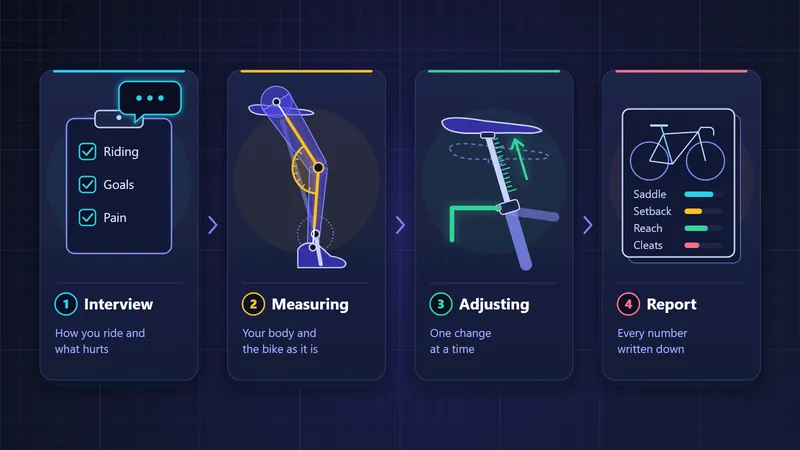
A check compares the bike with your last fit record and corrects anything that has moved. A full fit starts from you, with your goals, history, body and pedalling, and then sets every contact point. A check needs a record to compare against. Without one, it turns into a full fit.
| Quick check | Full fit | |
|---|---|---|
| The question | Has anything moved or changed since the last fit? | What position suits this body, this bike and this goal? |
| It starts from | Your last fit record | A conversation about goals, riding, injuries and pain |
| It covers | Saddle height, setback and tilt, cleat wear and position, bar and hood position, a short ride | All of that, plus flexibility and foot checks, measuring you while you pedal, and new parts where needed |
| It ends with | Small corrections and an updated record | A new position, a full record and a follow-up date |
| Book it for | A yearly check, a crash, a swapped part, a growing junior | A first fit, a new kind of bike, pain, an injury, a new goal |
BikeRadar's guide says a full fit can take up to three hours, up to an hour of it spent talking before you get on the bike. A check is shorter, because the record answers most of those questions.
When can a bike fit wait?
A bike fit can wait when nothing hurts or goes numb, you ride the same bike in the same way as last season, and nothing has changed in your body, shoes, saddle or goal. Measure the saddle height and check the cleats yourself, and book a fit when one of the moments above arrives.
Avoid a big change of position in the last weeks before a key event, because a new position needs a few weeks of normal riding to settle. Discomfort that you have learned to ride with still counts as a reason to book.
What should you bring to a bike fit?
Bring the bike, the shoes, pedals and shorts you ride in, and every earlier fit record you have. Write down what hurts, where and when, and what has changed in your kit and training. The record from this fit then becomes the starting point for the next one.
- The bike with the saddle and pedals you use.
- Your shoes, insoles, cleats and usual shorts.
- Old fit reports and sheets, including any handwritten notes.
- A short log of where it hurts, how long into a ride it starts, how bad it is from 0 to 10, and what changed in the last six weeks.
- Your goals: the events, the weekly hours and the kind of riding.
Ask the fitter for the full numbers, each with the point it was measured from, not only a summary page. A number without its reference point is hard to reuse, as our article on bike fit history shows.
Velograph keeps each fit in the rider's own record on the free Rider plan, with no end date, and the rider decides which fitter, coach or team can see it. Our page for riders sets out what a rider gets on their own.
Further reading
- Effectiveness of a 3D bikefitting method in riding pain, fatigue, and comfort: a randomized controlled clinical trial, Sports Biomechanics, 2025.
- Factors associated with overuse injury in cyclists: a systematic review, Journal of Science and Medicine in Sport, 2022.
- Tackling the top musculoskeletal challenges of cyclists: insights from bike fit services, Journal of Bodywork and Movement Therapies, 2025.
- Bike fits explained: what is a bike fit and should you get one?, BikeRadar, 2023.
Velograph is not affiliated with, sponsored by or endorsed by any team, rider or company named in this article. Names are used only to refer to publicly reported work.