Sweet spot training in cycling: the 88 to 93% of FTP band and other definitions, what the research does and does not show, sessions, and when to skip it.
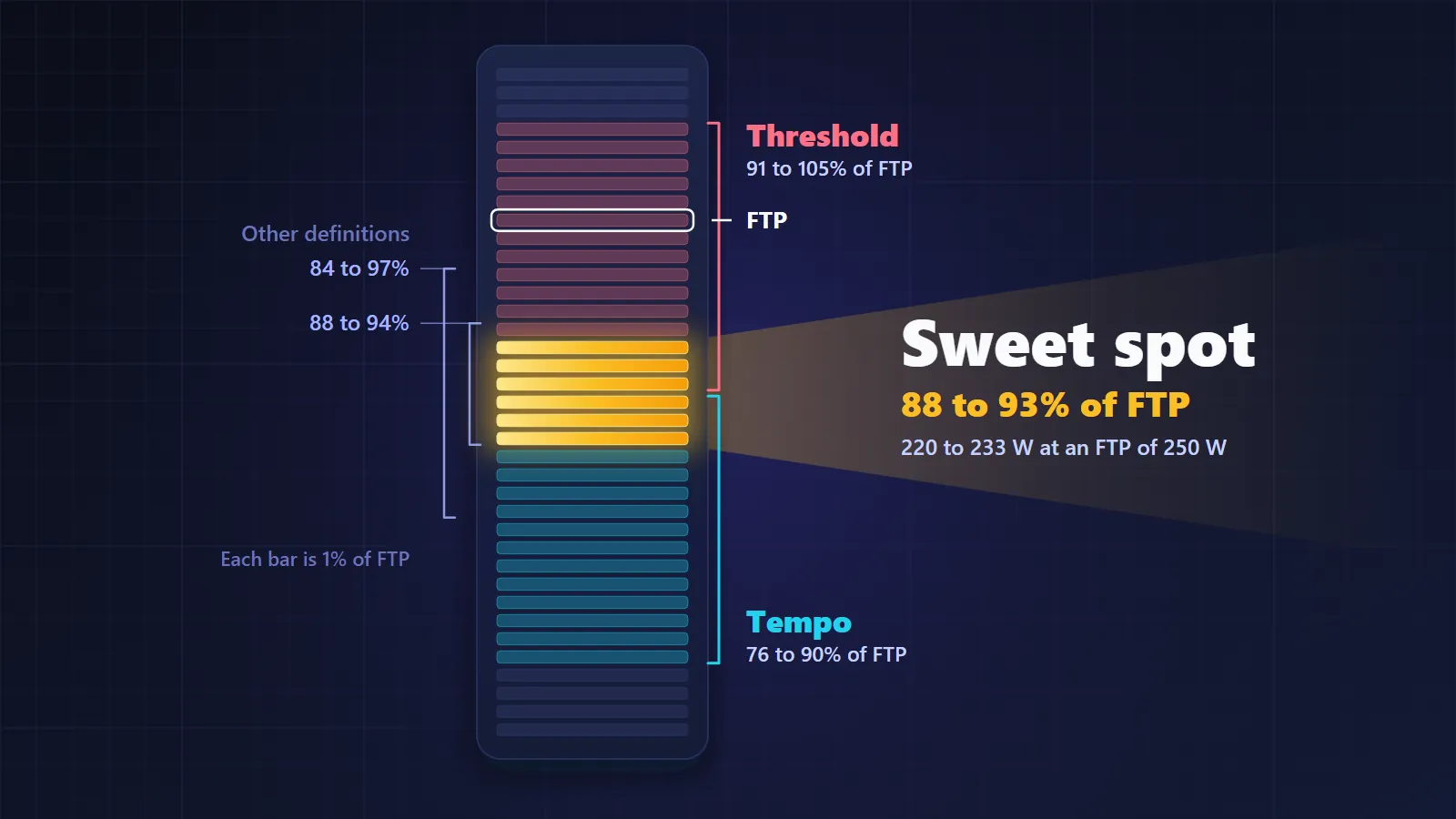
Sweet spot training means riding long intervals a little below your FTP, at about 88 to 93% of it in the range this article uses. FTP, your functional threshold power, is the highest power you can hold steadily for a long effort. Sweet spot sits where tempo meets threshold: hard enough to train you to hold high power for longer, easy enough to ride for 30 to 60 minutes in a session and repeat within the week. Its strength is time, because it packs a lot of work near threshold into a short ride. Its weakness is evidence. We found no peer-reviewed study that tests sweet spot training by that name.
What is sweet spot training?
Sweet spot training is riding intervals of 10 to 30 minutes a little below FTP, at about 88 to 93% of it. There is no single definition. TrainerRoad puts sweet spot at 88 to 94% of FTP, and FasCat Coaching at 84 to 97% of FTP or threshold heart rate.
Here is how three named sources define it, next to the range this article uses, which is also the one in Velograph's session library:
| Source | Sweet spot, % of FTP | At FTP 250 W |
|---|---|---|
| This article | 88 to 93% | 220 to 233 W |
| TrainingPeaks article by coach Pau Salva Martinez | 88 to 93% | 220 to 233 W |
| TrainerRoad | 88 to 94% | 220 to 235 W |
| FasCat Coaching, Frank Overton | 84 to 97% | 210 to 243 W |
In Andrew Coggan's power levels, 88 to 93% covers the top of tempo (76 to 90% of FTP) and the bottom of threshold (91 to 105%). The article on cycling training zones gives the full table, and what FTP is explains how to test the number the band is built on.
Frank Overton, who founded FasCat Coaching, says he coined the term in January 2005. In a 2020 article on FasCat's site, he wrote that it came out of a group of coaches who were testing a power-based performance model, which Coggan had presented at USA Cycling's coaches' summit in 2004. The name describes a trade: a lot of training benefit for a moderate cost in fatigue.
What does sweet spot training do?
Sweet spot training mainly builds your ability to hold high power for a long time, by adding long stretches near threshold with less fatigue than threshold intervals bring. It also adds training load quickly, which helps riders who have 6 to 8 hours a week.
A power-duration curve shows why it is repeatable. The example rider from our guide to the power curve holds 265 W for their best hour, so take that as their FTP. Their sweet spot is then 233 to 246 W.
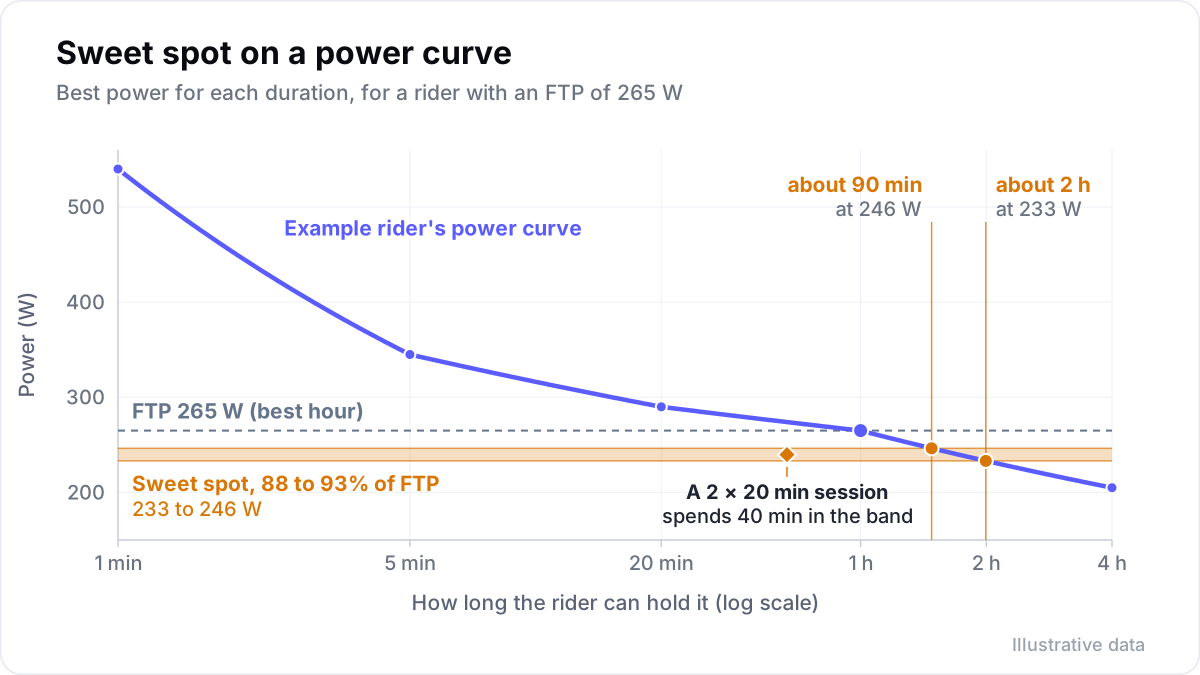
On the rider's curve, 246 W is what they could hold for about 90 minutes, and 233 W for about 2 hours. A session of 2 × 20 minutes asks for 40 minutes of that, broken by a rest. Threshold intervals at 95 to 100% of FTP sit much closer to the limit: the curve gives about 60 to 80 minutes at 252 to 265 W.
The same session library shows the trade in numbers. Its sweet spot 2 × 20 minutes takes 75 minutes and has a training load of about 82, where an hour at threshold scores 100. Its threshold 2 × 20 minutes, at 95 to 100% with 10 minutes between the blocks, takes 85 minutes and has a load of about 100.
Does sweet spot training work?
Nobody has shown that sweet spot training works better than other training, because no peer-reviewed study we could find has tested it by name. Studies of training between the two thresholds, which includes sweet spot, found gains, but not larger ones than polarised training.
The nearest evidence comes from studies that compare ways of spreading intensity across a week. They count time in three zones: below the first threshold, between the thresholds (where sweet spot sits) and above the second.
| Study | Who | What it found |
|---|---|---|
| Neal and colleagues, 2013 | 12 trained male cyclists, 6 weeks of each plan | A threshold-heavy plan (57% low, 43% between the thresholds) raised the lactate threshold by 2%; a polarised plan (80% low, 20% high) raised it by 9% |
| Rosenblat and colleagues, 2025 | 13 studies, 348 endurance athletes | No overall difference between polarised and pyramidal training; recreational athletes may gain more from pyramidal, competitive athletes from polarised |
| Cove and colleagues, 2025 | 41 studies, 797 trained cyclists | Polarised and non-polarised training gave similar gains in VO2max and time trials |
Pyramidal training means most time easy, a fair share between the thresholds and a little above, and a sweet spot plan with some VO2max work fits that shape. In short, sweet spot is a reasonable way to fill the middle of a pyramidal week. It is not proven to be better, and a plan heavy in it did less well than polarised training in Neal's study. The article on polarised training explains the counting behind those percentages.
Is sweet spot better than polarised training?
Neither sweet spot nor polarised training has been shown to be better for everyone. In two 2025 meta-analyses, polarised training and the alternatives gave similar gains on average, and one suggested that recreational athletes may gain more from pyramidal training, which includes sweet spot.
The practical answer depends on your week. Sweet spot suits a rider with few hours who wants each ride to count, a time triallist or a long-climb specialist, and the base phase of a season. Polarised training suits a rider with more hours who can keep easy days easy and wants to raise VO2max. Many plans use both, with sweet spot early in a block and harder intervals later, as the 12-week block in how to increase FTP does.
How long should sweet spot intervals be?
Sweet spot intervals usually last 10 to 30 minutes, adding up to 30 to 60 minutes in the band in one session. Start with 3 × 10 minutes and add time before you add intensity.
These are the sweet spot sessions in Velograph's library, each with a 15-minute warm-up and a 10-minute cool-down. Watts are for an FTP of 250 W.
| Session | Main set | Time in the band | Total |
|---|---|---|---|
| Sweet spot 3 × 10 min | 3 × 10 minutes at 220 to 233 W, 5 minutes easy after each | 30 min | 70 min |
| Sweet spot 3 × 15 min | 3 × 15 minutes, 5 minutes easy after each | 45 min | 85 min |
| Sweet spot 2 × 20 min | 2 × 20 minutes, 5 minutes easy after each | 40 min | 75 min |
| Sweet spot 3 × 20 min | 3 × 20 minutes, 5 minutes easy after each | 60 min | 100 min |
| Sweet spot 2 × 30 min | 2 × 30 minutes, 10 minutes easy after each | 60 min | 105 min |
| Over-unders 4 × 8 min | 2 minutes at 225 to 235 W and 1 minute at 263 to 275 W, ending on an under; 5 minutes easy after each set | 24 min under | 77 min |
| Criss-cross 2 × 20 min | 20 minutes at 220 to 233 W with a 20-second surge at 300 W every 2 minutes; 10 minutes easy between | 33 min steady | 85 min |
The library is part of the training plans in Rider Plus; the free Rider plan keeps your bikes, bike fits and rides with ride analysis, as what a rider gets on their own explains.
A sensible order is 3 × 10, then 3 × 15 or 2 × 20, then 3 × 20 and 2 × 30. Over-unders and criss-crosses come last. Their unders are close to sweet spot, but the overs and surges take you above threshold and teach you to settle again, as when a race speeds up over a climb.
Stay seated and keep the power even from the first minute of each block to the last. You should be able to say a few words at a time. On a 0 to 10 scale for the whole session, warm-up included, it should feel about 6 or 7. On a smart trainer, ERG mode holds the power for you; the guide to turbo trainer workouts covers when to use it.
How often should you do sweet spot training?
One or two sweet spot sessions a week suit most riders, with at least one easy day between them and most other riding easy. TrainerRoad, for example, suggests one or two moderate-intensity sessions a week, which can include sweet spot.
Two sessions a week work well in a base block of three weeks. Week 2 of the 12-week block in our guide to increasing FTP is such a week for about 8 hours, with sweet spot on Tuesday and Thursday and an easy day between them. In the next block, swap one session for VO2max intervals. The guide to structured training plans shows how to progress a block from week to week.
When should you not do sweet spot training?
Skip sweet spot when you are tired, in the last week or two before a goal race, and when your events depend on short, very hard efforts more than on steady power. It also does harm when every ride drifts into it.
- Tired legs. If you cannot hold the power in the first block, or your heart rate is far above its usual level, ride easy instead. Sweet spot is hard enough to add to the fatigue.
- Before a race. A taper keeps short, sharp efforts and cuts long blocks, so the legs arrive fresh.
- Short, punchy events. Criteriums and short hill climbs ask for power above threshold. VO2max work and sprints give more there.
- Grey-zone weeks. If your easy rides already sit near tempo, more middle-zone work leaves you tired without new stimulus. The 75 rule shows how to check how much of your riding is easy.
Sweet spot is a tool for steady power. Use it for a block, check what the next test says, and change the stimulus when progress stalls.
Further reading
- Six weeks of a polarized training-intensity distribution leads to greater physiological and performance adaptations than a threshold model in trained cyclists, Neal and colleagues, Journal of Applied Physiology, 2013.
- Which training intensity distribution intervention will produce the greatest improvements in maximal oxygen uptake and time-trial performance in endurance athletes?, Rosenblat and colleagues, Sports Medicine, 2025.
- The effect of training distribution, duration, and volume on VO2max and performance in trained cyclists, Cove and colleagues, Journal of Science and Medicine in Sport, 2025.
- Sweet spot training, Frank Overton, FasCat Coaching, updated 2026.
Velograph is not affiliated with, sponsored by or endorsed by any team, rider or company named in this article. Names are used only to refer to publicly reported work.